


The buddhist grottoes of Dunhuang, along the old Silk Road in northwestern China, are a vast warren of caves. They contain around 2,000 statues, and upward of 35,000m of mural paintings. Clerics and pilgrims have gathered there from China and Central Asia to worship, exchange goods and cultural practices.
Early last century Europeans rediscovered Dunhuang and brought its incomparable treasures to light. An unprecedented three-way loan exhibition in Kaohsiung offers a view of this melting pot.
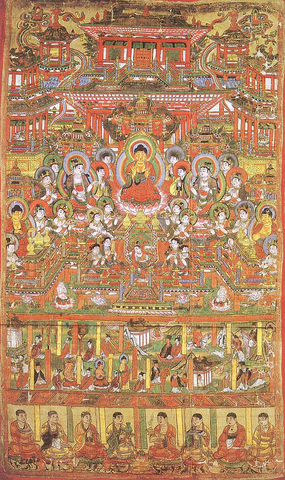
Visible at close range are silk pain-tings from the Musee Guimet, replications of cave murals and three grottoes reproduced to scale by the Dunhuang Academy.

PHOTO COURTESY OF KAOHSIUNG MUSEUM OF FINE ARTS
Most viewers don't notice focal themes, their relation to assembled objects -- but instead react directly to the visual impact of the curating. In esoteric shows, they rely on supporting didactic materials. Buddhist arts are an extreme form of esotericism requiring professional handling, and in countries known for their collections and preservation, like Japan, Russia, England, France and Germany, Buddhist exhibits are always organized around coherent themes by specialist curators trained in Buddhist art history.
This was not the case at the show's Taipei spring opening (Taipei Times, April 3, 2005). The Kaohsiung staging, however, is quite another matter. In its low-key approach, this museum has always outclassed others with good taste, generous galleries and above all, professional curators trained as art historians. A multi-lingual 415-paged catalogue gives detailed explanation of works.
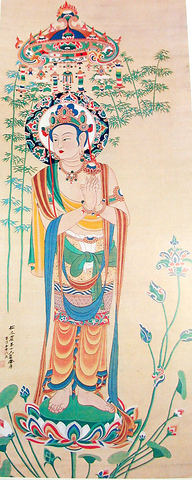
Crowning the exhibition are the thousand-year old silk banners from Cave 17, preserved by Musee Guimet but not yet shown anywhere else in the world. They are beautifully lighted and legible, thanks to Kaohsiung's gifted curator.
Tainan National University of the Arts had proposed combining Dunhuang Academy's giant, life-sized grottoes and murals with reconstructions of now-obsolete music instruments. These instruments are here played and displayed. Miraculously, a Tang dynasty (618 AD to 907 AD) music fragment was deciphered, reconstructed, and performed by music students (CD available).
However, little effort has been made to identify precisely which elements were "foreign" or from which culture. The Tang Court was itself non-Han and had introduced elements of nomadism. Cultural interaction lies beneath any Dunhuang enquiry, for China's population by the 5th century was only 50 percent Han. While 8th century murals show Persian textile designs, for instance, the riding habit, peaked caps, out-turned collar and pointed boots of the Sogdians had actually penetrated China already in the 6th and 7th centuries when multi-lingual scholar-merchants from Sogdiana served various Chinese northern courts.
The Tang Buddhist Pantheon has echoes of its worldly counterpart in the vast ranks of officialdom. Central Buddhas (emperor), flanking bodhisattvas (civil service ministers), muscular martial guardians (the military), musicians and dancers (bureau of rites and rituals), and various types of fowl (the hoi poloi).

Buddhist Cosmos also reveals enlightenment levels, from the most spiritual to the demonic or bestial. In architectural structure, paradise resembles palace, with symmetrical wings, surrounding landscape and the all-important pond skirting the balustrades.
Christendom from Pontiff Maximus down to cardinals, bishops and clergies was also organized along political and architectural schemata, and celestial representations closely reflect earthly conditions of the times. Patron-donors, East or West, lost no time in depicting themselves close to divinity. In 5th century China they were tucked humbly at the bottom, growing in audacity to outsize the Buddha by the 10th century.
The murals show astonishing disparity in scales indicative of sliding "enlightenment levels." They reveal degrees of humanity, including humor, expressions take on increasingly human attributes including greed, envy, hatred, desire etc. Humor or rage appear in inverse proportion to enlightenment. The colossal Central Buddhas do not smile or frown, they lack human attributes altogether. But even among celestial hosts, we find a few inattentive bodhisattvas and guardians during Buddha's Dharma Talks, some whispering to their neighbor, some looking out for absent friends and, down to the peacocks and human-headed musician fowl stalking the balustrades, marvelously human scowls of jealousy, accusation or pride.
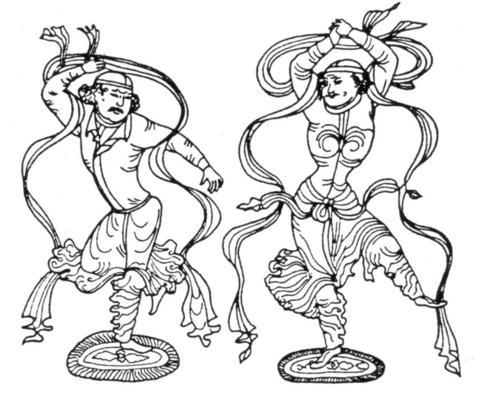
The sensuously corpulent, celestial white-scrubbed female musicians and dancers of Cave 220 and elsewhere, have no precedent in earlier Chinese figure painting. Where does such non-Han imagery come from? Curiously, these are direct transformations of campfire music-dances performed by caravan drivers where sweaty, bearded and booted drivers make merry. Both Kyrghisians and Sogdians, in different gear, are often depicted in such roadside entertainment.
Overall, we glimpse not only Buddhist cosmology, but also stunning craftsmanship. No 8th century paintings anywhere match the stunning iconographical paintings, lively narratives, penetrating architectural renderings, or varieties of landscapes, flora and fauna.
Dunhuang, at its time, was humanity's highest achievement in visual and musical arts. But since the 14th century it has changed and dispersed. These days, only by visiting such an extraordinary exhibition can we experience its once-resplendent and transformative energies.
Details
Dates and Time: To next Sunday, Aug. 7
Venue: Kaohsiung Museum of Fine Arts, 80, Meishuguan Road, Kushan District, Kaohsiung City.
Tel: (07) 555 0331
Tickets: NT$150
Opening Hours: From each Tuesday to Sunday, 9am to 5pm
Links: www.dunhuang-tnnua.com
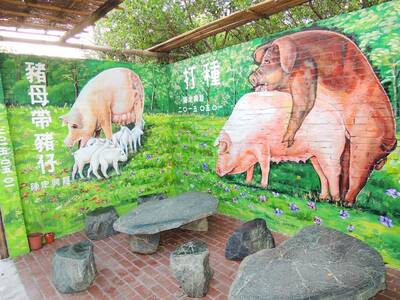
May 6 to May 12 Those who follow the Chinese-language news may have noticed the usage of the term zhuge (豬哥, literally ‘pig brother,’ a male pig raised for breeding purposes) in reports concerning the ongoing #Metoo scandal in the entertainment industry. The term’s modern connotations can range from womanizer or lecher to sexual predator, but it once referred to an important rural trade. Until the 1970s, it was a common sight to see a breeder herding a single “zhuge” down a rustic path with a bamboo whip, often traveling large distances over rugged terrain to service local families. Not only
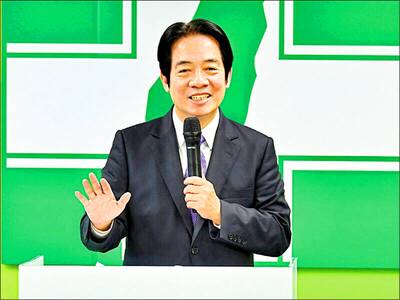
Ahead of incoming president William Lai’s (賴清德) inauguration on May 20 there appear to be signs that he is signaling to the Chinese Communist Party (CCP) and that the Chinese side is also signaling to the Taiwan side. This raises a lot of questions, including what is the CCP up to, who are they signaling to, what are they signaling, how with the various actors in Taiwan respond and where this could ultimately go. In the last column, published on May 2, we examined the curious case of Democratic Progressive Party (DPP) heavyweight Tseng Wen-tsan (鄭文燦) — currently vice premier
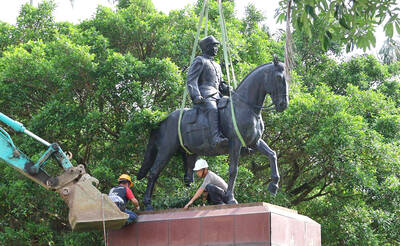
The last time Mrs Hsieh came to Cihu Park in Taoyuan was almost 50 years ago, on a school trip to the grave of Taiwan’s recently deceased dictator. Busloads of children were brought in to pay their respects to Chiang Kai-shek (蔣中正), known as Generalissimo, who had died at 87, after decades ruling Taiwan under brutal martial law. “There were a lot of buses, and there was a long queue,” Hsieh recalled. “It was a school rule. We had to bow, and then we went home.” Chiang’s body is still there, under guard in a mausoleum at the end of a path

Last week the Directorate-General of Budget, Accounting and Statistics (DGBAS) released a set of very strange numbers on Taiwan’s wealth distribution. Duly quoted in the Taipei Times, the report said that “The Gini coefficient for Taiwanese households… was 0.606 at the end of 2021, lower than Australia’s 0.611, the UK’s 0.620, Japan’s 0.678, France’s 0.676 and Germany’s 0.727, the agency said in a report.” The Gini coefficient is a measure of relative inequality, usually of wealth or income, though it can be used to evaluate other forms of inequality. However, for most nations it is a number from .25 to .50


 RSS
RSS