


A few weeks ago, Scott Chaskey, poet and farmer, was hunkered down in his favorite garlic field to get out of a chilly wind blowing off the ocean. The sand was warm between the perfectly tilled rows of green garlic stalks, mulched with a soft blanket of shredded leaves. Chaskey calls them "green sail masts," and so they were, all 20,000 of them, sailing down this 0.8-hectare field.
Since 1990, Chaskey has directed the plowing and planting at Quail Hill, a community farm in north Amagansett, New York. And now he has written about his experiences, from growing garlic, his favorite food, to growing a community -- of earthworms, bees, birds, foxes and humans -- all connected to the earth.
This Common Ground: Seasons on an Organic Farm, published in April by Viking, is an elegy to the land and to the creatures who inhabit it. It is all about rebuilding the connections that have been lost, over time, as the family farm has given way to industrialized agriculture and real estate development. (At Quail Hill, farmers use a chisel plow to loosen the earth, and plant 1,360kg of seed potatoes by hand. And Chaskey veers wide, with his plow, if a fox family has burrowed into the field.)
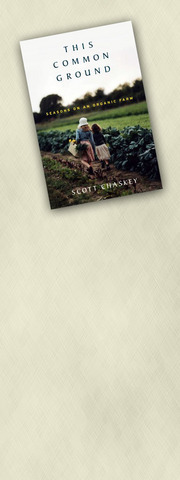
The book is also a gardener's bible, packed with practical knowledge that often runs counter to conventional wisdom (garlic, for instance, does better out here if it is planted in late October, not August), as well as insights into subtler and more difficult arts, like protecting land from the pressure to develop, or fostering an awareness that soil holds the key to plant health.
This particular soil, for instance, was enriched with more than 57 tonnes of compost per hectare, a month or so before garlic-planting time. "You don't want to put down compost the day before you plant," said Chaskey, whose worn herringbone cap and white beard put him somewhere between Walt Whitman and Edgar Wallis, the spry, 80-something gardener who taught him how to wield a long-handled spade in the cliff meadows of Cornwall, England.
Gardeners, he said, could put a good 10cm of compost down on their gardens in fall. And rock powder, too, which Chaskey works in with the compost, to add trace minerals lost through hundreds of years of growing corn and potatoes.
A native of upstate New York, Chaskey, 55, first learned the secrets of the soil double-digging vegetable gardens in England while studying poetry and writing at Oxford University. There he met his wife, Megan, who was also studying poetry. They moved to the little fishing village of Mousehole, at the very tip of Cornwall, where he gardened high above the crashing sea.
They came to Amagansett in 1989, where a group of 10 families, including Chaskey's mother and stepfather, had started one of the first community-supported agriculture projects, known as CSAs, in which participants share labor and costs.
At first, the fledgling farmers led a Gypsy-like existence, moving from one borrowed plot to another, but in 1990 they formed a rare partnership with the Peconic Land Trust. The trust had just received 8 hectares of farmland from an Amagansett landowner, who later donated her entire 90-hectare property to the trust. The community farmers needed a permanent home, so Quail Hill Farm was born.
In a community farm, members buy shares -- US$690 for a family, or US$355 for an individual at Quail Hill -- to pay for seeds, fertilizer and supplies. Members there harvest about 225 varieties of organic vegetables, herbs, flowers and raspberries twice a week during the growing season. They agree to accept crop failures due to weather, insects, disease or deer. "It's all about sharing the risk with the farmer," Chaskey said.
Fifteen years later, Chaskey works for the trust, managing, among other duties, the Quail Hill Farm, which has grown to about 175 families and 50 individual members. The Chaskey children, Levin, Rowenna and Liam, all born on the East End, are growing up on fresh, organic vegetables chosen not only for their superior taste, but often for their beauty as well. (They even like Chaskey's favorite spring cabbage, Early Jersey Wakefield, sauteed with olive oil and garlic.)
One of Chaskey's greatest satisfactions has been to revive fields long drained of nutrients by constant rotations of potatoes and corn, and by growing cover crops like oats, buckwheat, clover and bell beans, which add organic matter and nitrogen to impoverished soil. "When we took over farming the field we call Hurricane Hill," Chaskey writes, "there was not a worm to be found in the full five acres." Now, it is like crumbly chocolate cake, teeming with micro-organisms.
Quail Hill Farm is in an enviable position, compared with many CSAs, which are hard-put to find the capital for a new tractor. Its capital expenses are paid by the Peconic Land Trust, which also pays the salaries of Chaskey, a field manager and four summer apprentices.
There is a deep sense of place to these flat, sandy acres, where the rooster crows over the henhouse, nestled in a woods of native beech and holly. It's just about time to plant those 3,000 tomato seedlings thriving in the hoop house (where the free-ranging laying hens peck insects off the dirt floor). The peas, planted in early April, are already marching in wide green bands.
It's the community part that draws many to this farm. "Whenever I go to harvest in the fields, it's like therapy to me," said Gordian Raacke, a longtime member. Raacke doesn't have a green thumb; he's more interested, he says, in "growing the community." He flips the pancakes at the farm's annual breakfast, and helps organize the tomato taste-off in August. "It's a wonderful way for people to meet and learn about organic techniques," he said.
Chaskey has a lot of them up his sleeve. Like adding a half cup of bone meal when you plant tomatoes, or planting carrots in August to get the sweetest crop.
But he also reminds us to pause, as Edgar Wallis did in Cornwall, and listen. "To sense in the natural music of a meadow what a seed or plant senses," he writes, "to feel the interdependence of south wind, granite rock, mist and a robin's chatter."
Now, Chaskey stood into the wind on the tip of the East End of Long Island, and said: "Both are by the sea, at the end of peninsulas. And the light is very much the same."

In late October of 1873 the government of Japan decided against sending a military expedition to Korea to force that nation to open trade relations. Across the government supporters of the expedition resigned immediately. The spectacle of revolt by disaffected samurai began to loom over Japanese politics. In January of 1874 disaffected samurai attacked a senior minister in Tokyo. A month later, a group of pro-Korea expedition and anti-foreign elements from Saga prefecture in Kyushu revolted, driven in part by high food prices stemming from poor harvests. Their leader, according to Edward Drea’s classic Japan’s Imperial Army, was a samurai

The following three paragraphs are just some of what the local Chinese-language press is reporting on breathlessly and following every twist and turn with the eagerness of a soap opera fan. For many English-language readers, it probably comes across as incomprehensibly opaque, so bear with me briefly dear reader: To the surprise of many, former pop singer and Democratic Progressive Party (DPP) ex-lawmaker Yu Tien (余天) of the Taiwan Normal Country Promotion Association (TNCPA) at the last minute dropped out of the running for committee chair of the DPP’s New Taipei City chapter, paving the way for DPP legislator Su
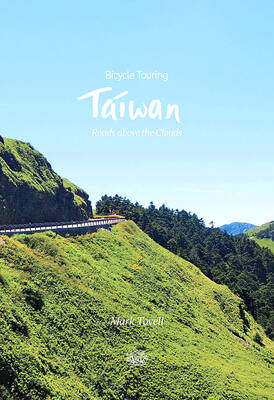
It’s hard to know where to begin with Mark Tovell’s Taiwan: Roads Above the Clouds. Having published a travelogue myself, as well as having contributed to several guidebooks, at first glance Tovell’s book appears to inhabit a middle ground — the kind of hard-to-sell nowheresville publishers detest. Leaf through the pages and you’ll find them suffuse with the purple prose best associated with travel literature: “When the sun is low on a warm, clear morning, and with the heat already rising, we stand at the riverside bike path leading south from Sanxia’s old cobble streets.” Hardly the stuff of your
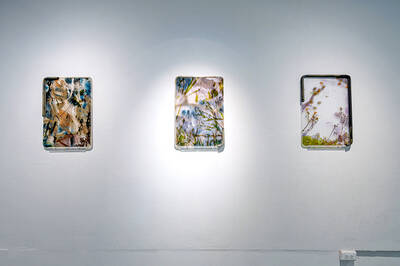
Located down a sideroad in old Wanhua District (萬華區), Waley Art (水谷藝術) has an established reputation for curating some of the more provocative indie art exhibitions in Taipei. And this month is no exception. Beyond the innocuous facade of a shophouse, the full three stories of the gallery space (including the basement) have been taken over by photographs, installation videos and abstract images courtesy of two creatives who hail from the opposite ends of the earth, Taiwan’s Hsu Yi-ting (許懿婷) and Germany’s Benjamin Janzen. “In 2019, I had an art residency in Europe,” Hsu says. “I met Benjamin in the lobby


 RSS
RSS