


At the last screening in Cannes this week of Hou Hsiao-hsien's (
The film was seen by critics as one of the standouts among the 20 other contenders in competition this year.
In a change from his previous films, which focus largely on history and Taiwan's political situation, Three Times, Hou's sixth entry in the Cannes competition, is simply a love story.
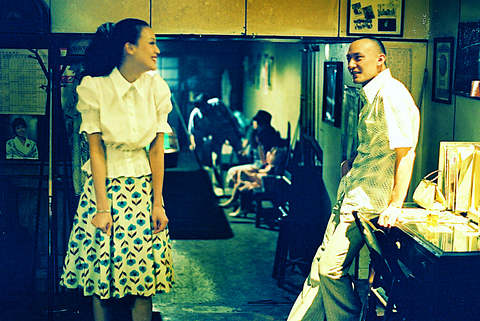
PHOTO: COURTESY OF SINOMOVIE
It's a three-segmented film set in different times: 1911, 1966 and 2005. His lead actors Shu Qi (
The first segment is titled "A Time of Love" (
Before going to military service, a young man, played by Chang, spends his time at a billiards halls and falls for one of the girls who works at the hall recording scores for customers.

PHOTO: YU SEN-LUN
Initially, he likes a girl named Spring, and one day he comes to the hall to look for Spring but finds that she's left to work in another city.
May, played by Shu, works at the billiard hall and reads his letter to Spring and is touched by the words.
They fall briefly for each other, but the man is sent off to military service. One weekend, the young soldier goes back home in the south in search of May.
"I remember I had such a crush on this one girl and I went on exactly that kind of journey," Hou said at the press conference of the film in Cannes.
The second segment, set in 1911, is, according to Hou, a time for the revolutionary spirit. The segment is titled "A Time For Freedom" (
Shu plays a courtesan who owns a parlor house and sings operas, plays music and recites poetry.
Chang is a client with aspirations to overthrow the Qing and to free Taiwan from Japanese rule. 1911 was the year the Qing dynasty fell and the ROC was founded.
He visits May's house regularly. She takes care of him and they talk about literature and his idealism in the fight against feudal customs. Throughout their relationship, she remains uncertain of her role and position.
The Chinese title of the movie means "the best times." Speaking about the title, Hou said: "For me, all of the three times are the best times. Because the times and moments will never come back. They are lost forever. You can only revoke the moments through memories. I've always wanted to make films about fragmentary memories."
Three Times integrates the different film styles with which Hou had earlier experimented.
The first two segments are the extension of Hou's A Time to Live and a Time to Die (
The third segment, "A Time For Youth" (
In the third segment, Shu plays a bisexual girl having an affair with Chang. She writes poems, pop songs and sings with a rock band. She is spontaneous and wild. But emotionally, she is very confused.
Working with Hou for the second time, Shu said she is getting more accustomed to Hou's filmmaking style.
"In this film I have many new tasks. First it's to learn to play pool well. Then to play the courtesan well I had to learn the special voice and languages in Southern Tones (
Hou was generous with his praise of the two main actors.
"We decided to work with Shu a long time ago, because after Millennium Mambo I thought her talent could be explored further. As for Chang Chen, after working with well-known directors such as Tian Zhuangzhuang (田壯壯) and Wong Kar Wai (王家衛 ) in Eros (愛神), I felt he became a very mature actor and he matches well with Shu Qi," he said.
"I think she is especially excellent in the first segment, playing the pure and slightly silly girl in the south."

In late October of 1873 the government of Japan decided against sending a military expedition to Korea to force that nation to open trade relations. Across the government supporters of the expedition resigned immediately. The spectacle of revolt by disaffected samurai began to loom over Japanese politics. In January of 1874 disaffected samurai attacked a senior minister in Tokyo. A month later, a group of pro-Korea expedition and anti-foreign elements from Saga prefecture in Kyushu revolted, driven in part by high food prices stemming from poor harvests. Their leader, according to Edward Drea’s classic Japan’s Imperial Army, was a samurai

The following three paragraphs are just some of what the local Chinese-language press is reporting on breathlessly and following every twist and turn with the eagerness of a soap opera fan. For many English-language readers, it probably comes across as incomprehensibly opaque, so bear with me briefly dear reader: To the surprise of many, former pop singer and Democratic Progressive Party (DPP) ex-lawmaker Yu Tien (余天) of the Taiwan Normal Country Promotion Association (TNCPA) at the last minute dropped out of the running for committee chair of the DPP’s New Taipei City chapter, paving the way for DPP legislator Su

It’s hard to know where to begin with Mark Tovell’s Taiwan: Roads Above the Clouds. Having published a travelogue myself, as well as having contributed to several guidebooks, at first glance Tovell’s book appears to inhabit a middle ground — the kind of hard-to-sell nowheresville publishers detest. Leaf through the pages and you’ll find them suffuse with the purple prose best associated with travel literature: “When the sun is low on a warm, clear morning, and with the heat already rising, we stand at the riverside bike path leading south from Sanxia’s old cobble streets.” Hardly the stuff of your

Located down a sideroad in old Wanhua District (萬華區), Waley Art (水谷藝術) has an established reputation for curating some of the more provocative indie art exhibitions in Taipei. And this month is no exception. Beyond the innocuous facade of a shophouse, the full three stories of the gallery space (including the basement) have been taken over by photographs, installation videos and abstract images courtesy of two creatives who hail from the opposite ends of the earth, Taiwan’s Hsu Yi-ting (許懿婷) and Germany’s Benjamin Janzen. “In 2019, I had an art residency in Europe,” Hsu says. “I met Benjamin in the lobby


 RSS
RSS