


You might have seen one at the Taipei 101 mall or while walking past the company's flagship store on Dunhua South Road -- television sets made to look like basketballs, footballs, stuffed animals, cartoon characters, or maybe an apple. They're the creation of Hannspree, a Taiwanese company that aims to create a "design revolution" in the television manufacturing industry by "thinking outside the box."
The company's belief is that we yearn for individuality in the television sets we all stare at like lemmings. If I'm a basketball fan, for instance, I might want a TV set modeled after my team's jersey. Bicycle enthusiasts might want a set with handlebars, though it's unclear what purpose the handle bars serve. "Find yourself" is the message beamed at visitors to the company's Taipei outlets, as well as to its US marketing headquarters in San Francisco.
The company isn't saying how many people have found themselves since they first opened their doors in October last year. But one thing was clear among visitors to the Hannspree outlet on Dunhua South Road this past weekend: finding yourself is an expensive enterprise. A 9.4-inch flat- screen LCD made to look like a cuddly crab, for example, costs NT$15,600 (about US$500). Most other models sell for twice that. A 12-inch Batman television will set you back NT$298,000.
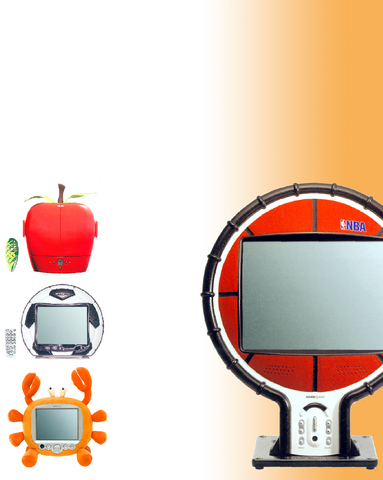
"They're all so cool," said one customer named Yen, "But I can't see paying NT$30,000 for a 12-inch television. I could get a wide-screen high-definition TV for that price."
He has a point. While the design of Hannspree's television casings might be considered revolutionary, the 9.4-inch and 12-inch screens they're wrapped around would seem behind the curve of where the industry is heading.
A bit of television history: While the first television broadcasts in the late 1920s and early 1930s titillated all those who saw them, they also caused the heart of the motion picture industry to skip a beat. Movie makers quickly realized they'd have to do something to keep movie-goers going to the movies instead of sitting at home in front of their television sets. The major improvements they made were color film and, much later, surround-sound systems that wouldn't be set up in any home for a long time.
The first major improvement they made, however was to change the aspect ratio of their product from the traditional 4:3 format to a wider, 16:9 format (these ratios are sometimes expressed as 1.33:1 and 1.78:1. Some films, like Apocalypse Now, are shot in the even more cinematographic 2.35:1 ratio). The idea was to give viewers more to view than their television sets would allow. Televisions were all made to a 4:3 aspect ratio -- as are the majority of Hannspree's sets -- because it's close to the 1.37:1 that has long been the standard of camera manufacturers.
All that is changing, however, at the same rate at which television technology becomes less expensive. Nearly all high definition television sets (HDTV) are manufactured to a 16:9 aspect ratio. As the technology becomes less expensive (and many HDTV sets are already half the price they were just a couple years ago), they'll undoubtedly become the television set of choice.
Eventually, the majority of television sets in use will be 16:9, wide-screen sets. As most television content is already digital, the industry will very easily adapt to the change. But the film industry, which currently goes to great pains to convert its content to be watched on 4:3 televisions, might eventually do away with the practice.
So, while it's exciting to think that we're on the verge of a revolution in television-watching, it means the NT$15,600, 9.4-inch cuddly crab television set you bought your toddler will be a collector's item by the time the child gets into high school.
Representatives from Hannspree stress that their television designs will change with viewer's needs, but were non-committal on whether or not their prices would change.
"We're trowing out the rules," said one company representative."We're selling television sets to people who think the set itself is as important as what you watch on it."
Now that's truly thinking outside the box.
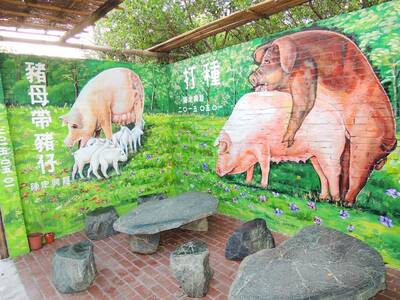
May 6 to May 12 Those who follow the Chinese-language news may have noticed the usage of the term zhuge (豬哥, literally ‘pig brother,’ a male pig raised for breeding purposes) in reports concerning the ongoing #Metoo scandal in the entertainment industry. The term’s modern connotations can range from womanizer or lecher to sexual predator, but it once referred to an important rural trade. Until the 1970s, it was a common sight to see a breeder herding a single “zhuge” down a rustic path with a bamboo whip, often traveling large distances over rugged terrain to service local families. Not only

Ahead of incoming president William Lai’s (賴清德) inauguration on May 20 there appear to be signs that he is signaling to the Chinese Communist Party (CCP) and that the Chinese side is also signaling to the Taiwan side. This raises a lot of questions, including what is the CCP up to, who are they signaling to, what are they signaling, how with the various actors in Taiwan respond and where this could ultimately go. In the last column, published on May 2, we examined the curious case of Democratic Progressive Party (DPP) heavyweight Tseng Wen-tsan (鄭文燦) — currently vice premier
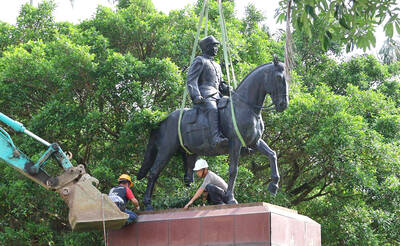
The last time Mrs Hsieh came to Cihu Park in Taoyuan was almost 50 years ago, on a school trip to the grave of Taiwan’s recently deceased dictator. Busloads of children were brought in to pay their respects to Chiang Kai-shek (蔣中正), known as Generalissimo, who had died at 87, after decades ruling Taiwan under brutal martial law. “There were a lot of buses, and there was a long queue,” Hsieh recalled. “It was a school rule. We had to bow, and then we went home.” Chiang’s body is still there, under guard in a mausoleum at the end of a path

Last week the Directorate-General of Budget, Accounting and Statistics (DGBAS) released a set of very strange numbers on Taiwan’s wealth distribution. Duly quoted in the Taipei Times, the report said that “The Gini coefficient for Taiwanese households… was 0.606 at the end of 2021, lower than Australia’s 0.611, the UK’s 0.620, Japan’s 0.678, France’s 0.676 and Germany’s 0.727, the agency said in a report.” The Gini coefficient is a measure of relative inequality, usually of wealth or income, though it can be used to evaluate other forms of inequality. However, for most nations it is a number from .25 to .50


 RSS
RSS