


Eesidents of Taipei looking for an abstract and different view of the city are in for a treat over the coming month, as the opening of the 2nd Taipei Public Art Festival (
Organized by the Taipei City Government and with backing of several of Taipei's most prominent art groups and institutions including the Taipei Fine Arts Museum (
Entitled Utopia of Togetherness, the contemporary yet momentary facelift has, unlike too many of Taipei's seemingly never-ending flow of phony festivals, been well thought out and planned. Some of the works are so good in fact that it will be a shame when they are removed in a month's time, as they add flair to the run-down and often forgotten part of Taipei.
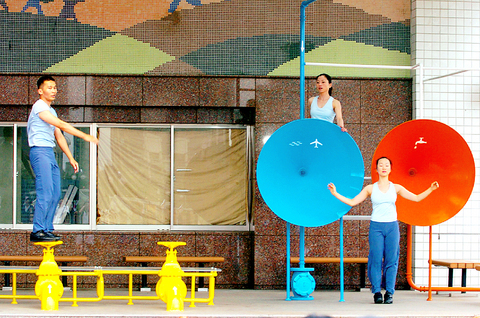
PHOTO: SEAN CHAO, TAIPEI TIMES
Instead of erecting dozens of installations at one single venue or scattering them randomly throughout the district, organizers have laid the works out in premeditated manner that allows visitors to take in both the artworks themselves as well as some of the district's historical sites.
In order to see the works visitors can follow the special "art route." Beginning at the Yuanshan MRT station and finishing at the Dansui River, the route passes through the district's major thoroughfares and ambles through many of the area's lesser streets and lanes.
Although many of the works are worthy of contemplative thought, the exhibition's most arresting piece is that entitled Reborn Terrain. Designed by Lin Lung-ju (林龍如) and Hsiung Yi-yi (熊宜一), the work was made by transforming a standard steel-and-concrete elevated pedestrian overpass into a wood-paneled Noah's Ark-like structure. Here visitors can either choose to take the view or continue to the riverbank, which, hidden by the huge concrete floodwall, offers a peaceful contrast to the roar of the traffic.
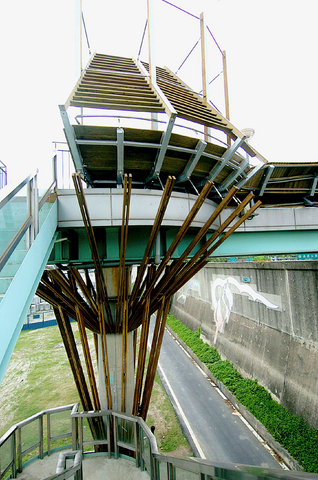
The "art route" terminates at the Dihua Sewage Treatment Plant, which, while not sounding like a particularly inviting destination, has been transformed into a mini-art park of its own, where half a dozen of the festival's more innovative works are on display.
As well as getting to take in a range of street-side artworks, visitors can also wander the once-busy detention cells and interrogation rooms of one of Taipei's most notorious police stations. During the years of Japanese occupation the Lanzhou police station was used a surveillance center, where law-enforcement officials would monitor the neighborhood for anti-Japanese activities.
Recently renovated and transformed into what has been dubbed the "Utopian Police Station," the structure has been altered by artist Chiang Yang-huei (
For an in-depth Chinese language look at the works featured in the 2nd Taipei Public Art Festival and a map pinpointing the locations of each work, log on to the official Web site at www.taipeiart.com.
Event information:
What: The 2nd Taipei Public Art Festival (
Where: Datung District, from Yuanshan MRT to Dihua Street Sewage Plant.
When: Now through May 9

In late October of 1873 the government of Japan decided against sending a military expedition to Korea to force that nation to open trade relations. Across the government supporters of the expedition resigned immediately. The spectacle of revolt by disaffected samurai began to loom over Japanese politics. In January of 1874 disaffected samurai attacked a senior minister in Tokyo. A month later, a group of pro-Korea expedition and anti-foreign elements from Saga prefecture in Kyushu revolted, driven in part by high food prices stemming from poor harvests. Their leader, according to Edward Drea’s classic Japan’s Imperial Army, was a samurai

The following three paragraphs are just some of what the local Chinese-language press is reporting on breathlessly and following every twist and turn with the eagerness of a soap opera fan. For many English-language readers, it probably comes across as incomprehensibly opaque, so bear with me briefly dear reader: To the surprise of many, former pop singer and Democratic Progressive Party (DPP) ex-lawmaker Yu Tien (余天) of the Taiwan Normal Country Promotion Association (TNCPA) at the last minute dropped out of the running for committee chair of the DPP’s New Taipei City chapter, paving the way for DPP legislator Su
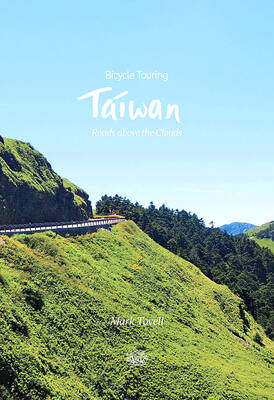
It’s hard to know where to begin with Mark Tovell’s Taiwan: Roads Above the Clouds. Having published a travelogue myself, as well as having contributed to several guidebooks, at first glance Tovell’s book appears to inhabit a middle ground — the kind of hard-to-sell nowheresville publishers detest. Leaf through the pages and you’ll find them suffuse with the purple prose best associated with travel literature: “When the sun is low on a warm, clear morning, and with the heat already rising, we stand at the riverside bike path leading south from Sanxia’s old cobble streets.” Hardly the stuff of your
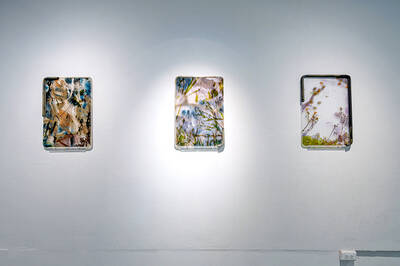
Located down a sideroad in old Wanhua District (萬華區), Waley Art (水谷藝術) has an established reputation for curating some of the more provocative indie art exhibitions in Taipei. And this month is no exception. Beyond the innocuous facade of a shophouse, the full three stories of the gallery space (including the basement) have been taken over by photographs, installation videos and abstract images courtesy of two creatives who hail from the opposite ends of the earth, Taiwan’s Hsu Yi-ting (許懿婷) and Germany’s Benjamin Janzen. “In 2019, I had an art residency in Europe,” Hsu says. “I met Benjamin in the lobby


 RSS
RSS