


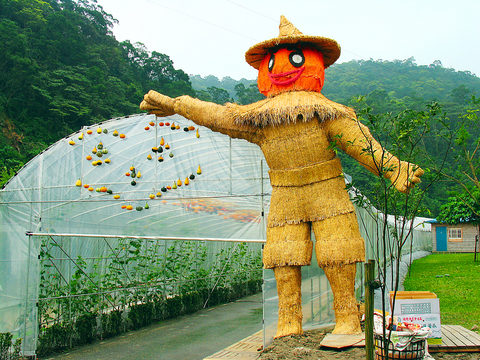
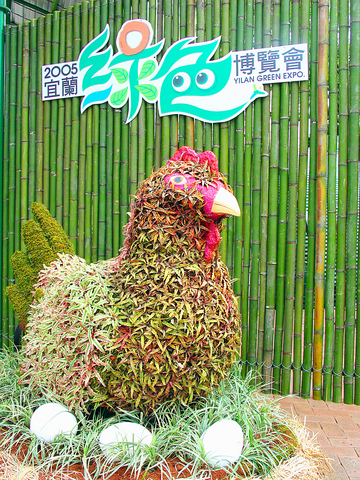
Ilan County has a surprising amount to offer tourists, especially in the springtime, when the county pulls out its pruning shears and goes to work at Wulaokeng Scenic Area to prepare for the annual Ilan Green Expo (宜蘭錄色博覽會). The festival has become a favorite for kids and families and this year is no exception as organizers have gone to great lengths to bring a wide variety of interesting and occasionally curious items into one place.
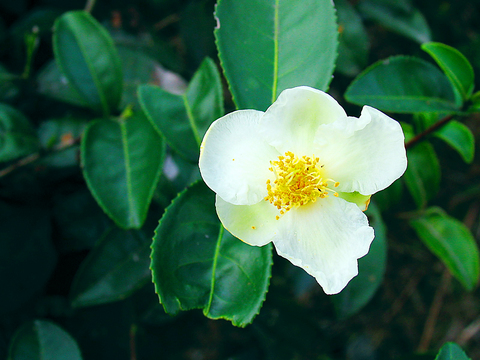
Of course green means plants and flowers and the Green Expo delivers plenty of this. When the Taipei Times visited during last-minute preparations last month, a small army of gardeners was working to put the finishing touches on trellises and easily hundreds of thousands of flowers.
They line the pathways that lead into the scenic area and hop over a manmade creek that runs through Wulaokeng. The beds are bursting with color in part because so many different varieties not usually seen in one spot have been planted side by side.
PHOTOS: TAIPEI TIMES
Don't let the cacophony of color in the flowerbeds detract from the trees they're planted around; the banyans and various ficus trees found in Wulaokeng are the area's finest feature.
Flora aside, organizers have brought a unique selection of fauna into this year's Green Expo offerings. Eight individual exhibitions have been constructed and a number of them deal with an unorthodox array of things that creep, crawl and fly.
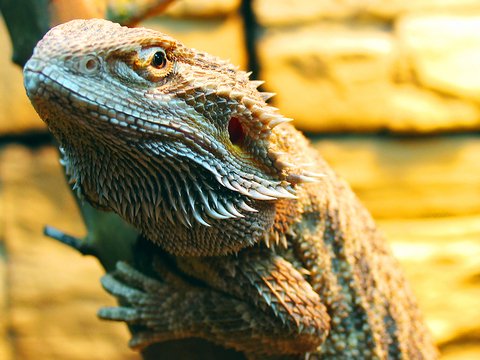
The first such pavilion is dedicated to lizards and butterflies and houses dozens of varieties of reptiles from around the world from legless lizards to giant iguanas. An enclosure at the exit is home to hundreds of butterflies that flutter around visitor's heads and elicit plenty of squeals from kids.
Another pavilion celebrates the role of silkworms. The entire exhibition is filled with mounds of the little white worms feeding on mulberry bushes, with interactive displays that tell you all about how silk is made.
Yet another pavilion is dedicated to ants. You might have a hard time actually seeing any of the stars of this exhibition, but several adorable anthropomorphic ants sit atop displays that teach kids and adults alike about the important ecological role these little workers play. There is also a special section on fire ants that was added after the recent "infestation" of the species in Taiwan.
Yet another pavilion is dedicated to shells, how they're formed and the many uses they have in our daily lives.
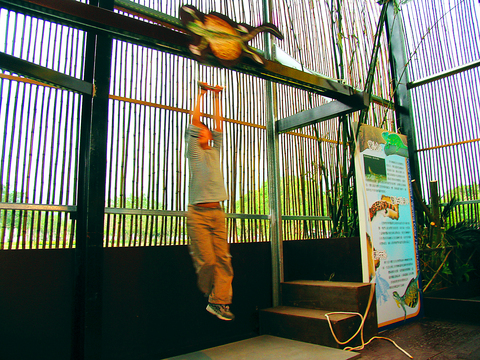
Finally things that nest -- birds, bugs and rodents -- are featured in the last of the pavilions dedicated to fauna. This is also the best designed of the pavilions, both from an aesthetic point of view and an educational one, with a lot of information given on each of the species on display that will fascinate both kids and adults.
Organizers deserve applause for these interesting, if unorthodox, pavilions, the likes of which you'll not soon see at any other expo -- as other pavilions simply leave visitors scratching their heads.
Sandwiched between silkworms, bugs and birds is an exhibition on Taiwan's Aboriginal culture. This pavilion is simply a series of tableaus, mannequins posed as hunters or fishermen, a woman weaving, etc. Beside each tableau, a plaque labels various items in the scene both in Chinese and its Aboriginal language.
The problem here is that no indication is given as to which of Taiwan's Aboriginal tribes these scenes or the items in them belong. And no further information is given as to why or how. The entire pavilion is tantamount to a vocabulary lesson -- in what language is anyone's guess. Sad that organizers treated nesting bugs better than Taiwan's several rich Aboriginal cultures.
Another curiosity is the pao tsai pavilion, an exhibition on Korean food and the wonder of kimchee. Visitors file through this gallery of plastic platters of food gobsmacked as to why it's there or what it has to do with a "green" theme. Only when you reach the end -- shelves of Korean food products and a line of cash registers -- do you become aware of the pavilion's purpose.
The remaining pavilions are given over to pure fun. For kids (or anyone young at heart and short in stature), the playground pavilion is worth a couple of hours itself. A giant ship has been marooned in the middle of Wulaokeng with slides coming off it and a huge indoor jungle gym has been erected at the site.
Closer to the entrance of the scenic area, a 3-D theater will show daily screenings of computer-generated animation shorts: The Giant Little Ant, Deep Blue and a story about a boy who dreams of a magic pig.
And of course there is food. Near the entrance to the park is an area with a cafe and restaurant as well as several stalls selling specialties from all over the island.
But chief among the Green Expo's charms is the place at which it's held. Wulaokeng Scenic Area is nestled in a nook of the Shincheng River and offers pits for barbecuing and plenty of big open spaces for tossing a ball or Frisbee.
If time permits -- and if exhibitions about ants aren't your thing -- take a stroll upstream into the surrounding hillsides. There is no camping allowing and swimming is prohibited for good reason: The current is swift and comes quickly to a stepped dam downstream.
There will also be near-daily concerts held in a large outdoor amphitheater that's been erected for the event. For a schedule of who's playing when, check the expo's Web site at http://igreen.e-land.gov.tw.
All told, the Ilan Green Expo makes a great day trip that is sure to be fun for the whole family.

In late October of 1873 the government of Japan decided against sending a military expedition to Korea to force that nation to open trade relations. Across the government supporters of the expedition resigned immediately. The spectacle of revolt by disaffected samurai began to loom over Japanese politics. In January of 1874 disaffected samurai attacked a senior minister in Tokyo. A month later, a group of pro-Korea expedition and anti-foreign elements from Saga prefecture in Kyushu revolted, driven in part by high food prices stemming from poor harvests. Their leader, according to Edward Drea’s classic Japan’s Imperial Army, was a samurai

The following three paragraphs are just some of what the local Chinese-language press is reporting on breathlessly and following every twist and turn with the eagerness of a soap opera fan. For many English-language readers, it probably comes across as incomprehensibly opaque, so bear with me briefly dear reader: To the surprise of many, former pop singer and Democratic Progressive Party (DPP) ex-lawmaker Yu Tien (余天) of the Taiwan Normal Country Promotion Association (TNCPA) at the last minute dropped out of the running for committee chair of the DPP’s New Taipei City chapter, paving the way for DPP legislator Su
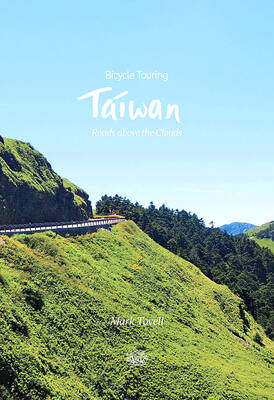
It’s hard to know where to begin with Mark Tovell’s Taiwan: Roads Above the Clouds. Having published a travelogue myself, as well as having contributed to several guidebooks, at first glance Tovell’s book appears to inhabit a middle ground — the kind of hard-to-sell nowheresville publishers detest. Leaf through the pages and you’ll find them suffuse with the purple prose best associated with travel literature: “When the sun is low on a warm, clear morning, and with the heat already rising, we stand at the riverside bike path leading south from Sanxia’s old cobble streets.” Hardly the stuff of your

Located down a sideroad in old Wanhua District (萬華區), Waley Art (水谷藝術) has an established reputation for curating some of the more provocative indie art exhibitions in Taipei. And this month is no exception. Beyond the innocuous facade of a shophouse, the full three stories of the gallery space (including the basement) have been taken over by photographs, installation videos and abstract images courtesy of two creatives who hail from the opposite ends of the earth, Taiwan’s Hsu Yi-ting (許懿婷) and Germany’s Benjamin Janzen. “In 2019, I had an art residency in Europe,” Hsu says. “I met Benjamin in the lobby


 RSS
RSS