


This is a slightly better book than it seems at first sight, but is nonetheless far less good than some of its early sections might lead you to believe.
When I began reading Touching Earth, I thought it was an oriental genre novel, full of luxuriant images of the gorgeous and exotic East. The scene was Bali and both human life and nature appeared to be characterized by abundance, a characteristic that was reflected in an opulent prose style. There were sorcerers, long fingernails, fruits of every description, jeweled combs, moonlit nights and an abundance of coconut oil.

I know what this is all about, I thought. This writer, though no doubt well aware that in many literary circles irony, understatement and a critical stance are highly valued, believes that she, by contrast, will be lush, indulgent, and implicitly critical of the West for lacking these qualities. You may have lost the feeling for these things, I imagined she was saying, but Asians are happily still in touch with them. And by writing like this, I'll show you what you're missing.
Then came the shock. The first chapter dealt with a Balinese girl called Nutan who, with her twin sister Zeenat, is put on a plane for London by their father. After leaving their exotic paradise island, they're launched into jobs waitressing in a bleak London restaurant run by a distant relation.
From the descriptions of this grim capital city in winter -- its inhabitants visiting cold, gloomy temples to worship their god with guilty, downcast eyes, children as young as 13 roaming the streets and swearing as they drink cider from plastic bottles -- I should have known something slightly different from what I'd expected was in store.
But I continued assuming that the main angle was the decadent West contrasted with the vibrant East. The author, I took for granted, still valued, above all else, the sensibility of some happy-go-lucky Asian, awash in the pleasures of the senses while at the same time maintaining a natural dignity thanks to a morally responsible family life.
My eyes were opened, however, when I got to a chapter narrated by a girl, Elisabeth, from the west of Ireland. Earlier there had been chapters narrated by a couple of Sicilians, Riccardo (Ricky) and Francesca. These had certainly summoned up a different world from Bali, but even so, I remained unaware of what the author was up to.
The chapter on the Irish west took me aback more than a little -- it summoned up an Irish world I felt that, in a small way, I knew and understood. All these early narratives look back at their speakers' childhoods before following them to the UK and London.
What I hadn't appreciated was the author's command of different casts of mind, and with them tones of voice. These chapters, I now saw, were strongly differentiated. And the Balinese exoticism was not Rani Manicka's own take on the world, but just one of many personas she felt able to inhabit.
Next came the mini-story of an East African Indian youth, Anis, living with his family in London following their expulsion from Kenya in the 1960s. One day he cracks the secret code on his father's computer and reads his sex diary -- crammed full of gay encounters. Anis' homophobia at this point is extremely pronounced. Was this the author's attitude too? I read on, totally unsure now what to expect.
The final major character introduced, Bruce, is a denizen of London's deprived East End. His father had been a servant with some affluent families, and from this, his mother had acquired a subtle form of social snobbery. At the end of this section Bruce, who has set up as a hairdresser, meets Francesca, one of his customers. Now all the characters were ready to interact, painted puppets in the author's gaudy marionette box.
They all meet up in Ricky's "Spider's Den," an apartment where almost anything can, and usually does, happen. This turns out to be a world consisting largely of prostitution, cocaine-use and -- inevitably -- loss of illusions. (The book's subtitle is "A novel of Innocence Corrupted").
The second half of the novel consists of fast-changes from one character to another, postcards to the reader from the edge of their experiences together. It's a lengthy sequence of nightclubs, drugs, sexual musical chairs and character vignettes. Some of these pasted-together fragments only consist of a single sentence.
Others arrive on the scene -- Maggie, Haylee, and towards the end, even the author herself shows up. Anis has an affair with Zeenat and gets hooked on heroin, while Ricky makes money buying and selling restaurants and, at least partly, avoiding the tax man.
This book, then, is essentially an attempted blockbuster and, as I've unfortunately come to expect from such productions, much of it is vivid but shallow, full of cliches about different national types, and, in the final analysis brash, like an over-colorful inflight magazine, and more than a touch predictable.
There's one more thing. I happen to know that twins in Bali are traditionally viewed as bringing extremely bad luck. The unfortunate parents who produce them have to go to excessive, and usually very expensive, lengths to mitigate their misfortune. Even their houses can be pulled down to dissipate the spirits who brought such a perceived disaster upon them.
Such a traditional belief doesn't appear to have any bearing on the Balinese twins who appear in this story. I should, perhaps, have taken more notice of this at the start.
I know that this book is likely to find many readers. But reviewers, like other people, can't easily change their tastes. And so I must end by saying that I cannot, in all honesty, recommend it.
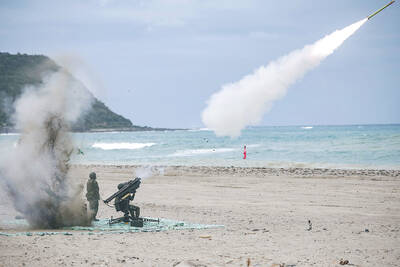
In late October of 1873 the government of Japan decided against sending a military expedition to Korea to force that nation to open trade relations. Across the government supporters of the expedition resigned immediately. The spectacle of revolt by disaffected samurai began to loom over Japanese politics. In January of 1874 disaffected samurai attacked a senior minister in Tokyo. A month later, a group of pro-Korea expedition and anti-foreign elements from Saga prefecture in Kyushu revolted, driven in part by high food prices stemming from poor harvests. Their leader, according to Edward Drea’s classic Japan’s Imperial Army, was a samurai

The following three paragraphs are just some of what the local Chinese-language press is reporting on breathlessly and following every twist and turn with the eagerness of a soap opera fan. For many English-language readers, it probably comes across as incomprehensibly opaque, so bear with me briefly dear reader: To the surprise of many, former pop singer and Democratic Progressive Party (DPP) ex-lawmaker Yu Tien (余天) of the Taiwan Normal Country Promotion Association (TNCPA) at the last minute dropped out of the running for committee chair of the DPP’s New Taipei City chapter, paving the way for DPP legislator Su
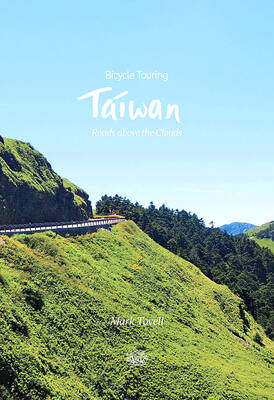
It’s hard to know where to begin with Mark Tovell’s Taiwan: Roads Above the Clouds. Having published a travelogue myself, as well as having contributed to several guidebooks, at first glance Tovell’s book appears to inhabit a middle ground — the kind of hard-to-sell nowheresville publishers detest. Leaf through the pages and you’ll find them suffuse with the purple prose best associated with travel literature: “When the sun is low on a warm, clear morning, and with the heat already rising, we stand at the riverside bike path leading south from Sanxia’s old cobble streets.” Hardly the stuff of your
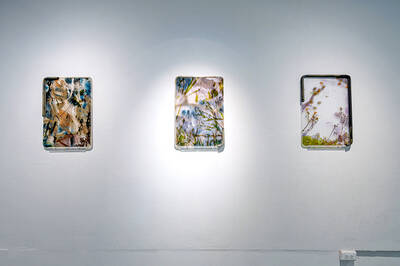
Located down a sideroad in old Wanhua District (萬華區), Waley Art (水谷藝術) has an established reputation for curating some of the more provocative indie art exhibitions in Taipei. And this month is no exception. Beyond the innocuous facade of a shophouse, the full three stories of the gallery space (including the basement) have been taken over by photographs, installation videos and abstract images courtesy of two creatives who hail from the opposite ends of the earth, Taiwan’s Hsu Yi-ting (許懿婷) and Germany’s Benjamin Janzen. “In 2019, I had an art residency in Europe,” Hsu says. “I met Benjamin in the lobby


 RSS
RSS