


At a theater on Taipei's west side, a set piece is being broken down and hauled out to make way for the next production. A couple of stagehands discuss what they'll need for the show, crunching wood shavings underfoot.
It's a scene played out at theaters the world over, but the stage at this theater is among the world's smallest, and its actors -- the ones the audience sees, at least -- are made of wood. It's TTT Puppet Theater (大稻埕偶戲館) and it's the sole puppet theater in a district that once had 10 such venues.
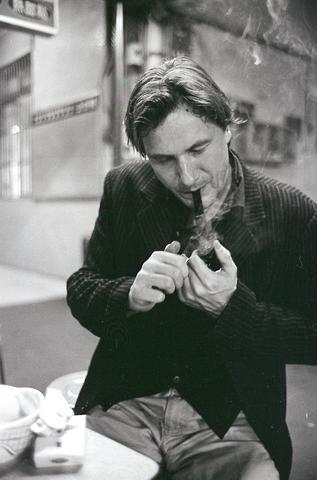
PHOTO COURTESY OF NATALIE FALGARONE
Presiding over the company of puppeteers, wood carvers and lighting and costume designers is Robin Ruizendaal, an 11-year resident of Taiwan and a paradox of a local personality. Though a man holding a puppet isn't often taken seriously, Ruizendaal also holds a wealth of knowledge on Chinese and Taiwanese culture, gleaned from years of research in sinology.
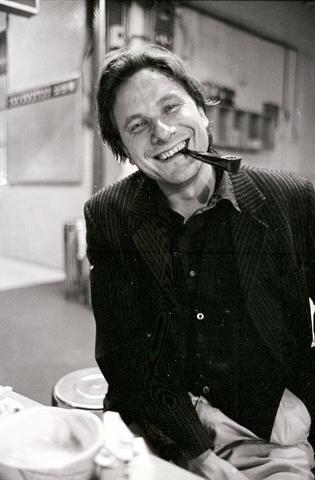
PHOTO COURTESY OF NATALIE FALGARONE
Ruizendaal first began learning Mandarin at 19 and continued his studies at Holland's Leiden University. In the early 1980s, he began research on his doctoral dissertation on Chinese marionette theater. It was a topic that would gain him a kind of access to Chinese culture that few researchers before him had enjoyed.
"I thought [puppet theater] was a nice window to research Chinese society because it's not upper-class culture, it's grassroots culture," he said.
"At the time China was very closed. We didn't know anything about what was happening in the countryside. I thought it was a really interesting, very localized form of art through which I could observe society, because it's related to religion, social groups, theatre, language, music. It had many elements which interested me."
In China, his research followed people associated with the art form from the Republican period in the 1920s, through the Cultural Revolution and up to the 1990s. Among his several observations, Ruizendaal said he learned that the politics of the Chinese Communist Party and the Chinese Nationalist Party were actually very similar.
"The destruction of Chinese religion was high in the priorities of both parties," he said. "I observed China as a religious state where everything is related to religion; everybody lives from house altar to neighborhood altars to temples. What the Communists were doing, as well as the Kuomintang was trying to destroy that element of Chinese culture."
The Communists succeeded in the cities, Ruizendaal said, razing hundreds of temples in Beijing alone.
"But in the countryside where I worked you see the tenacity of religious structure, which was interlinked with social culture so strong that it made an enormous rebound."
"The same thing is happening in Communist China now as happened in Taiwan, with the government initially against theater, banning it for several reasons. ... But in the 1990s there was this turnaround where Communist cadres started supporting theater as a local art, trying to make it function outside the state system."
Was it allowed to be as bawdy an entertainment as it previously had been?
"Yes. You can't get away from sex and shit," he laughs. "Without them, nobody would come."
But Ruizendaal considers Taiwanese puppet culture special compared with its counterparts in China or Japan or other parts of Asia in that it's been popularized in the media.
"Starting in the 1970s, there was an enormous craze for puppet theater -- televised puppet theater -- and so it's really part of the heritage of people in their 40s, 50s and 60s. They all have a warm feeling for puppet theater even though they don't watch it anymore."
The craze continues today, Ruizendaal said, with televised puppet shows and Web sites dedicated to puppets that provide information on each character's biography and birth sign, even their blood type.
"It goes far -- especially among university students," Ruizendaal said.
"It's one of the only forms of art that didn't come from China or Japan or the US. The traditional small puppets come from China, but the big puppets, with their specific Taiwanese lingo, they're a purely Taiwanese art."
And so Ruizendaal's job is as much popularization of puppetry as it is preservation. His main tasks, he explains, are making new plays based on traditional ones, creating a new audience for live puppet theater and promoting it abroad.
TTT works closely with theaters in Cambodia, Myanmar, Indonesia and India.
Last year they toured 12 countries. This year they'll take in five countries, including a second appearance at London's Victoria and Albert Museum.
Despite the considerable attention he's received in local media for his work, Ruizendaal doesn't find it strange that the task of preserving a uniquely Taiwanese art form has fallen to a foreigner.
"I think that, in a global perspective -- in the world of the arts, at least -- the concept of `foreigner' is changing a bit. Maybe not for bus drivers ... but in the arts it's getting quite normal to have conductors from Japan working in Europe. Puppetry is just on the periphery of the arts."
TTT Puppet Theater's upcoming shadow puppet production, The Child in the Rice Paddy (
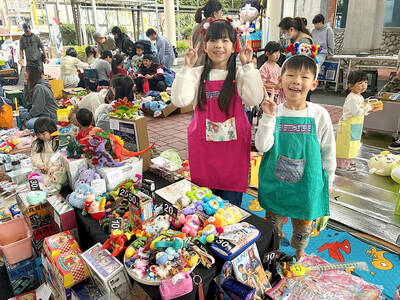
What was the population of Taiwan when the first Negritos arrived? In 500BC? The 1st century? The 18th? These questions are important, because they can contextualize the number of babies born last month, 6,523, to all the people on Taiwan, indigenous and colonial alike. That figure represents a year on year drop of 3,884 babies, prefiguring total births under 90,000 for the year. It also represents the 26th straight month of deaths exceeding births. Why isn’t this a bigger crisis? Because we don’t experience it. Instead, what we experience is a growing and more diverse population. POPULATION What is Taiwan’s actual population?

For the past five years, Sammy Jou (周祥敏) has climbed Kinmen’s highest peak, Taiwu Mountain (太武山) at 6am before heading to work. In the winter, it’s dark when he sets out but even at this hour, other climbers are already coming down the mountain. All of this is a big change from Jou’s childhood during the Martial Law period, when the military requisitioned the mountain for strategic purposes and most of it was off-limits. Back then, only two mountain trails were open, and they were open only during special occasions, such as for prayers to one’s ancestors during Lunar New Year.

You would never believe Yancheng District (鹽埕) used to be a salt field. Today, it is a bustling, artsy, Kowloon-ish “old town” of Kaohsiung — full of neon lights, small shops, scooters and street food. Two hundred years ago, before Japanese occupiers developed a shipping powerhouse around it, Yancheng was a flat triangle where seawater was captured and dried to collect salt. This is what local art galleries are revealing during the first edition of the Yancheng Arts Festival. Shen Yu-rung (沈裕融), the main curator, says: “We chose the connection with salt as a theme. The ocean is still very near, just a
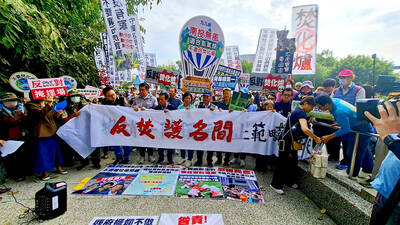
A key feature of Taiwan’s environmental impact assessments (EIA) is that they seldom stop projects, especially once the project has passed its second stage EIA review (the original Suhua Highway proposal, killed after passing the second stage review, seems to be the lone exception). Mingjian Township (名間鄉) in Nantou County has been the site of rising public anger over the proposed construction of a waste incinerator in an important agricultural area. The township is a key producer of tea (over 40 percent of the island’s production), ginger and turmeric. The incinerator project is currently in its second stage EIA. The incinerator


 RSS
RSS