


Do you konw where your 18.5 year old is? That's the average age that Taiwanese youth are losing their virginity, according to a world-wide Internet survey conducted by condom manufacturer Durex. The company claims the survey is the largest of its kind and, while it has obvious shortcomings, it offers a rare look at how attitudes of young Taiwanese towards sex compare with those of others around the world.
Released last month, the Global Sex Survey is now in its eighth year and has grown dramatically since it was first conducted online three years ago. That year, only 50,000 young adults from 22 countries took part in the survey. This year's poll, however, had 350,000 respondents in 42 countries.
Durex won't say exactly how many respondents there were in Taiwan, only that each country must have had at least 1,000 valid responses to qualify. They also decline to specify what constitutes a valid response or how they ensure that participants aren't exaggerating in their answers.
"We trust that the responses are honest," said Joy Li (
Still, the company's polling methodology could be considered as pliant as their products. The questions have changed over the years, making it difficult to identify trends. Only a few questions have remained consistent: the frequency with which respondents have sex and -- not exactly hard science -- which celebrities are considered sexiest.
But if the survey seems prurient in approach, it reveals that Taiwanese are prudent by comparison. If Taiwanese first have sex at 18.5 years of age, for example, it means they're waiting nearly a year longer than their peers around the world, who first have sex at an average of 17.7 years old.
More strikingly, Taiwanese have, for better or worse, consistently ranked near the bottom in frequency of sex. If the survey results are to be believed, there is increasingly less sex taking place in Taiwan. The average number of happy endings fell from 121 two years ago to 113 last year. That number fell again to 80 this year, ahead of only Singapore and Hong Kong, tied at 79, and Japan at a flaccid 46 times a year. The global average was 103, with the make-love-not-war French topping the chart at 137 times a year. Of all the Asian nations polled, in fact, only Thais rose above the 100 mark.
Nor, according to the survey, do Taiwanese spend much time warming up. Only 16.3 minutes are spent on foreplay, the fifth-least of all 41 nations surveyed and 3.4 minutes short of the global average.
"There are many other surveys similar to ours conducted in Taiwan," Li said. "The responses they receive are often very similar to what you'll read in the Global Sex Survey. What they cannot provide -- and this is where Durex's survey is most beneficial -- is a comparison of local norms and mores regarding sex with attitudes in other countries."
sensitive areas
Apart from its more titillating questions, such as whether or not respondents own a vibrator or if they like to role play during sex, the survey also touches on some areas of more serious concern to researchers.
Two years ago, for instance, the survey revealed that more than 40 percent of Taiwanese claimed to have had unprotected sex. More worryingly, 48 percent said they would still have sex with someone who refused to wear a condom, the highest percentage of any nationality polled other than Yugoslavians. Perhaps not surprisingly, 69 percent felt HIV/AIDS is a serious problem in Taiwan.
Those numbers fell this year, with 37 percent admitting to having had unprotected sex -- two points more than the global average -- and less than half of respondents (48 percent) worrying about HIV/AIDS. Another 37 percent were concerned with unplanned pregnancy and a carefree 4 percent said they have no concerns about sex.
These kinds of numbers often help guide pundits and politicians in crafting public health policies. Realizing this, Durex this year asked even more direct questions regarding what role respondents feel government should play in the sex lives of its citizenry. For Taiwan, the results were surprising.
more sex education desired
Despite a heated political environment, Taiwanese were more likely than any other nation polled to call for government educational incentives regarding sex. Another 38 percent said the government should focus on implementing a sex education syllabus in schools and 8 percent said it should just provide free contraception.
Few were willing to entirely hand over sex education to the government. More than half of respondents (55 percent) felt parents should be responsible for teaching kids about the birds and the bees. Only 7 percent felt the government should be handed the task. In China, 14 percent of the people said instruction about intimacy is the government's responsibility, more than any nation surveyed and twice the global average.
There are other numbers about which the government can do very little. Last year's survey asked if respondents were happy with their sex lives. Taiwan ranked third from the bottom, with 61 percent of respondents answering in the affirmative. Taiwanese, according to the survey, were only 2 points happier with their sex lives than Finns or Russians, who tied as the least-satisfied nations at 59 percent. The global average was 73 percent.
Some claim that ranking at the bottom of a global survey on sex isn't such a bad thing, citing a different set of statistics which show that with a low frequency of sex come low rates of sexually transmitted diseases and unplanned pregnancy.
Wang Ping (王蘋), the secretary general of the Gender/Sexuality Rights Association Taiwan (台灣性別人權協會) and an author known for her lascivious literary style, has a different opinion. "Our sexuality is not just part of who we are, it's the primary thing that makes us a society," she said. "It's the thing that brings us together. ... Having less sex might lead to fewer problems, but it will also lead to a weaker understanding of ourselves."
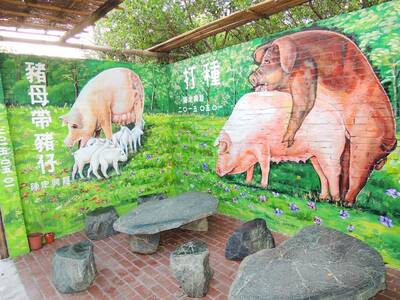
May 6 to May 12 Those who follow the Chinese-language news may have noticed the usage of the term zhuge (豬哥, literally ‘pig brother,’ a male pig raised for breeding purposes) in reports concerning the ongoing #Metoo scandal in the entertainment industry. The term’s modern connotations can range from womanizer or lecher to sexual predator, but it once referred to an important rural trade. Until the 1970s, it was a common sight to see a breeder herding a single “zhuge” down a rustic path with a bamboo whip, often traveling large distances over rugged terrain to service local families. Not only

Ahead of incoming president William Lai’s (賴清德) inauguration on May 20 there appear to be signs that he is signaling to the Chinese Communist Party (CCP) and that the Chinese side is also signaling to the Taiwan side. This raises a lot of questions, including what is the CCP up to, who are they signaling to, what are they signaling, how with the various actors in Taiwan respond and where this could ultimately go. In the last column, published on May 2, we examined the curious case of Democratic Progressive Party (DPP) heavyweight Tseng Wen-tsan (鄭文燦) — currently vice premier

The last time Mrs Hsieh came to Cihu Park in Taoyuan was almost 50 years ago, on a school trip to the grave of Taiwan’s recently deceased dictator. Busloads of children were brought in to pay their respects to Chiang Kai-shek (蔣中正), known as Generalissimo, who had died at 87, after decades ruling Taiwan under brutal martial law. “There were a lot of buses, and there was a long queue,” Hsieh recalled. “It was a school rule. We had to bow, and then we went home.” Chiang’s body is still there, under guard in a mausoleum at the end of a path

Last week the Directorate-General of Budget, Accounting and Statistics (DGBAS) released a set of very strange numbers on Taiwan’s wealth distribution. Duly quoted in the Taipei Times, the report said that “The Gini coefficient for Taiwanese households… was 0.606 at the end of 2021, lower than Australia’s 0.611, the UK’s 0.620, Japan’s 0.678, France’s 0.676 and Germany’s 0.727, the agency said in a report.” The Gini coefficient is a measure of relative inequality, usually of wealth or income, though it can be used to evaluate other forms of inequality. However, for most nations it is a number from .25 to .50


 RSS
RSS