


Did the Kirov Ballet live up to its gilded reputation? Taking a cue from Tim Rice's lyrics for Evita one would have to say: "Yes! And no and yes and no and ?" Well, mostly yes.
There were some spectacular performances -- one of which was enough to bring tears to your eyes -- the technical proficiency of the dancers was amazing, the corps de ballet looked beautiful and graceful and the Kirov Orchestra was in fine form. All too often, however, the emotional connection between the dancers and the music or the story appeared to have been discarded in the drive for style over substance.
But the audiences appeared pleased with the productions and the National Theater looked close to being sold out the two nights that were reviewed.
There was definitely a festive air for the gala opening last week. There was also a lot of security for the president and other top officials who were invited to attend. The evening began with Mikhail Fokine's Chopinana (Les Sylphids) to the music of Frederic Chopin. It's a lovely little ballet and the Kirov's performance was very soft and musical.
This was followed by five short pieces: Le Spectre de la Rose, Talisman, The Dying Swan, Le Coirsaire Pas De Deux and Polovtsian Dances.
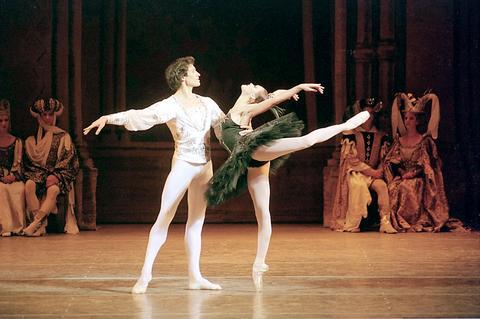
Le Spectre de la Rose is unusual in that it is the male dancer who is the focus of the piece, from the moment he makes his grand jete entrance. When people talk of the amazing arms of the Kirov's dancers, it is usually the women they are talking about. Igor Kolb's arms were amazing -- liquid and languid and hardly real.
Talisman, with Irma Nioradze and Mikhail Lobukhin got off to an uneven start, but picked up speed and finished strongly. This pas de deux is not seen that often. It is all that is left from a ballet by Marius Petipa created in 1889 called Le Talisman.
The highlight of the evening was Uliana Lopatkina as The Dying Swan. She was unbelievable: Six minutes of heartbreaking fluttering, yearning arms, tiny stuttering steps, and deeply arching body. Her arms -- at times floating through the air, at other times bending backwards at amazing angles -- looked so unlike a normal human being's that you would almost swear they really were wings. A last stretch back, a broken wing hanging in the air, and the swan folded herself over her legs, bowed her head and moved no more. It was a performance that could have wrung tears from a stone.
Lopatkina's performance was a hard one to follow, but Alina Somova and Leonid Sarafanov managed a flashy Le Corisaire Pas De Deux. His leaps and spins were right on the mark every time and she nailed her 32 foutettes as if they were nothing. The fast pacing of this piece set the stage for Fokine's Polovtsian Dances, a rousing one-act ballet from the opera Prince Igor by Alexander Borodin. The bare-chested nomadic warriors and exotic dancing girls were ably led by Islom Baimuradow, all fierceness and flash.
The gala finished with the Paquita Grand Pas, which, with its multitude of dainty solos and variations, was a very polished and elegant end to an enjoyable evening and triggered several rousing rounds of applause for the company.
On Saturday night the loudest applause was for the dancers whose roles are unique to Russian productions of Swan Lake: Andrey Ivanov as the jester and Ilya Kuznetsov as the evil magician, Von Rothbart. Ivanov, a short dancer with bulky thighs, has some of the fastest pirouettes ever seen. Fast, confident, and cheeky; just what a good jester ought to be.
Kuznetsov, dressed in black leotard and tights, with small silver-tipped wings and headdress, was made up to look like a very evil owl. He exuded menace. He is a great jumper, though one got the impression that some of his jetes had to be reined in because the depth of the National Theater's stage is not what the Kirov is used to back in St. Petersburg.
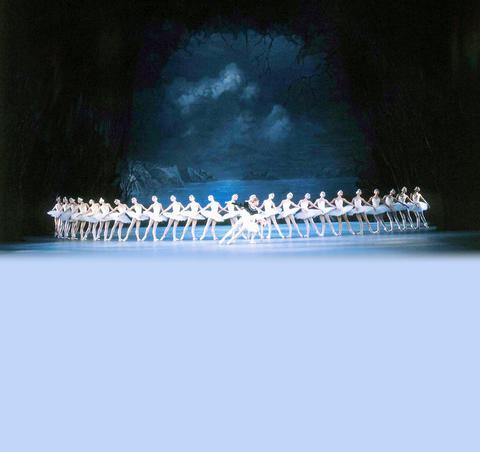
The corps de ballet was a stunning flock of 26 swans with pliant backs and lovely arms that seemed to be so light they couldn't be real. Their arms didn't just move through the air, they caressed it, sifting each mote through their fingers. The four Signets -- Svetlana Ivanova, Elena Yshkouskaya, Yana Khaldina and Elena Sheshina -- were a joy to watch. Very crisp and clean, not a feather out of place, they whipped through their piece if anything just a little too fast. You didn't want it to end.
Sofia Gumerova and Kolb, however, were a bit disappointing as the leads. Gumerova is a tall, regal looking dancer and she moves beautifully as Odette/Odile, combining a sense of strength with one of fragility. But as the White Swan, Odette, Gumerova was all turned inwards, remote.
Kolb is a very accomplished classic dancer, though he looked more at home as the fun-loving prince in Act I than he did as the smitten lover in the rest of the ballet. But there didn't seem to be any spark between him and Gumerova and hardly even much eye contact.
As Odile, the Black Swan, Gumerova was in complete control -- smiling all the while -- even through her 32 foutettes, which were rather sloppy and for a moment in doubt of being completed.
As for the Kirov's happy ending, with the prince tearing off one of Rothbart's wings and killing him, freeing Odette from the curse, it appears to be a rather abrupt and unsatisfactory conclusion.
Not that suicide should be promoted as a way out of an unhappy love affair, but Peter Tchaikovsky's music for this scene calls for more theatrics than a prince waving a piece of cloth around before dashing back to pose with his swan princess.
Hopefully, the younger Kirov dancers will learn that along with all that wonderful technique, you need to spend some time to show some emotion.

“Taiwan’s Opposition Leader Comes to US With a Message Straight Out of Beijing” read a May 31 headline in the Wall Street Journal. Top US administration officials and members of Congress almost certainly read the WSJ, and if there was a bullet point takeaway that people in Washington should absorb ahead of Chinese Nationalist Party (KMT) Chair Cheng Li-wun’s (鄭麗文) arrival in DC on June 9, that headline is it. The last few columns have discussed this very topic, and the timing is not coincidental. While those top officials likely do not read the Taipei Times, judging by the number

With weighty, anxiety-inducing geopolitical topics dominating the headlines, checking in on the wild and weird state of local politics can take some of the edge off. This November’s elections will determine who will be in charge of fixing potholes in your neighborhood, not the potholes in Taiwan’s complicated geopolitical space. Recently, after an online interview with a Taipei-based journalist, I commented that Taipei journalists never go further than the MRT can take them. He laughed and agreed. Naturally, the Taipei mayoral race is eating up much of the press attention. TAIPEI CITY Democratic Progressive Party (DPP) candidate Puma Shen (沈伯洋) has
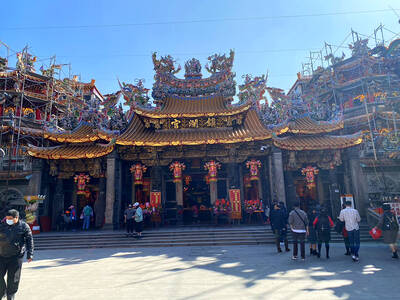
In December of 2008 Lee E-tin (李乙廷), a Miaoli county legislative hopeful, was convicted of vote-buying. Rather than buy votes retail, voter by voter, in the usual manner, Lee had done it wholesale, in a commendably efficient manner: he had visited local temples and made donations to gain their support. Because he did not normally make donations to temples, the court ruled he was attempting to improperly influence voter behavior. The case indicates how important temples are in influencing political life. Both judge and politician appeared to see them in the same way. Beijing sees them that way as well. Democratic Progressive

Audiences in Leicester, Cardiff, London and Sheffield will this month gather to watch a series of black-and-white Taiwanese-language films made more than 70 years ago. On the surface, these screenings commemorate the seventieth anniversary of taiyupian (台語片) — Taiwanese-language cinema. Yet the significance of these events extends far beyond nostalgia or film history. They represent a remarkable chapter in Taiwan’s ongoing effort to recover, preserve and reinterpret a cultural heritage that was once thought to have largely disappeared. The centerpiece of the program is the Ho Chi-ming (何基明) directed Xue Pinggui and Wang Baochuan (薛平貴與王寶釧), a film produced in 1955 and


 RSS
RSS