


Those gathering at Chiang Kai-shek Memorial Hall on Saturday afternoon for the second annual Taiwan Lesbian, Gay, Bisexual, Transgender Pride Parade (台灣同志大遊行) were greeted by admonitions from a Christian group warning homosexuals, "If you do not change your sexuality, you will not enter heaven."
Another group of Christians took a more embracing approach, choosing rather to invite parade-goers to Sunday church services. But while the church took a divided stance, Taiwan's homosexual community chose to unite.

PHOTOS: JULES QUARTLY, TAIPEI TIMES
Organizers estimated around 3,000 people turned up to have their voices heard, their presence felt, and -- because it was a parade -- to fill the streets with music, dancing and bacchanalian revelry.

The parade gathered followers, both gay and straight, as it flowed past 228 Park, a well-known homosexual enclave immortalized in novelist Kenneth Pai's (
One female marcher who joined the party said, "I'm not gay, but I came because I have many gay friends and I want to support them."
Parade organizers from the Taiwan Tongzhi Hotline Association (
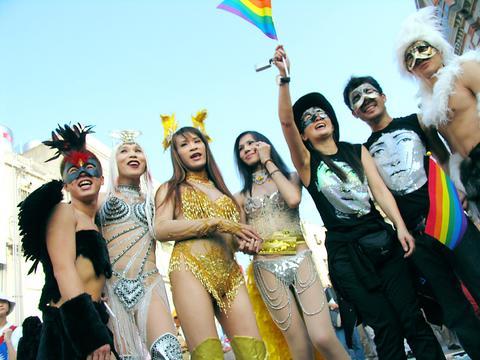
Despite fears of facing the media cameras, many young gays came out of the proverbial closet in order to support the Parade and their community.
"I know my parents might see me, but I think it is also important for me to be here," said one university student attending the parade.
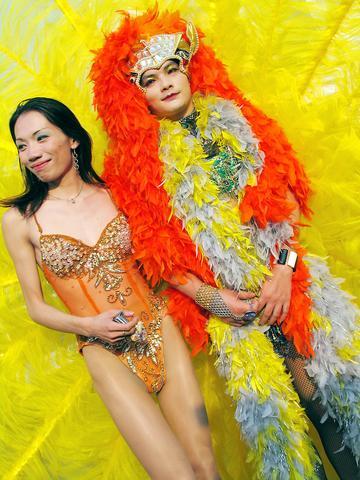
Excited photographers captured images of a small minority of parade goers dressed in various costumes, including a group dressed as the holy figure Kuan Yin, a group of young men called the Waterboys clad in just Speedos, as well as drag queens wearing costume jewelery and thick layers of make-up.
What most photographers did not capture were images of followers carrying an AIDS quilt, or quiet homosexual couples marching hand-in-hand, some boasting legally unrecognized unions outlasting many heterosexual marriages.
The fact that the parade-goers did not encounter much societal disapprobation, save the Christian saviors and the occasional annoyed motorist, might cast Taiwan as a gay-friendly Shangri La.
However, when the Parade spilled into the courtyard outside Red Playhouse in Ximending, two homosexuals from Kaohsiung testified to the contrary, reporting frequent police harassment and gay arrests on trumped-up charges.
This testimonial from the south both underscored Taipei's unique position as a liberal outpost in Taiwan and also the need for similar gatherings that will further shed light on existing discrimination.
Following the sober reminders, organizers attempted to rally the group into repeating various contrived chants of resistance borrowed from similar protests rallies around the world. It was a call to action that did not quite pass muster with the crowd. However, pop-diva Sandy Chen (
Other public figures, including university professors and Taiwanese starlets, taped messages that were broadcast on the large screen across from the Ximending MRT station.
DJ Victor Cheng, who mixed records and led the parade on a truck with a sound system, summed up this year's Pride Parade thus: "When my friends try to compare this parade to larger events in the US, I remind them that this is how parades in the US got their start ... the turnout this year proves that the parade will continue to become stronger."
Last year, 1,000 people participated and the larger-scale event this year may indeed bode well for the Pride Parade's future in Taiwan, yet one attendee took a more jaded and perhaps more realistic view of Taiwan's state of affairs. "Society doesn't have a problem with gay people in the public sphere, but when gays enter the home, when a gay is in their family, that's where they draw the line."
True enough, unlike similar manifestations in New York, San Francisco, or Sydney, one did not catch a glimpse of parents out to support their gay children. But reaching that level of acceptance might be a long-term project, or at least an aspiration for the next Taiwan Pride Parade.
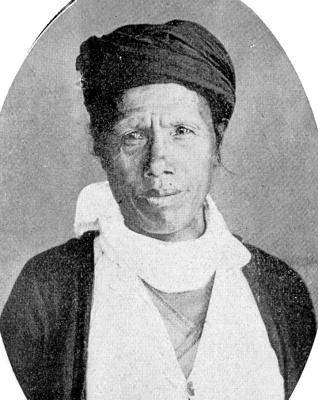
May 11 to May 17 Traversing the southern slopes of the Yushan Range in 1931, Japanese naturalist Tadao Kano knew he was approaching the last swath of Taiwan still beyond colonial control. The “vast, unknown territory,” protected by the “fierce” Bunun headman Dahu Ali, was “filled with an utterly endless jungle that choked the mountains and valleys,” Kano wrote. He noted how the group had “refused to submit to the measures of our authorities and entrenched themselves deep in these mountains … living a free existence spent chasing deer in the morning and seeking serow in the evening,” even describing them as

Yesterday, the Democratic Progressive Party (DPP) nominated legislator Puma Shen (沈伯洋) as their Taipei mayoral candidate, the Chinese Nationalist Party (KMT) put their stamp of approval on Wei Ping-cheng (魏平政) as their candidate for Changhua County commissioner and former legislator Tsai Pi-ru (蔡壁如) of the Taiwan People’s Party (TPP) has begun the process to also run in Changhua, though she has not yet been formally nominated. All three news items are bizarre. The DPP has struggled with settling on a Taipei nominee. The only candidate who declared interest was Enoch Wu (吳怡農), but the party seemed determined to nominate anyone
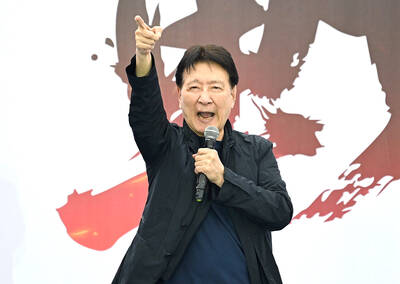
In a sudden move last week, opposition lawmakers of the Chinese Nationalist Party (KMT) and Taiwan People’s Party (TPP) passed a NT$780 billion special defense budget as a preemptive measure to stop either Chinese leader Xi Jinping (習近平) or US President Donald Trump from blocking US arms sales to Taiwan at their summit in Beijing, said KMT heavyweight Jaw Shaw-kong (趙少康), speaking to the Taipei Foreign Correspondents Club on Wednesday night in Taipei. The 76-year-old Jaw, a political talk show host who ran as the KMT’s vice presidential candidate in 2024, says that he personally brokered the deal to resolve
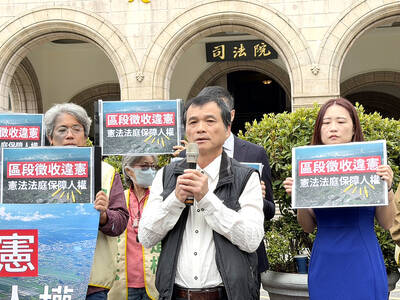
What government project has expropriated the most land in Taiwan? According to local media reports, it is the Taoyuan Aerotropolis, eating 2,500 hectares of land in its first phase, with more to come. Forty thousand people are expected to be displaced by the project. Naturally that enormous land grab is generating powerful pushback. Last week Chen Chien-ho (陳健和), a local resident of Jhuwei Borough (竹圍) in Taoyuan City’s Dayuan District (大園) filed a petition for constitutional review of the project after losing his case at the Taipei Administrative Court. The Administrative Court found in favor of nine other local landowners, but


 RSS
RSS