


As the train speeds under London, the sharp-eyed traveler spies through the window that the darkened tunnel is suddenly wider, and appears to be covered in dusty tiles.
An illusion? No, just one of the city's fabled "ghost stations."
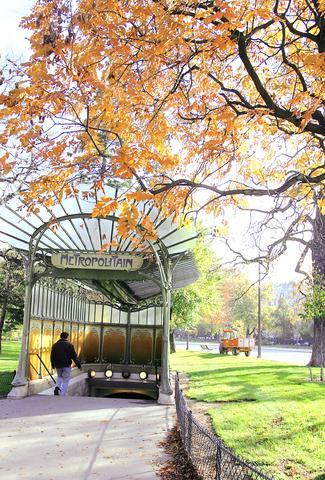
PHOTO: AGENCIES
With a history dating back 141 years and almost 160km of underground track, it is little wonder the London underground network has some phantoms lurking in its subterranean depths.

However few attract more interest than the ghost stations, several dozen stops which were abandoned decades ago through lack of use, or in some cases, never even opened.
A whole sub-culture has grown up around the sealed-off platforms and crumbling staircases, fueled by a mix of genuine historical interest and occasionally wild urban myths about what secrets may lurk under the capital's streets.
Mike Ashworth, curator of infrastructure at the London Transport Museum, used to lead tours around some of the abandoned stations until they were stopped due to safety concerns.
Ashworth says he can well understand the appeal of these long-forgotten corners of the world's oldest subway rail system.
"What you normally associate with underground stations is that they are very familiar places, very well lit and very busy. The main thing you notice about disused stations is the fact that they are very eerie," he said.
"It's a psychological thing -- you're somewhere that's normally very full of people, that isn't."
One of the best-known abandoned stops is Down Street, on the
underground's Piccadilly Line, which opened in 1907 but shut in 1932 as it was sandwiched close between two other central London stops and thus little used.
While the platforms are bricked up, meaning little can be seen as trains rush through, those allowed entry via the still-existing overground station facade enter one of London's most curious historic sites.
In the early days of World War II as German bombs rained down, prime minister Winston Churchill and his ministers used Down Street as an emergency headquarters before a purpose-built bunker was ready.
As well as an ancient telephone exchange and signs pointing to a Committee Room, there is also a tin bathtub popularly referred to as "Churchill's bath".
"It's certainly a suite of rooms which Churchill would have had access to, and used, along with everyone else who was working there," said Ashworth.
Another famous example is Aldwych, a one-stop spur line in the center of the city which saw minimal use before it finally closed in 1994.
Since then, the station's interior has been restored to its original 1907 glory and is hired out for films and parties, while the empty tunnel features regularly in moody pop music videos, one of which reportedly gave the floor its current fine coat of purple glitter.
"The joke is, more people go to Aldwych now it's closed than when it was open," Ashworth said.
Another long-shut station, South Kentish Town, is allegedly haunted by the ghost of a passenger who accidentally alighted at the abandoned platform and was never seen again.
The truth is more prosaic -- shortly after it closed in 1924, a passenger did get off but realized his mistake and got straight back on the same train.
However this story was reported in newspapers and later expanded into a comic tale of a trapped commuter by poet Sir John Betjeman, the presumed source of the ghost legend.
The final conclusion of this tale was garish 1972 British B-movie Death Line, in which the mutant descendants of Victorian workers sealed in an Underground tunnel hunt passengers for food.
Urban myths about the network, popularly known as the Tube, are rife, notes Ashworth.
"Because it's under the ground, and there's this air of mystery and secrecy, people are absolutely convinced that there are things there, which patently are not," he said.
"Particularly after World War II and into the 1950s, when there was a degree of official secrecy about what was down there, all sorts of strange legends grew up."
Perhaps the most common is that of a secret tunnel underneath Buckingham Palace, ready to whisk the royal family away from peril.
It is undermined somewhat by the fact that the one route that goes anywhere near the palace, the Victoria line, was not built until the late 1960s, long after the legend originated.
Even more exotic is a long-established rumor that a secret line runs from the center of London to the Burlington Bunker, a vast post-war underground government complex in the countryside built to house the government in the event of nuclear war.
Again this story seems somewhat unlikely, given that the construction of a deep tunnel the 124 or so kilometers from London would be not only prohibitively expensive, but hard to keep a secret.

In late October of 1873 the government of Japan decided against sending a military expedition to Korea to force that nation to open trade relations. Across the government supporters of the expedition resigned immediately. The spectacle of revolt by disaffected samurai began to loom over Japanese politics. In January of 1874 disaffected samurai attacked a senior minister in Tokyo. A month later, a group of pro-Korea expedition and anti-foreign elements from Saga prefecture in Kyushu revolted, driven in part by high food prices stemming from poor harvests. Their leader, according to Edward Drea’s classic Japan’s Imperial Army, was a samurai

The following three paragraphs are just some of what the local Chinese-language press is reporting on breathlessly and following every twist and turn with the eagerness of a soap opera fan. For many English-language readers, it probably comes across as incomprehensibly opaque, so bear with me briefly dear reader: To the surprise of many, former pop singer and Democratic Progressive Party (DPP) ex-lawmaker Yu Tien (余天) of the Taiwan Normal Country Promotion Association (TNCPA) at the last minute dropped out of the running for committee chair of the DPP’s New Taipei City chapter, paving the way for DPP legislator Su
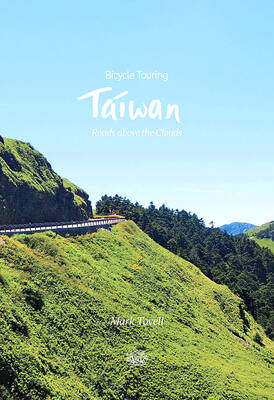
It’s hard to know where to begin with Mark Tovell’s Taiwan: Roads Above the Clouds. Having published a travelogue myself, as well as having contributed to several guidebooks, at first glance Tovell’s book appears to inhabit a middle ground — the kind of hard-to-sell nowheresville publishers detest. Leaf through the pages and you’ll find them suffuse with the purple prose best associated with travel literature: “When the sun is low on a warm, clear morning, and with the heat already rising, we stand at the riverside bike path leading south from Sanxia’s old cobble streets.” Hardly the stuff of your
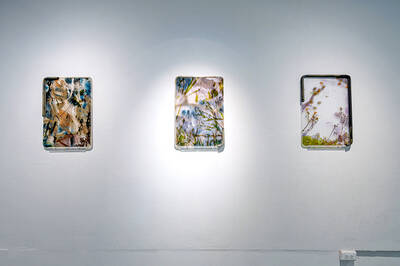
Located down a sideroad in old Wanhua District (萬華區), Waley Art (水谷藝術) has an established reputation for curating some of the more provocative indie art exhibitions in Taipei. And this month is no exception. Beyond the innocuous facade of a shophouse, the full three stories of the gallery space (including the basement) have been taken over by photographs, installation videos and abstract images courtesy of two creatives who hail from the opposite ends of the earth, Taiwan’s Hsu Yi-ting (許懿婷) and Germany’s Benjamin Janzen. “In 2019, I had an art residency in Europe,” Hsu says. “I met Benjamin in the lobby


 RSS
RSS