


I have met the Dalai Lama once. It was during his last visit to Taipei and I was particularly lucky to have what was in effect a private chat with him -- maybe I should say an "audience." After some affable introductory exchanges, I asked him my big question. "Do you really think," I asked, "that you can prevent earthquakes?"
It had been reported in advance that rituals would be performed in Nantou County to protect the population from another disaster like the one of September 1999. His initial reaction was to burst out laughing. The Dalai Lama often laughs and makes jokes and some people think it's a characteristically Tibetan way of looking at things. At that Taipei press conference, he kept bringing a cup of tea up to his lips, smiling at the banks of cameramen who got ready to photograph him drinking it, then laughing as he put the cup down, without drinking. It was a ritual he went through while something he'd said was being translated and he clearly thought it added to the general gaiety of occasion.
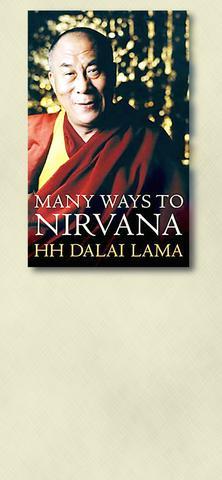
The many ways to nirvana
After pointing out that he himself wouldn't be conducting the rite in question, but that its main aims were to "clear the air" and to assist the souls of those who'd died in 1999, he countered my skeptical rationalism by saying that, even if the ritual did no good, at least it couldn't do any harm. It struck me at the time that this was a modest assertion from someone who many of his followers believe to be a mage with the power to bring off near-miracles when the need arises.
This book is made up of four addresses delivered in India between 1999 and last year, plus one other of uncertain date. They're quite short, and are followed by questions. (Even the Buddha, he points out, gave his followers permission to question his words). The Dalai Lama's answers are often interesting. Someone asks about terrorism and he answers that, in the long term, the only answer is dialogue, compassion and understanding. Someone else asks about the possessiveness some people have toward him and he replies that it doesn't affect him, and he's simply a being made up of earth, wind, water and fire. "I am just sitting here," he says.
But as this book demonstrates, the Dalai Lama is a powerful and benign personality, independent in many matters, and much more than a mere pawn in the game of international politics. For someone who was chosen shortly after birth by means of a variety of signs and portents few of us would set any store by in ordinary circumstances, he's an extraordinarily wise human being and a powerful force for good.
This book was first published by Penguin Books India, and the audience the Dalai Lama has in mind is essentially an Indian one. As he remarks at one point, he has lived in India for 41 years (he was speaking in 2001) and he defends his friendly attitude to Hinduism -- not always shared by fellow Buddhists, he says. He does make some critical comments about caste, but goes on to point out that at the Hindu festival at Kumbha Mela, 25 million people gathered without a single animal being killed for food. "If 10,000 Tibetans gathered, I think the butchers would be very busy. A bit unfortunate." He's trying to promote vegetarianism, he says. Earthquakes feature here too -- his 2001 address followed a major one in Gujarat.
Spiritual books are frequently hard-going for the ordinary reader. In common with Christian handbooks, this one talks about perfection, concentration and so on, but also deals extensively with the characteristic Buddhist practices of meditation and the pursuit of "emptiness." Elsewhere he remarks that Buddhists can't accept a creator because they don't see how a creator could occur in the first place.
In answer to another question elsewhere, the Dalai Lama states his belief that there can probably never be one world religion, and that the different faiths all have much to offer.
There are some difficult technical passages, such as this one: "The grosser level of impermanence refers to transitory states of a particular object in the sense of disintegration of its continuity. When we talk about subtle impermanence, it is more in the sense of momentary disintegration rather than disintegration in terms of its continuity." Luckily, they aren't typical.
Popes and Dalai Lamas haven't usually taken to setting down their wisdom in cold print. But, the two present incumbents have each been responsible for several books. This is slightly perplexing, given that their strength would appear to lie in the cabalistic secrets they alone have access to. To explain these mysteries in paperback pages might run the risk of their being analyzed and refuted by their enemies. During the 19th century, Buddhism and Roman Catholicism alike were frequently derided as enemies of science, and hence of progress. More recently, they came back into favor, probably because they were perceived as bulwarks against communism.
The Dalai Lama is understandably a great friend of Taiwan, even though on his last visit a party of what looked like aged KMT soldiers and their wives lined up with placards at the airport (the wrong airport as it turned out) demanding that he go away and recognize a "one China" that included Tibet. But I doubt if such people would have very much interest in the contents of this book, whatever their political stance.

In late October of 1873 the government of Japan decided against sending a military expedition to Korea to force that nation to open trade relations. Across the government supporters of the expedition resigned immediately. The spectacle of revolt by disaffected samurai began to loom over Japanese politics. In January of 1874 disaffected samurai attacked a senior minister in Tokyo. A month later, a group of pro-Korea expedition and anti-foreign elements from Saga prefecture in Kyushu revolted, driven in part by high food prices stemming from poor harvests. Their leader, according to Edward Drea’s classic Japan’s Imperial Army, was a samurai

The following three paragraphs are just some of what the local Chinese-language press is reporting on breathlessly and following every twist and turn with the eagerness of a soap opera fan. For many English-language readers, it probably comes across as incomprehensibly opaque, so bear with me briefly dear reader: To the surprise of many, former pop singer and Democratic Progressive Party (DPP) ex-lawmaker Yu Tien (余天) of the Taiwan Normal Country Promotion Association (TNCPA) at the last minute dropped out of the running for committee chair of the DPP’s New Taipei City chapter, paving the way for DPP legislator Su
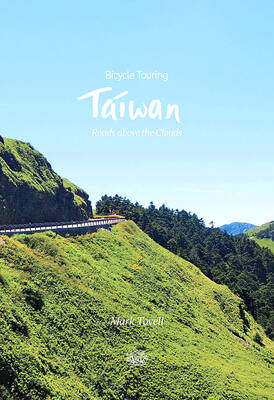
It’s hard to know where to begin with Mark Tovell’s Taiwan: Roads Above the Clouds. Having published a travelogue myself, as well as having contributed to several guidebooks, at first glance Tovell’s book appears to inhabit a middle ground — the kind of hard-to-sell nowheresville publishers detest. Leaf through the pages and you’ll find them suffuse with the purple prose best associated with travel literature: “When the sun is low on a warm, clear morning, and with the heat already rising, we stand at the riverside bike path leading south from Sanxia’s old cobble streets.” Hardly the stuff of your

Located down a sideroad in old Wanhua District (萬華區), Waley Art (水谷藝術) has an established reputation for curating some of the more provocative indie art exhibitions in Taipei. And this month is no exception. Beyond the innocuous facade of a shophouse, the full three stories of the gallery space (including the basement) have been taken over by photographs, installation videos and abstract images courtesy of two creatives who hail from the opposite ends of the earth, Taiwan’s Hsu Yi-ting (許懿婷) and Germany’s Benjamin Janzen. “In 2019, I had an art residency in Europe,” Hsu says. “I met Benjamin in the lobby


 RSS
RSS