


One short flight for man, or the start of a long voyage for rich men.
That's one way of looking at Monday's historic jaunt of the revolutionary spacecraft SpaceShipOne, which crossed the brink of space for the second time in six days. The achievement enabled the spacecraft's team to claim the US$10 million Ansari X prize and prove its viability as the prototype for the first commercial space liner.
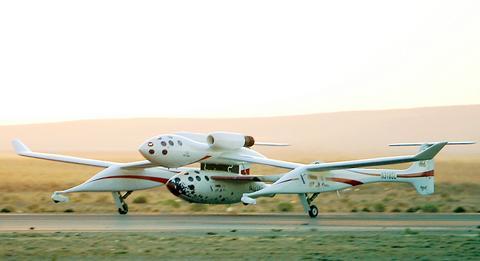
PHOTOS: AP
"This is a milestone for humanity," said John Spencer, president of the Space Tourism Society in Los Angeles. He told Space.com that the flight represented "the kickoff of the space tourist industry."
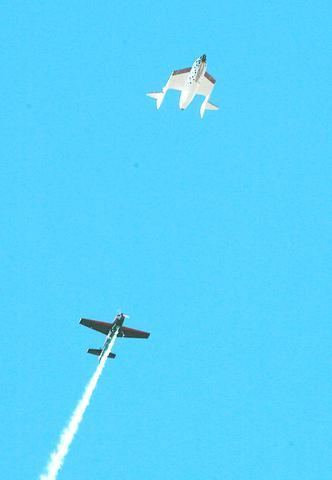
PHOTO: AP
But don't get your flight suit out of the closet just yet, unless you have a large appetite for risk and adventure and an even larger bank account.
Although the flight was completed without glitches, the previous mission five days earlier was marked by a series of almost 30 rolls. That's enough to induce motion sickness among even those with stomachs of steel. Even the standard re-entry procedure subjected the pilot's body to five time the force of gravity.
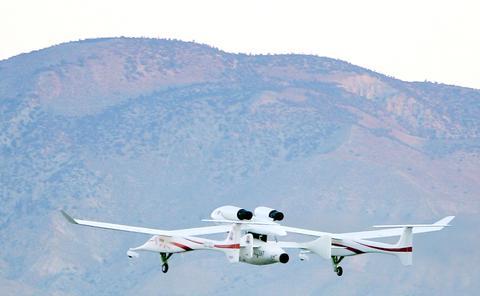
But for those hardy individuals perpetually looking to cross the next frontier, these risks are but minor inconveniences on the way to realizing the lifelong dream of flying through space and experiencing the surreal sensation of life unbounded by the pull of earth's gravity.
Adventurer and entrepreneur Richard Branson has already booked his place on a suborbital space flight, paying up to US$15 million to license the SpaceShipOne technology as the basis for his own fleet of space-liners, which will fly under the banner of his newly formed company Virgin Galactic. The expected price of a ticket will be some US$175,000 per trip, which, if it is similar to Monday's flight, would last about 90 minutes.
Branson might have some cheaper competition, however.
Just minutes after SpaceShipOne touched down, a company called Space Adventures was busy calling prospective clients and journalists, offering them the chance of a ride in the record-breaking craft for just US$102,000, including four days of training.
There are also numerous other teams work to build reusable, commercially viable space craft capable of carrying passengers to the edge of space. They vowed, after the flight, to keep developing their vehicles, even though SpaceShipOne looked to have claimed the US$10 million prize.
At least 24 teams were working on spaceships to win the prize. Many see the opening of the space frontier as lucrative enough to justify their investments, even without the incentive of the X Prize.
"I think you'll see the first Canadian, the first Russian, the first British, the first Romanian -- all the X Prize teams outside the US will continue their work to become the first of their nation to carry out a first private flight into space," said X Prize founder Peter Diamandis.
Brian Feeney, who leads a rival X Prize effort called the da Vinci Group, said that he was determined to continue.
"We're moving our program as fast as we can," Feeney said. "We'll announce a launch date in a short period of time."
Ultimately, however, the true value of the success may not lie in ferrying space fans for a brief jaunt into the blackness but in developing revolutionary new techniques that can carry the scientific exploration of space to a new level.
The SpaceShipOne project cost less than US$30 million to plan, develop and execute, less than a 10th of what it costs the US government space agency NASA for a single, US$500 million space shuttle launch.
Given the recent setbacks faced by government space agencies: the twin failures of two unmanned expeditions to Mars, the loss of the space shuttle, and just this week, the failure of the oxygen system on the International Space Station, new ways of approaching the scientific and engineering challenges of space travel are badly needed.
SpaceShipOne designer Burt Rutan clearly believes the private space industry is at a watershed.
"The big guys, the Boeings, the Lockheeds and the nay-saying people at (NASA headquarters) Houston ... I think they are looking at each other now and saying, `We're screwed,'" Rutan said.
The next major step may be prompted by the US$50 million American Space Prize, to be given for the first privately funded, reusable space ship able to carry seven people into orbit. Such a craft would have huge commercial value for the satellite industry.
With the likes of Rutan eyeing the prize, it could be won faster than many people imagine.
A brilliant and original thinker, famous for designing aircraft that reimagine the possibilities of flight, Rutan previously designed and built the Voyager, the spindly craft that in 1985 was the first to fly non-stop around the world without refueling.
Now, even in the glare of Monday's success, Rutan was still thinking about pushing the envelope even further.
"What you've seen here is a research and development program to look at new ideas on how manned spacecraft can really be significantly safer, and there will be new ideas out there," Rutan said. "We will be developing new ideas also on
SpaceShipTwo."
The final frontier
▲ The X prize was inspired by Charles Lindberg's solo, non-stop transatlantic flight in 1927 and is a US$10 million prize awarded to the first spacecraft built with private funds to carry a pilot and the weight of two passengers 100km above the earth. It was won by SpaceShipOne after Monday's flight.
▲ It was established in 1996 by space enthusiasts keen to kick-start an era of affordable, private space travel, which would resemble the commercial air industry.
▲ The first space tourist was US businessman Dennis Tito who paid a reported US$20 million to ride on a Russian rocket to the International Space Station in April 2001. The second, a year later, was a South African Internet millionaire, Mark Shuttleworth.
▲ Space Adventures, a company based in Arlington, Virginia, say it has over 100 people registered who are willing to pay US$100,000 for suborbital flights, if they become available.
▲ Some budding companies are building their business around rockets that do other work in space, such as launching satellites, with passenger flight as a possible spin-off. There may even be high-speed suborbital flights from New York to Tokyo.
Source: news@nature.com
May 6 to May 12 Those who follow the Chinese-language news may have noticed the usage of the term zhuge (豬哥, literally ‘pig brother,’ a male pig raised for breeding purposes) in reports concerning the ongoing #Metoo scandal in the entertainment industry. The term’s modern connotations can range from womanizer or lecher to sexual predator, but it once referred to an important rural trade. Until the 1970s, it was a common sight to see a breeder herding a single “zhuge” down a rustic path with a bamboo whip, often traveling large distances over rugged terrain to service local families. Not only
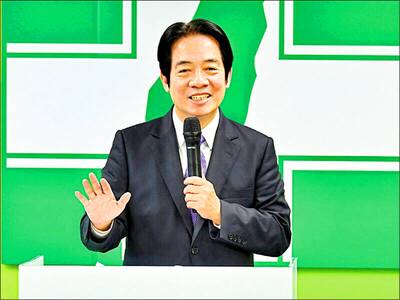
Ahead of incoming president William Lai’s (賴清德) inauguration on May 20 there appear to be signs that he is signaling to the Chinese Communist Party (CCP) and that the Chinese side is also signaling to the Taiwan side. This raises a lot of questions, including what is the CCP up to, who are they signaling to, what are they signaling, how with the various actors in Taiwan respond and where this could ultimately go. In the last column, published on May 2, we examined the curious case of Democratic Progressive Party (DPP) heavyweight Tseng Wen-tsan (鄭文燦) — currently vice premier
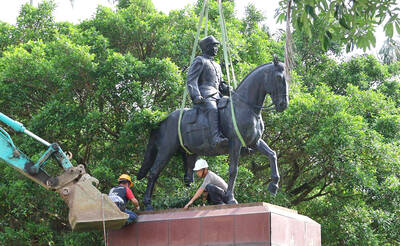
The last time Mrs Hsieh came to Cihu Park in Taoyuan was almost 50 years ago, on a school trip to the grave of Taiwan’s recently deceased dictator. Busloads of children were brought in to pay their respects to Chiang Kai-shek (蔣中正), known as Generalissimo, who had died at 87, after decades ruling Taiwan under brutal martial law. “There were a lot of buses, and there was a long queue,” Hsieh recalled. “It was a school rule. We had to bow, and then we went home.” Chiang’s body is still there, under guard in a mausoleum at the end of a path

Last week the Directorate-General of Budget, Accounting and Statistics (DGBAS) released a set of very strange numbers on Taiwan’s wealth distribution. Duly quoted in the Taipei Times, the report said that “The Gini coefficient for Taiwanese households… was 0.606 at the end of 2021, lower than Australia’s 0.611, the UK’s 0.620, Japan’s 0.678, France’s 0.676 and Germany’s 0.727, the agency said in a report.” The Gini coefficient is a measure of relative inequality, usually of wealth or income, though it can be used to evaluate other forms of inequality. However, for most nations it is a number from .25 to .50


 RSS
RSS