


Philip Short took four years to write this biography, after completing his much-praised life of Mao Zedong (毛澤東) in 1999. He has trawled deep and wide, reading what are probably just about all the written sources, but also interviewing the surprisingly large number of surviving and accessible former Khmer Rouge leaders.
Comparisons with Mao are inevitable. Despite the fact that, as Short claims, more of China's citizens died as a direct result of Mao's rule than have died under the rule of any leader in history, Mao's life has a heroic dimension that Pol Pot's cannot claim. Mao, for all his egregious faults, invites comparison with other revolution-consolidating figures such as Washington and Napoleon. Pol Pot's rule had no such dimensions. Instead, his small country has become a by-word for senseless extermination and his reign put the final nail worldwide into the coffin of communism as a credible ideal.
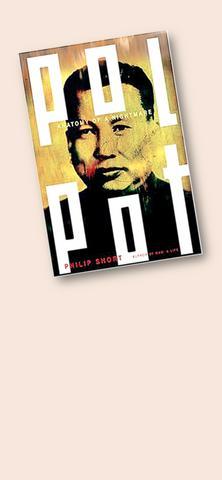
Short insists that it was French Marxism that underpinned Khmer Rouge ideology. Pol was a student in Paris, arriving on Oct. 1, 1949, the very day Mao stood at the Gate of Heavenly Peace in Beijing and announced the foundation of the People's Republic of China. At that time he had no political interests and was obsessed only with his new girlfriend. But a discussion group was formed, for Cambodian students focusing on liberation from colonial rule and its roots lay in Marxist theory. (In the early 1950s some 25 percent of the French electorate voted communist, more than for any other political grouping). Thus, when Phnom Penh was devastatingly emptied of its inhabitants in April 1975, it was the Paris Commune of 1871 that Pol cited, saying it had been overthrown because the proletariat had failed to exercise dictatorship over the bourgeoisie, and he wasn't going to repeat the mistake.
Unlike William Shawcross in Sideshow: Kissinger, Nixon and the Destruction of Cambodia,(1991), Short doesn't believe massive US bombing was a direct cause of the brutality of the Khmer Rouge regime, though he agrees three times the tonnage of bombs was dropped on Cambodia than was dropped on Japan in World War II, atom bombs included. Instead, it had other causes -- a traditional Khmer belief in fate and the doomed nature of the weak, the Khmer Rouge soldiers' extreme youth and lack of education (some believed Phnom Penh's Western-style toilets were wells for drinking water), their knowledge that to hold back might bring rebuke whereas going too far would never be censured, and so on.
Nevertheless, horror certainly prevailed. When the film The Killing Fields was being made, Cambodians shown preliminary footage insisted that things had in reality been much worse. The filmmakers didn't make any changes, however, saying that if they did, audiences simply wouldn't believe it.
As for his interview material, some analysts have insisted on disbelieving anyone implicated in the nightmare. Short, though, argues that most are likely to be telling the truth when there are no indications to the contrary. He became adept in seeing when his questions were considered too probing and evasions ensued, and generally accepts what he was told up to that point.
A concept that recurs throughout the book is the divide in Asia between the Chinese-influenced, essentially Confucian territories and the Indian-influenced, Theravada Buddhist, ones. In the region, Vietnam belongs to the first group, Cambodia, together with Thailand and Laos, to the second. Asian Marxism, as formulated by Mao, was in essence a Chinese construct, Short says, and things were inevitably different in Cambodia -- a medieval society whose peasants couldn't conceive of another successful rice harvest after the deposition of the god-king Sihanouk.
The 20th century produced many political monsters, and the public has largely been happy to account for them simply in terms of "evil," Hitler, Stalin and Pol Pot are frequently written off as deranged individuals out of a horror movie who somehow managed to obtain real power. But they too had their ideals. Hitler dreamed of a Germany populated by flaxen-haired vegetarians in rose-covered cottages who painted landscapes and listened to Wagner. And Pol Pot was a mild-mannered man with a winning smile who first wanted independence from France, then came to believe in a fundamentalist Marxism rooted in the soil as the only way to recover the greatness that had produced Angkor Wat.
Philip Short's qualities are a lack of dogmatism and a sage international perspective. He points out, for instance, that after the fall of the pro-German Vichy government in France in 1945, the number of revenge killings of collaborators was proportionally similar to those in Cambodia after the fall of Lon Nol. All totalitarian regimes torture and kill their opponents, he writes elsewhere, and all soldiers are trained to ignore pity. If he has a general theory, it is that Cambodia was not an aberration, but rather a society where malign forces present in other places collided with particular intensity.
Pol Pot is both comprehensive and highly readable. Experts in the field point to earlier works on Pol such as Nyan Chander's Brother Enemy (1986), but Short's humane account looks set to stand close to the cutting-edge in this daunting, but inevitably thought-provoking, historical territory.

In late October of 1873 the government of Japan decided against sending a military expedition to Korea to force that nation to open trade relations. Across the government supporters of the expedition resigned immediately. The spectacle of revolt by disaffected samurai began to loom over Japanese politics. In January of 1874 disaffected samurai attacked a senior minister in Tokyo. A month later, a group of pro-Korea expedition and anti-foreign elements from Saga prefecture in Kyushu revolted, driven in part by high food prices stemming from poor harvests. Their leader, according to Edward Drea’s classic Japan’s Imperial Army, was a samurai

The following three paragraphs are just some of what the local Chinese-language press is reporting on breathlessly and following every twist and turn with the eagerness of a soap opera fan. For many English-language readers, it probably comes across as incomprehensibly opaque, so bear with me briefly dear reader: To the surprise of many, former pop singer and Democratic Progressive Party (DPP) ex-lawmaker Yu Tien (余天) of the Taiwan Normal Country Promotion Association (TNCPA) at the last minute dropped out of the running for committee chair of the DPP’s New Taipei City chapter, paving the way for DPP legislator Su
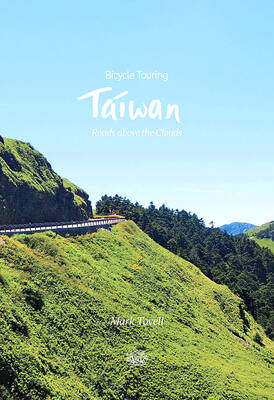
It’s hard to know where to begin with Mark Tovell’s Taiwan: Roads Above the Clouds. Having published a travelogue myself, as well as having contributed to several guidebooks, at first glance Tovell’s book appears to inhabit a middle ground — the kind of hard-to-sell nowheresville publishers detest. Leaf through the pages and you’ll find them suffuse with the purple prose best associated with travel literature: “When the sun is low on a warm, clear morning, and with the heat already rising, we stand at the riverside bike path leading south from Sanxia’s old cobble streets.” Hardly the stuff of your
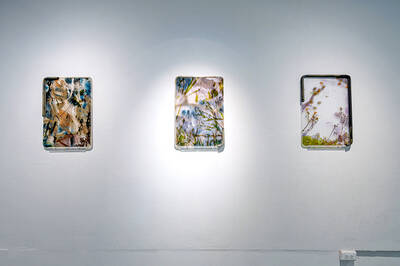
Located down a sideroad in old Wanhua District (萬華區), Waley Art (水谷藝術) has an established reputation for curating some of the more provocative indie art exhibitions in Taipei. And this month is no exception. Beyond the innocuous facade of a shophouse, the full three stories of the gallery space (including the basement) have been taken over by photographs, installation videos and abstract images courtesy of two creatives who hail from the opposite ends of the earth, Taiwan’s Hsu Yi-ting (許懿婷) and Germany’s Benjamin Janzen. “In 2019, I had an art residency in Europe,” Hsu says. “I met Benjamin in the lobby


 RSS
RSS