


In 1662, Zheng Cheng-gong (鄭成功), also known as Koxinga, (國姓爺) defeated the Dutch in Taiwan and ended 38 years of colonization in Taiwan. Three-hundred-and-forty-two years later, in 2002, during a World Cup Baseball match, when Taiwan was playing against the Netherlands, a group of local fans held up a portrait of Koxinga and shouted, "Go! Go! Taiwan!"
Koxinga's triumph is strongly emphasized in Taiwanese history books, so much so that the facts of 17th century Dutch rule have became an unknown past.

PHOTO COURTESY OF RADIO TAIWAN INTERNATIONAL
For example, few know that Anping Castle (安平古堡) in Tainan City was actually the southern face of the exterior wall of Fort Zeelandia, which the Dutch spent 20 years building. The special relations between Dutch missionaries and Taiwan Aboriginal groups are also little known.
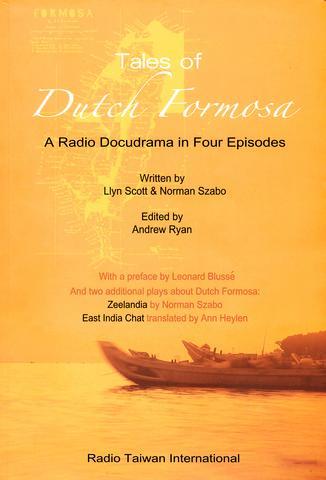
Tales of Dutch Formosa, produced by Radio Taiwan International (中央廣播電台), is the first English-speaking radio drama about Taiwan's history and Aboriginal people, to deal with this period of Taiwan history.
The drama was first produced and broadcast on Aug. 16 two years ago. It was well-received and was broadcast again last year.
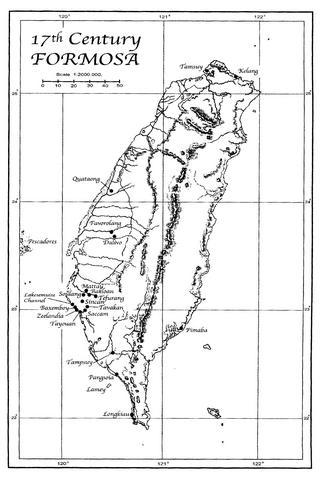
In the hope of further disseminating the history of Taiwan in the 17th century, the drama has become a language-teaching textbook. Radio Taiwan International made the script and radio drama into an album of four CDs and a book. The album was launched last Friday.
Tales of Dutch Formosa was written by Llyn Scott and Norman Szabo. Scott, a professor in the English Department at Fu Jen Catholic University, is also the director of the drama. Andrew Ryan, a radio program host took charge of the editing of the book, recording and sound engineering for the album.
"In Taiwan, it is rare to see a film or drama about its historical past. I hope the readers can see the radio drama as the gold pendant hung on the neck of Domingo Aguilar, the Spanish adventurer in Taiwan in the 17th century. We hope that the production of the program is like the lure of the gold pendant, attracting more people to come together and explore the undiscovered gold mine that is the history of Dutch Formosa," Llyn Scott said, at the launch of the book.
Tales of Dutch Formosa starts in 1624, when the Dutch East India Company set up a trading center in what is now the Tainan area. The story focuses on the interaction between Dutch governors, missionaries and Taiwanese Aboriginal people.
There are stories about the Dutch missionaries setting up schools and teaching Aborigines how to read and write using the Roman alphabet, as well as teaching them to recite prayers, the articles of faith and sing psalms.
There are also depictions of Aboriginal rituals, which were seen as uncivilized and evil in the eyes of the ministers. For example, one of the Aboriginal beliefs was that women should not give birth to a baby before the age of 35. Abortions were therefore common practice in the villages. The missionaries attempt to convince the villagers about the sinful nature of abortions.
There are, of course, scenes of battle, such as when Koxinga attacked the fort of Zeelandia. With fires burning the city, missionaries saw the Aborigines, their former students, helping the Chinese and fired on them.
Tsao Yung-ho (曹永和), a historian at Academia Sinica and an expert on Taiwan-Dutch relations during Dutch rule, praises Tales of Dutch Formosa. He said the new information helps reconstruct a new historical perspective on Taiwan's history.
"What we know about Taiwan history is mainly the history after the Qing Dynasty. We know little about the history before that [time]. That was a period when the Dutch beat the Spaniards and established their power in Taiwan. It was also a time of sea expeditions and the Protestants took over Taiwan after the Catholics," Tsao said at the press conference.
He said the Dutch built up different relations with the residents of Taiwan. With the Han people who had migrated from China, it was basically an economic partnership and the Chinese were made to pay taxes. "With the Aborigines, however, it was a deeper relationship. The Dutch were teachers, governors and moral instructors to the native villagers," Tsao said. "This was a special relationship between the Dutch and the Aborigines. This made the Aborigines more difficult to tame, even after Koxinga and the other Han rulers who came later to Taiwan," Tsao said.
Tales of Dutch Formosa is a radio drama full of music and sound effects. The album recruits famous Puyuma singer Samingad (紀曉君) to sing songs from Aboriginal ceremonies. The program also recruits 17 musicians who perform the background music.
For more information about purchasing the program, contact Radio Taiwan International. Tel: (02) 2885 6168 # 731 or go to www.cbs.org.tw.

In late October of 1873 the government of Japan decided against sending a military expedition to Korea to force that nation to open trade relations. Across the government supporters of the expedition resigned immediately. The spectacle of revolt by disaffected samurai began to loom over Japanese politics. In January of 1874 disaffected samurai attacked a senior minister in Tokyo. A month later, a group of pro-Korea expedition and anti-foreign elements from Saga prefecture in Kyushu revolted, driven in part by high food prices stemming from poor harvests. Their leader, according to Edward Drea’s classic Japan’s Imperial Army, was a samurai

The following three paragraphs are just some of what the local Chinese-language press is reporting on breathlessly and following every twist and turn with the eagerness of a soap opera fan. For many English-language readers, it probably comes across as incomprehensibly opaque, so bear with me briefly dear reader: To the surprise of many, former pop singer and Democratic Progressive Party (DPP) ex-lawmaker Yu Tien (余天) of the Taiwan Normal Country Promotion Association (TNCPA) at the last minute dropped out of the running for committee chair of the DPP’s New Taipei City chapter, paving the way for DPP legislator Su
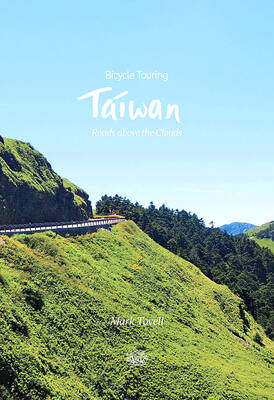
It’s hard to know where to begin with Mark Tovell’s Taiwan: Roads Above the Clouds. Having published a travelogue myself, as well as having contributed to several guidebooks, at first glance Tovell’s book appears to inhabit a middle ground — the kind of hard-to-sell nowheresville publishers detest. Leaf through the pages and you’ll find them suffuse with the purple prose best associated with travel literature: “When the sun is low on a warm, clear morning, and with the heat already rising, we stand at the riverside bike path leading south from Sanxia’s old cobble streets.” Hardly the stuff of your

Located down a sideroad in old Wanhua District (萬華區), Waley Art (水谷藝術) has an established reputation for curating some of the more provocative indie art exhibitions in Taipei. And this month is no exception. Beyond the innocuous facade of a shophouse, the full three stories of the gallery space (including the basement) have been taken over by photographs, installation videos and abstract images courtesy of two creatives who hail from the opposite ends of the earth, Taiwan’s Hsu Yi-ting (許懿婷) and Germany’s Benjamin Janzen. “In 2019, I had an art residency in Europe,” Hsu says. “I met Benjamin in the lobby


 RSS
RSS