


Personal Digital Assistants (PDA) have become the mobile generation's Swiss army knives. Whether they look and act more like a cellphone, Walkman, or Gameboy, palmtop or handheld computers are a far cry from the appointment book replacements they once were.
These days they tackle tasks like GPS navigation in automobiles or act as remote controls for stereo systems, even as a new breed of smart phones have blurred the line between computer and cellphone. Yet those looking to buy one of these pocket giants should think carefully about what kind of device they need.
"The classical PDA is in danger of extinction. Smart phones are the trend right now," says Sony's Myriam Hoffmann. Newer Smart phones can do everything a PDA can while replacing the old fashioned cellphone.
Yet customers need to think about whether they want one device for everything, or whether they'd be better served with several devices that do their jobs supremely well.
This means, for example, that the average cellphone users doesn't need to carry around a virtual briefcase when the working day is done. Size plays an important role here, since some of these devices are big enough to leave a bulge in your jacket pocket.
"Intelligent cellphones" have already moved past the PDA on the market. The share of smart phones among mobile devices in Europe climbed in the first quarter of this year from 35 percent to 63 percent compared year to last year, according to the British marketing research firm Canalys. The percentages for handhelds sank from 40 percent to 29 percent during that same period.
That's no surprise, since smart phones are being offered for steep discounts by cellular service providers. Users who sign a service contract can receive one for little more than the service contract itself.
Sony has been one of the first to react to this trend, halting production of its Clio line of PDAs on the European and North American markets.
The modern crop of palmtop computers are genuine multimedia do-it-alls, says Steffen Hinze, a sales associate at the German electronics chain Mediamarkt.
Current handhelds can run office applications in the place of notebook computers, he notes. Many models also offer dictation devices. Pop-out keyboards such as on the Nokia Communicator 9500 and expandable displays, as with the Tungsten T3 from PalmOne, make usage even easier.
More than a few handhelds also offer a built-in digital camera for taking snapshots and video sequences. Many of the devices also serve as an MP3 player for music on the go.
Even video playback is possible: With the proper software, DVD films can be compressed into handheld computer format.
There is also a wide range of games available for PDAs. Fans of Lara Croft of Tomb Raider fame can guide her through handheld-sized labyrinths.
With processor speeds of up to 400 megahertz and high-resolution displays with color TFT touch screens, the playing enjoyment is comparable with that of a PC, Hinze says. Toshiba's e800 even offers VGA resolution on its PDA monitor.
PDAs run the gamut in terms of price and options. Introductory models like the Palm Zire can be found for under US$100. Multimedia functions appear in devices for as little as US$250. But there's seemingly no limit to how high prices can go. The magnesium casing on Panasonic's CF-P1MK2 is intended to survive falls, dust and splashing water. To pay for all that technology, the device retails at more than US$1,900.
The pre-installed operating systems are also varied: While PDAs usually use the mini-Windows system Pocket PC and Palm OS, most smart phones use the Symbian operating system.
Storage capacity runs from 16 megabytes to 128 megabytes, usually expandable with flash storage cards. Customers should take a look at which kinds of media will work with which devices: While classic PDAs often use the CompactFlash format, already the most widely available, smart phones often use Secure Digital storage or Multimedia cards. Sony customers, by contrast, are forced to by Sony's proprietary Memory Stick format.
Many models can also surf wirelessly on the Internet, says Patrizia Incardona, who runs a Web site devoted to PDAs. The MDA II from T-Mobile, for example, offers an integrated Bluetooth port, while the Pocket Loox 610 from Fujitsu Siemens is equipped with Wireless LAN.
Another alternative is to use a GPRS connection, although that connection is much slower, Incardona reminds. A PDA can even serve as a car navigation system, if outfitted with a GPS receiver.
When buying a PDA, customers should look for devices with long battery life, Incardona reports. Wireless and multimedia applications use a lot of energy, meaning that many devices need recharging after only one day.
A replacement battery is a wise investment. In a few years, PDAs will probably be able to function as televisions by receiving terrestrial digital signals, says Hinze.
The rapid development of the mini computer does have its downside, though. Just recently the first smart-phones virus was identified. Users need to think not only of the fun side of their devices, but about security as well.

In late October of 1873 the government of Japan decided against sending a military expedition to Korea to force that nation to open trade relations. Across the government supporters of the expedition resigned immediately. The spectacle of revolt by disaffected samurai began to loom over Japanese politics. In January of 1874 disaffected samurai attacked a senior minister in Tokyo. A month later, a group of pro-Korea expedition and anti-foreign elements from Saga prefecture in Kyushu revolted, driven in part by high food prices stemming from poor harvests. Their leader, according to Edward Drea’s classic Japan’s Imperial Army, was a samurai

The following three paragraphs are just some of what the local Chinese-language press is reporting on breathlessly and following every twist and turn with the eagerness of a soap opera fan. For many English-language readers, it probably comes across as incomprehensibly opaque, so bear with me briefly dear reader: To the surprise of many, former pop singer and Democratic Progressive Party (DPP) ex-lawmaker Yu Tien (余天) of the Taiwan Normal Country Promotion Association (TNCPA) at the last minute dropped out of the running for committee chair of the DPP’s New Taipei City chapter, paving the way for DPP legislator Su
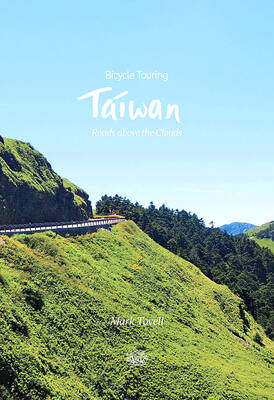
It’s hard to know where to begin with Mark Tovell’s Taiwan: Roads Above the Clouds. Having published a travelogue myself, as well as having contributed to several guidebooks, at first glance Tovell’s book appears to inhabit a middle ground — the kind of hard-to-sell nowheresville publishers detest. Leaf through the pages and you’ll find them suffuse with the purple prose best associated with travel literature: “When the sun is low on a warm, clear morning, and with the heat already rising, we stand at the riverside bike path leading south from Sanxia’s old cobble streets.” Hardly the stuff of your
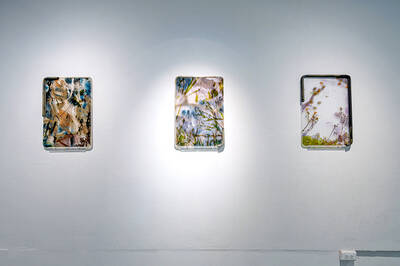
Located down a sideroad in old Wanhua District (萬華區), Waley Art (水谷藝術) has an established reputation for curating some of the more provocative indie art exhibitions in Taipei. And this month is no exception. Beyond the innocuous facade of a shophouse, the full three stories of the gallery space (including the basement) have been taken over by photographs, installation videos and abstract images courtesy of two creatives who hail from the opposite ends of the earth, Taiwan’s Hsu Yi-ting (許懿婷) and Germany’s Benjamin Janzen. “In 2019, I had an art residency in Europe,” Hsu says. “I met Benjamin in the lobby


 RSS
RSS