


Non-birdwatchers view enthusiasts as an exotic species of their own, but this book could expand the breed. Even a casual perusal of this lavishly illustrated yet compact book wipes away the Taipei of streets and smog that most of us know, offering routes bedecked with jewel-colored birds through unpeopled pockets of landscape.
Organized by season and location, it gives 17 birdwatching walks with commentary tossed in about intriguing trees, plants and buildings, the history of paths, folklore and other background. Where else might one learn that the "Guishan Power Plant has become famous for its popsicles"?

The book, a translation of a Chinese book released last year, lacks nothing in portraying its highly visual subjects. An external anatomy chart is helpful for non-birders, decoding such terms as the alula (the elbow of the wing) and supercilium (the eyebrow stripe, a fun linguistic link to eyebrow-raised superciliousness). We learn also that an avian "vagrant" is one who has lost its way during migration, and that "decorative feathers" aren't so named for our appreciation but for mating purposes, and appear only during breeding season.
A sensible bilingual approach has been taken, so non-Chinese speakers can point at many location names embedded in the text to ask for directions, but it's a pity that the Chinese names for the species aren't included to swap notes with local birders one might encounter. The maps are attractive but strictly in English; I wouldn't have minded a little more visual clutter to add Chinese locators.
In contrast, the descriptions of birdcalls seem Chinese: "[T]he Muller's barbet sounds like a temple block being drummed with its calls of `kou, kou, kou, kou,' the streak-breasted scimitar babbler's `duo, duo, duo, duo?gagui' is deep and loud, and the small red-headed tree babbler calls out `jiuji' in a quiet, thin voice."
The Chinese bulbul "loves to sing in a bright, crisp voice, calling out `qiaokeli? qiaokeli?' or `chocolate! chocolate!'" The white-breasted water hen's "doleful cries of `kua, kua' have led people to believe that it is the reincarnation of a wife who could not bear being mistreated by her mother-in-law, and therefore drowned herself in the water. It is also often called the `Pitiful Bird.'"
Non-birders will be bemused by the writers' anthropomorphizing, finding moods and sentiments in every swoop of the wing and around every curve of the path. "The sparrow-like Indian tree pipit loiters among the higher branches, and the rarely seen red-flanked bluetail timidly seeks cover behind the tree trunks, while the brown shrike watches passersby with curious interest." (Scientists might find more quotidian explanations for these behaviors.) Further, the kindly Malaysian night heron fathers inspire the admonition "We can learn a lot from the way these birds care for their families and share the responsibilities."
But not all birds are lovey-dovies. "Little knights in black armor," black drongos are "very territorial, chasing away other birds and even humans who trespass into its territory." We're further warned, "Do not underestimate the Vinous-throated Parrotbill along the sides of the ditch, for this fierce bird is quite territorial and can cause serious injury."
The streak-breasted scimitar babbler was believed by some Aborigines to have predictive abilities, and is also known as the "banded-eyed pirate." In contrast, the day-glo-colored river kingfisher, which adorns the cover with its tiny tail and gigantic beak, is another chivalrous species: "During courting, the male will do everything it can to find and present to the female her favorite kind of food, which she will accept shyly." Would madame like a tadpole?
The collared Scops owl will call back to humans, and one can also look for crested serpent eagles to "roll in the air and grasp each other's feet, which is their way of expressing affection," or see same species "leading their offspring, teaching them flight skills."
Among species to look for are the plain flowerpecker, rough-legged buzzard, white-rumped munia, white-eared sibia and yellow-bellied prinia (who can make "monotonous sounds like the baa-ing of sheep"); the black-naped blue monarch, the spruce siskin, the "dinosaur-like" Swinhoe's japalura, and others.
The writers can be effusive, describing the 108-year-old botanical garden as "like an ark from the last century, stranded in Taipei City." These living specimens from other continents are now the most precious natural assets of Taipei, and have contributed greatly to education and recreation. The Malaysian night heron, which boarded this botanical ark by accident, further adds to the legendary past of Taipei Botanical Garden." It is a fine garden -- and free of admission charges, unlike the famous gardens worldwide that its exhibits depict.
Nonetheless it's clear that this book is not a scientific exercise but one of pleasant propaganda: "It's very rewarding to pay more attention to the plants and creatures in urban forest parks. This is one of the reasons why the Taipei City Government has put so much effort into bringing Daan Forest Park to our residents." A reference is made to the site's past as a squalid military village, but a photo from that era might have made the transformation more impressive. In general the book slights such social issues -- particularly the implicit truth that the greatest threat to these birds is the city itself.

In late October of 1873 the government of Japan decided against sending a military expedition to Korea to force that nation to open trade relations. Across the government supporters of the expedition resigned immediately. The spectacle of revolt by disaffected samurai began to loom over Japanese politics. In January of 1874 disaffected samurai attacked a senior minister in Tokyo. A month later, a group of pro-Korea expedition and anti-foreign elements from Saga prefecture in Kyushu revolted, driven in part by high food prices stemming from poor harvests. Their leader, according to Edward Drea’s classic Japan’s Imperial Army, was a samurai

The following three paragraphs are just some of what the local Chinese-language press is reporting on breathlessly and following every twist and turn with the eagerness of a soap opera fan. For many English-language readers, it probably comes across as incomprehensibly opaque, so bear with me briefly dear reader: To the surprise of many, former pop singer and Democratic Progressive Party (DPP) ex-lawmaker Yu Tien (余天) of the Taiwan Normal Country Promotion Association (TNCPA) at the last minute dropped out of the running for committee chair of the DPP’s New Taipei City chapter, paving the way for DPP legislator Su
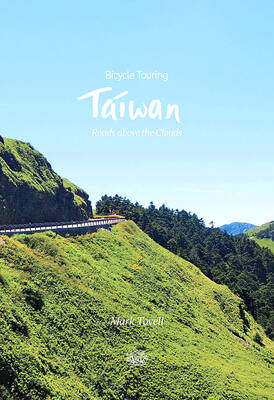
It’s hard to know where to begin with Mark Tovell’s Taiwan: Roads Above the Clouds. Having published a travelogue myself, as well as having contributed to several guidebooks, at first glance Tovell’s book appears to inhabit a middle ground — the kind of hard-to-sell nowheresville publishers detest. Leaf through the pages and you’ll find them suffuse with the purple prose best associated with travel literature: “When the sun is low on a warm, clear morning, and with the heat already rising, we stand at the riverside bike path leading south from Sanxia’s old cobble streets.” Hardly the stuff of your
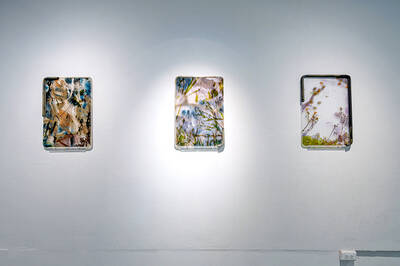
Located down a sideroad in old Wanhua District (萬華區), Waley Art (水谷藝術) has an established reputation for curating some of the more provocative indie art exhibitions in Taipei. And this month is no exception. Beyond the innocuous facade of a shophouse, the full three stories of the gallery space (including the basement) have been taken over by photographs, installation videos and abstract images courtesy of two creatives who hail from the opposite ends of the earth, Taiwan’s Hsu Yi-ting (許懿婷) and Germany’s Benjamin Janzen. “In 2019, I had an art residency in Europe,” Hsu says. “I met Benjamin in the lobby


 RSS
RSS