


I was once privileged to teach in the UK alongside an astute, laconic and rather eminent historian. He was in the habit of taking his most promising students for walks round the college grounds when he would test their minds by asking them seemingly simple, but in reality subtle, questions. One of his favorites was "Is it wrong to be rich?"
"Is Taiwan Chinese?" is a similar question. My colleague's question was complex because it quietly challenged the Marxist assumption that the rich were the villains of every story. The strategy he used to urge on students was to question the question. Who would ask something like this? The wrong approach was to reply with an outright "Yes!" or "Of course not!"
"Is Taiwan Chinese?" is similarly a deceptively simple query. What does it mean? Does it refer to racial composition, territorial allegiance or political history? Or does it mean what some innocents may at first sight think it obviously means, should Taiwan become a part of China?
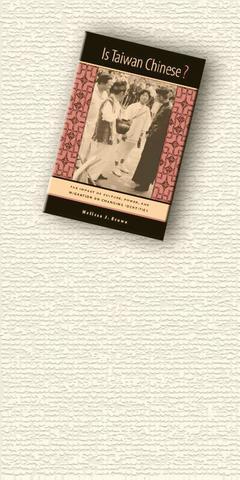
These options are narrowed down when you read the book itself. The title probably does refer to the claims Beijing repeatedly makes about the island, and to the way many people have unthinkingly accepted China's designation of Taiwan as a "breakaway province." But it seeks to answer the question by looking at the racial composition of the island, and comes to its political conclusions, such as they are, at least partly as a result of that investigation.
Readers of a pro-DPP disposition can rest assured -- this book essentially supports their position. The author, an anthropologist at Stanford University, spends most of her energy investigating the ethnographic profile of Taiwan's population, looking at the history of intermarriage and cultural exchange among Han Chinese, Hakka, Hoklo, Aborigines and so on in a handful of selected locations. Her special interest is in the "plains Aborigines" in Tainan County.
To simplify a complex picture, she concludes that the Taiwanese are of extraordinarily mixed ethnicity, and that their social habits are equally eclectic. Any view that they are for the most part Chinese who happen to live on an off-shore island is consequently dismissed as, at best, a gross over-simplification.
Much of the author's work is very detailed, but some general points emerge. One, for example, is that historical records suggest that in the 17th century most of the immigrants to Taiwan from China were unaccompanied men, and that subsequent intermarriage with Aborigine girls resulted in perhaps half the population being "mixed" by the end of the Dutch occupation in 1650.
For the ordinary reader this book will be hard-going. Phrases such as "identity formation," "demographic conditions" and "uxorically local minor marriage" abound, and indeed lie close to the heart of the author's area of concern. The author does explain such phrases when they first occur, but even so this book is not for the feint-hearted.
The author points out that differences over perceptions of ethnic identity erupted into violence elsewhere in the late 20th century -- in the Balkans, Rwanda and Kashmir, for instance. Moreover, it's in the power of politicians to manipulate such perceptions. Whatever we may like to be the case, ethnography can't be wholly isolated from politics.
Time is also an important issue in this book's analysis. How long is long? If a family that originated in China has been in Taiwan for 300 years, does that make it Taiwanese? Or does China's 3,000-plus-year history have precedence? Again, the PRC has existed for only some 50 years, yet uses imperial boundaries to legitimize its inclusion of Tibet and Mongolia in the modern state. When Melissa Brown says that such arguments are essentially political, or rather can be and are used by politicians, you can understand what she means.
Enthnicity, statehood, belonging and race all constitute labyrinths that you can quickly get lost in, or halls of mirrors where it's all but impossible to tell the reality from the myth. Even so, Brown risks a strictly political last chapter. It doesn't have the convoluted nature of the earlier material. Instead, it looks at scenarios of how the future might unfold, scenarios that differ little from what you might find in editorial columns, and even rely on remarks of interviewees in China, a handful out of over a billion.
The sociological analysis that takes up most of the book doesn't admit to such simple summaries. Topics such as bound feet, family graves or a new wife's status in her husband's family are as complex as life itself -- and indeed in former times in essence were life itself. Melissa Brown has her specialism, but doesn't lead to any simple conclusions. As far as the problematic issue of the future is concerned, her opinion is neither more nor less valid than that of any ordinary Taiwanese. Simply put, it remains problematic.

In late October of 1873 the government of Japan decided against sending a military expedition to Korea to force that nation to open trade relations. Across the government supporters of the expedition resigned immediately. The spectacle of revolt by disaffected samurai began to loom over Japanese politics. In January of 1874 disaffected samurai attacked a senior minister in Tokyo. A month later, a group of pro-Korea expedition and anti-foreign elements from Saga prefecture in Kyushu revolted, driven in part by high food prices stemming from poor harvests. Their leader, according to Edward Drea’s classic Japan’s Imperial Army, was a samurai

The following three paragraphs are just some of what the local Chinese-language press is reporting on breathlessly and following every twist and turn with the eagerness of a soap opera fan. For many English-language readers, it probably comes across as incomprehensibly opaque, so bear with me briefly dear reader: To the surprise of many, former pop singer and Democratic Progressive Party (DPP) ex-lawmaker Yu Tien (余天) of the Taiwan Normal Country Promotion Association (TNCPA) at the last minute dropped out of the running for committee chair of the DPP’s New Taipei City chapter, paving the way for DPP legislator Su
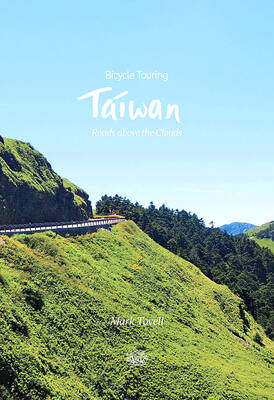
It’s hard to know where to begin with Mark Tovell’s Taiwan: Roads Above the Clouds. Having published a travelogue myself, as well as having contributed to several guidebooks, at first glance Tovell’s book appears to inhabit a middle ground — the kind of hard-to-sell nowheresville publishers detest. Leaf through the pages and you’ll find them suffuse with the purple prose best associated with travel literature: “When the sun is low on a warm, clear morning, and with the heat already rising, we stand at the riverside bike path leading south from Sanxia’s old cobble streets.” Hardly the stuff of your
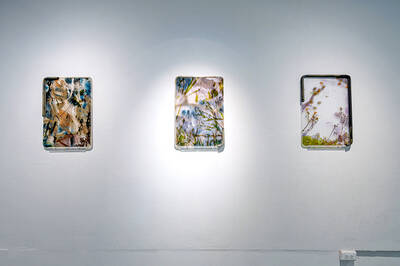
Located down a sideroad in old Wanhua District (萬華區), Waley Art (水谷藝術) has an established reputation for curating some of the more provocative indie art exhibitions in Taipei. And this month is no exception. Beyond the innocuous facade of a shophouse, the full three stories of the gallery space (including the basement) have been taken over by photographs, installation videos and abstract images courtesy of two creatives who hail from the opposite ends of the earth, Taiwan’s Hsu Yi-ting (許懿婷) and Germany’s Benjamin Janzen. “In 2019, I had an art residency in Europe,” Hsu says. “I met Benjamin in the lobby


 RSS
RSS