


It was a list of questions that brought Huda (胡慧親) to the Taipei Grand Mosque. "Why can't they eat pork? Why must women cover up? And why, if men can take four wives, can't women take four husbands?"
After enrolling in a six-week course on the fundamentals of Islam she found her answers, and she found religion. "When I first heard about the course, I told myself, `This is your time to learn something new.' I discovered how to live my life according to the Koran, and now I feel very peaceful," she said.
While stories of suicide attacks and beheadings permeate news coverage from Afghanistan and the Middle East, Taipei Grand Mosque Imam Ma Shiao-chi (
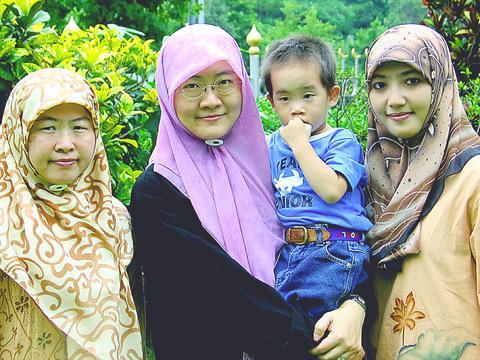
PHOTO: DIANA FREUNDL
"The news always highlights the bad things. About 90 percent of the news is negative. They hear stories about people getting their heads cut off and think Islam is a bad religion. They know very few things about Islam. They want to know what makes people do these things," he said.
Most of those going to the mosque are women, he said. Whether they were born into a non-practicing Muslim family, converted for marriage, or, like Huda, are simply curious to learn more about the religion, the women Ma meets want to better understand the role of women in Islam.
Perhaps they have no intentions of converting, Ma said, but at least they take the time to dispel a few stereotypes about the religion.
PHOTO: DIANA FREUNDL
Some, however, do convert. As a teenager, Sana (鄭淑芬) researched various religions and recalls visiting several temples, but it was Islam that appealed most to her. "So many things led me to feel Islam was the right religion. ? Even, when I was a child, I never liked to eat pork," she said.
After living in Pakistan with her husband and children for eight years, Sana said she is now re-adjusting to being part of a minority religion in Taiwan.
According to various statistics on religious practices in Taiwan, most people consider themselves Taoist, Buddhist, or followers of Confucius, and in many cases a combination of all three. Christianity is also a significant religion in Taiwan, with nearly 1 million declared Christians. Taiwan has an estimated 130,000 Muslims, less than half of which are Chinese-Muslims.
"I am Chinese and I am Muslim. I respect both cultures," Sana said giving the example of wearing a white headscarf (a color often associated with death in Taiwan). "If it makes someone feel sad, I take it off."
Sana and Huda describe wearing the hijab as an honor and affirmation of their faith. They agreed, however, that while its purpose is to prevent unwanted attention to their bodies, it in fact often draws more attention. This they said is part of learning to live in a non-Muslim society.
Likewise, Huda, who works in an international trading company, was originally told she could not wear her hijab to work, as it might make clients uncomfortable. "Eventually my colleagues and boss accepted it. It took time, but they know being Muslim is an important part of my life," she said.
While he criticized the unfair portrayal of Islam in the media, Ma said Muslim practitioners in Taiwan experience little persecution from the public. One reason he said might have to do with the small number of followers. "We are very few, so we are not really a risk to them," he said.
The majority of Chinese practicing Islam are second- and third-generation Muslims, whose families came to Taiwan with the Chinese Nationalist Party (KMT) in 1949. As years passed, people started to relax their religious observations, Ma said.
"A lot of Muslims in Taiwan were born Muslim, but not all of them pray every day and some started to eat pork. But Islam is a lifestyle. You need to do the Muslim practices [the Five Pillars of Islam] or else it is easy to lose the religion," he said.
Nadia (買黛蕾) was born into a non-practicing Chinese-Muslim household. Following in her sister's footsteps, she made the transition to a more pious observance during college. As she learned more about the religion, she began to dress more conservatively, covering all but her face and hands. "It was just an outfit on the outside, but it changed my life on the inside. I felt more confident," she said.
In addition to Muslims rediscovering their lost faith, Ma said most women embracing Islam in Taiwan do so for marriage. Of the 20 new converts last year 12 were for marriage, he said.
According to the Koran, a Muslim man can marry a woman from a monotheistic religion (Christianity, Islam and Judaism), but he is prohibited from marrying a woman from a polytheistic religion (Buddhism, Taoism, Hinduism).
Marriage is how Aisha (
A decade later she started reading the Koran, attending classes and wearing the headscarf and feels her relationship with her husband is better for it. "Now we have the same way of looking at things. I can communicate better with my husband," she said.
Each of the women said Islam places a large emphasis on respect and equality for women. One of the most debated gender issues in the Koran is the tradition that allows Muslim men to take four wives.
Sana said she would find it difficult to share her husband with another woman, but noted the practice is not exclusive to Islam.
"My father had three wives, but not the legal way. This hurt my mother and me a lot. He never asked my mother and he never treated all of his children the same," she said.
"Even if I agreed to a second marriage, there are many rights to protect me and my property. He must still provide for me and our children," Sana said.
The women and the Imam said the conditions under which a man is permitted to take four wives make it virtually impossible for him to do so. According to the Koran, the first wife must agree to any additional marriage[s] and he must treat each of his wives equally, both financially and intimately.
"I don't think most men, Muslim and non-Muslim, are able to treat four all women equally," Sana said. Does she think a woman could treat four men equally? "Oh, so many kids," she said, laughing.
Note: Most women who convert to Islam take a religious name. The women interviewed for this article chose to use their Muslim names and are referred to by them throughout the article. Their Chinese names appear in parentheses.

In late October of 1873 the government of Japan decided against sending a military expedition to Korea to force that nation to open trade relations. Across the government supporters of the expedition resigned immediately. The spectacle of revolt by disaffected samurai began to loom over Japanese politics. In January of 1874 disaffected samurai attacked a senior minister in Tokyo. A month later, a group of pro-Korea expedition and anti-foreign elements from Saga prefecture in Kyushu revolted, driven in part by high food prices stemming from poor harvests. Their leader, according to Edward Drea’s classic Japan’s Imperial Army, was a samurai

The following three paragraphs are just some of what the local Chinese-language press is reporting on breathlessly and following every twist and turn with the eagerness of a soap opera fan. For many English-language readers, it probably comes across as incomprehensibly opaque, so bear with me briefly dear reader: To the surprise of many, former pop singer and Democratic Progressive Party (DPP) ex-lawmaker Yu Tien (余天) of the Taiwan Normal Country Promotion Association (TNCPA) at the last minute dropped out of the running for committee chair of the DPP’s New Taipei City chapter, paving the way for DPP legislator Su

It’s hard to know where to begin with Mark Tovell’s Taiwan: Roads Above the Clouds. Having published a travelogue myself, as well as having contributed to several guidebooks, at first glance Tovell’s book appears to inhabit a middle ground — the kind of hard-to-sell nowheresville publishers detest. Leaf through the pages and you’ll find them suffuse with the purple prose best associated with travel literature: “When the sun is low on a warm, clear morning, and with the heat already rising, we stand at the riverside bike path leading south from Sanxia’s old cobble streets.” Hardly the stuff of your

Located down a sideroad in old Wanhua District (萬華區), Waley Art (水谷藝術) has an established reputation for curating some of the more provocative indie art exhibitions in Taipei. And this month is no exception. Beyond the innocuous facade of a shophouse, the full three stories of the gallery space (including the basement) have been taken over by photographs, installation videos and abstract images courtesy of two creatives who hail from the opposite ends of the earth, Taiwan’s Hsu Yi-ting (許懿婷) and Germany’s Benjamin Janzen. “In 2019, I had an art residency in Europe,” Hsu says. “I met Benjamin in the lobby


 RSS
RSS