


Spain's San Fermin bull-running fiesta attracts all manner of thrill-seekers.
"I've never been seriously injured. I lost my kidney one year," said Bomber, a 56-year-old Californian, after one early morning run.
Fellow American R.J. Smith ran with the bulls in Pamplona for the 31st time this year, despite a long white scar from a bull's goring on his buttock and a false hip beneath it which bear witness to his bull-running addiction.
Some come to San Fermin for the fiesta and never see a bull, some come to see their friends and others to follow writer Ernest Hemingway's footsteps. But for many the bull-running fiesta has become a mecca for adrenalin junkies of all ages from all over the world.
Smith, a 67-year-old former air force pilot who still hang-glides on skis, says bull-running is obsessive.
"It draws you. Once you do it you want to do it again and again and again."
That seemed to be the case for his godson who came to Pamplona for the second time this year, despite swearing after his first experience he never would.
"I got out and I said I'm never doing this ever again. It scared me so damn bad," Daniel Voltz said the night before the first of this year's runs. He ran the following morning along the slippery cobbled streets and survived unscathed.
That day, in an unusually clean run, only five people were taken to hospital.
Bomber says he has missed only one fiesta in the last 33 years.
"It's very very difficult, your adrenalin ... and your imagination [are] running and it's very hard not to run."
Extreme sport aficionados say there's nothing quite like a 600kg beast pointing his deadly horns at you with no one there to bail you out.
"I've done bungee jumping, parachuting, parascending, diving ... always finding the next stupid thing to do ... This is the best so far. I'm not sure what follows," said Mark Kinder, a 31-year-old information technology manager from England.
"I'm a little bit of an adrenalin junkie."
NO FEAR OF LAW SUITS
The running of the bulls is a centuries-old tradition that became internationally famous when Hemingway -- whose statue stands outside the Pamplona bullring -- set part of his 1920s tale of thwarted passion, The Sun Also Rises, here.
Organizers say 1.5 million people come each year to the July 6 to July 14 fiesta.
Thousands of people gather just after dawn into a narrow 825m stretch of road that leads from the bulls' corral to the ring, where the animals come up against a matador that evening.
Some swig from traditional Spanish wine skins as they wait for the bulls to be let out, while police haul those who are very drunk through the barriers to safety.
Red Cross staff perch on the gates at regular intervals ready to scoop up the injured. Locals and foreigners crowd around the barriers to catch a few seconds of the run.
At 8am a rocket is set off and six bulls followed by a handful of steers charge towards the runners. Some start jogging, some have second thoughts and bail over the fence and some linger, waiting for the bulls to get closer.
People trip up, roll under the legs of the bulls, get trampled on or stepped over and every year someone gets a part of their body pierced by a bull's horn.
Watch those horns
Bulls are chosen for Pamplona for having the biggest horns.
In 1995 a young American Matthew Tassio fell over on the run and when he stood up a bull's horn went into his back. In 1947 a bull killed a local butcher, slicing through his stomach, liver and lung and then killed a soldier within minutes.
Last year a 62-year-old local man died after spending months in a coma, bringing the total of bull-run deaths to 15 since 1910.
Runners come to what they say is one of the few places where no law or fear of litigation stops them risking their lives and experiencing the delirium that comes with escaping in one piece.
"I'm seeking an adrenalin rush ... In today's world, being able to run with bulls, in Australia the liability insurance [would stop it]. But here tradition overrules all that politics ... They seem to understand that you're big enough to make your own decision," said Mick Russell, a 22-year-old builder from Shepperton, Australia.
Pamplona's authorities did try to stop locals running with the bulls for centuries but in 1867 they gave up and made it an official part of the festival.
"It's something to make you feel alive ... I have to feel the adrenalin, I want a near-death experience," said Bobby Moran, 23, an accountant from Melbourne.
Caracas fireman Hugo Sanchez uses a fair bit of adrenalin in his day job, but says he likes to experience a rush that other people's lives do not depend on. He came to Pamplona this year for the first time and plans to come back for as long as he can.
"Pure adrenalin ... like everything beautiful in this life," Sanchez said.

Taiwan’s English education system is being pulled apart by three opposing forces. Bilingual Nation 2030 pulls students toward English and global communication. Artificial Intelligence (AI) readiness pulls them toward digital judgment, verification and AI-mediated work. But Taiwan’s old exam culture pulls them back toward memorization, grammar drills, timed reading and correct answers. If the education system keeps using old exams to define success, it risks producing graduates who are neither genuinely bilingual nor genuinely AI-ready, but trained for tasks machines can already perform. The first force is Bilingual Nation 2030. Launched in 2018, the policy aimed to “help Taiwan’s workforce connect

“Taiwan’s Opposition Leader Comes to US With a Message Straight Out of Beijing” read a May 31 headline in the Wall Street Journal. Top US administration officials and members of Congress almost certainly read the WSJ, and if there was a bullet point takeaway that people in Washington should absorb ahead of Chinese Nationalist Party (KMT) Chair Cheng Li-wun’s (鄭麗文) arrival in DC on June 9, that headline is it. The last few columns have discussed this very topic, and the timing is not coincidental. While those top officials likely do not read the Taipei Times, judging by the number

With weighty, anxiety-inducing geopolitical topics dominating the headlines, checking in on the wild and weird state of local politics can take some of the edge off. This November’s elections will determine who will be in charge of fixing potholes in your neighborhood, not the potholes in Taiwan’s complicated geopolitical space. Recently, after an online interview with a Taipei-based journalist, I commented that Taipei journalists never go further than the MRT can take them. He laughed and agreed. Naturally, the Taipei mayoral race is eating up much of the press attention. TAIPEI CITY Democratic Progressive Party (DPP) candidate Puma Shen (沈伯洋) has
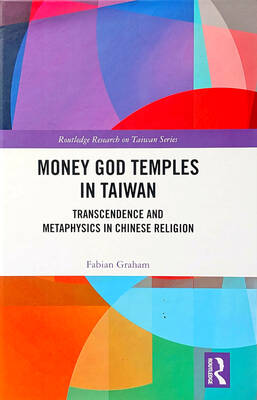
As someone who normally steers clear of books with “transcendence” or “metaphysics” in their subtitles, this reviewer — a casual observer of local belief systems since the 1990s — found Fabian Graham’s Money God Temples in Taiwan a challenging read. Those who’ve only dipped their toes into temple culture will likely need to parse several sections with special care if they’re to keep up with the author, a British ethnographic researcher whose previous books have investigated religious practices among ethnic Chinese in Southeast Asia. This scholarly volume examines a facet of Taiwan’s religious landscape that didn’t exist a century ago, and


 RSS
RSS