


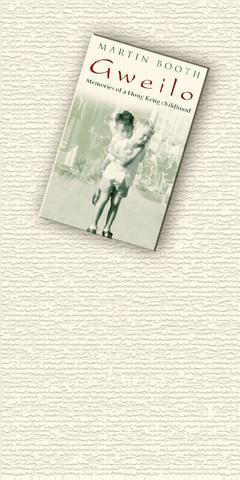
Gweilo is the Cantonese term signifying red-haired devil or foreigner. Martin Booth spent four years of his childhood in Hong Kong and this is his memoir of those days back in the 1950s. He's the author of many books, both fiction and non-fiction, most of them concerned in one way or another with Asia. Sadly, Gweilo was his swan song -- he died last year, while it was still in manuscript.
Colonial Hong Kong in 1952 (the year Booth arrived, at the age of seven) exhibited few of the virtues of a modern world struggling to be born. Other places may have been experiencing Elvis Presley and the first stirrings of the Beat poets, but the British colony, at least as exemplified by Booth's stubborn and irascible father, was more interested in pink gins, anti-communism, and the restoration of an old world after the terrible humiliation of Japanese conquest.
Booth has many adventures in Gweilo. He gains easy access into the legendary Kowloon Walled City (as in so many fairy stories, the adventures begin when the child makes straight for the one place his parents have told him he must never go). There he is befriended by two men who proceed to show him an opium den and a brothel, before he learns that they are in reality triad supremos who locals would happily give an arm to avoid meeting.
In the Tsim Sha Tsui area of Kowloon he learns a salesman's trick of smilingly "accepting" the same number of US dollars for an article priced in the Hong Kong currency, then one seventh its value. He also learnt the technique of the pick-pockets. Their trick, apparently, involved two men, one to shove the victim and the second to take his wallet. This contrasts with the London habit (described to me by an inmate when I was briefly teaching in the city's Pentonville Jail) of one man shoving, a second taking the wallet as the victim turns to see who pushed him, and a third immediately receiving the stolen item so that the actual thief, the second man, can hold up his hands and say "Not me, gov'nor!"
There are tales of typhoons, of course, as well as horse racing and every other conceivable form of gambling, fugitive Russians, trams, and food of every kind. There are trips to the New Territories (including Shatin, then paddy fields and fishing villages but now a densely-packed suburb), and one to Lantau island and its Buddhist monasteries. The family live first in Mongkok, then on the Peak on Hong Kong island. The youthful Booth finds the former greatly preferable, though the latter was and is the most prestigious address anyone could ask for in Hong Kong.
The buffoon-like father is no comic parody. There's true feeling here, and it gives the book a serious undertow. At the end of a chapter describing a visit to an island leper-colony, and the father's rage after the boy allows a leper to stroke his blond hair for good fortune, Booth writes, "It was from that moment that I hated my father, truly abhorred him with a loathing that deepened as time went by and was to sour the rest of both our lives."
Booth adopts a simple but effective plan in this readable, and in several aspects engrossing, book. The father is an intolerable bigot, and the mother someone who would like to understand her Chinese neighbors but is effectively prevented from doing so by her husband. The way is thus open for the small boy to get to know the locals on his own terms and so gain a host of insights that the mature author will later utilize.
Innumerable English novels for children have proceeded on this assumption -- that the child has an open and inquiring cast of mind denied to his elders, and this enables him to solve mysteries, insinuate himself into criminal conspiracies, and generally make the world a better place where all the attempts of the adults have failed. As childhood drifts away, the knowledge and friendships he had as a boy begin to evaporate like a dream. It's the procedure adopted by Kipling in Kim, Stevenson in Treasure Island, J.K.Rowling in the Harry Potter books, and many others. A darker version is that of J.M.Barrie in Peter Pan where nothing is as simple as it seems. (The year's best news so far is that the incomparable British TV mini-series about Barrie, The Lost Boys, is being released on DVD in October.)
Readers who've lived in Hong Kong recently will find this book absorbing reading, and will be intrigued with the details of the territory as it was 50 years ago. Booth may judge that the British world lacked charm, though it was probably his father who was largely responsible for this, but the Chinese world remains fascinating to an extreme degree. It is, however, the unique mix that makes Hong Kong so very distinctive.
Martin Booth died at 58, and wrote this book knowing he didn't have long to live. The desire to memorialize is strong, and masterpieces have resulted from the impulse to set the record straight. All that ancient times can speak to us through are DNA-datable bones and shards of pottery. At least we have books, and this one, though not a masterpiece, serves as an atmospheric evocation of somewhere that's simultaneously instantly recognizable and lost for ever.
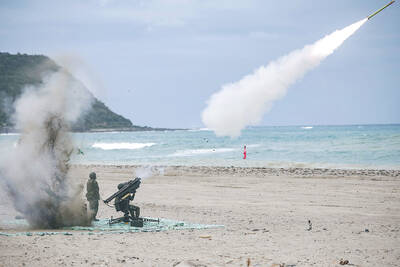
In late October of 1873 the government of Japan decided against sending a military expedition to Korea to force that nation to open trade relations. Across the government supporters of the expedition resigned immediately. The spectacle of revolt by disaffected samurai began to loom over Japanese politics. In January of 1874 disaffected samurai attacked a senior minister in Tokyo. A month later, a group of pro-Korea expedition and anti-foreign elements from Saga prefecture in Kyushu revolted, driven in part by high food prices stemming from poor harvests. Their leader, according to Edward Drea’s classic Japan’s Imperial Army, was a samurai

The following three paragraphs are just some of what the local Chinese-language press is reporting on breathlessly and following every twist and turn with the eagerness of a soap opera fan. For many English-language readers, it probably comes across as incomprehensibly opaque, so bear with me briefly dear reader: To the surprise of many, former pop singer and Democratic Progressive Party (DPP) ex-lawmaker Yu Tien (余天) of the Taiwan Normal Country Promotion Association (TNCPA) at the last minute dropped out of the running for committee chair of the DPP’s New Taipei City chapter, paving the way for DPP legislator Su
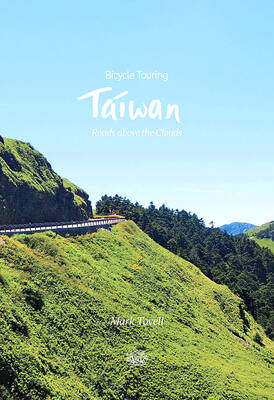
It’s hard to know where to begin with Mark Tovell’s Taiwan: Roads Above the Clouds. Having published a travelogue myself, as well as having contributed to several guidebooks, at first glance Tovell’s book appears to inhabit a middle ground — the kind of hard-to-sell nowheresville publishers detest. Leaf through the pages and you’ll find them suffuse with the purple prose best associated with travel literature: “When the sun is low on a warm, clear morning, and with the heat already rising, we stand at the riverside bike path leading south from Sanxia’s old cobble streets.” Hardly the stuff of your
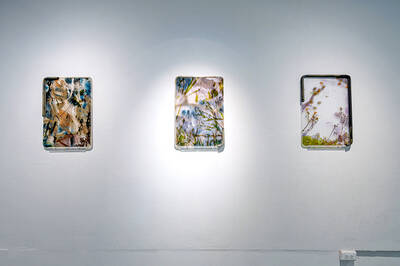
Located down a sideroad in old Wanhua District (萬華區), Waley Art (水谷藝術) has an established reputation for curating some of the more provocative indie art exhibitions in Taipei. And this month is no exception. Beyond the innocuous facade of a shophouse, the full three stories of the gallery space (including the basement) have been taken over by photographs, installation videos and abstract images courtesy of two creatives who hail from the opposite ends of the earth, Taiwan’s Hsu Yi-ting (許懿婷) and Germany’s Benjamin Janzen. “In 2019, I had an art residency in Europe,” Hsu says. “I met Benjamin in the lobby


 RSS
RSS