


Once one of the nation's largest mining settlements, Jinguashih (金
All this could change later this summer, however, when the equally picturesque yet little-mentioned town of Jinguashih stamps its mark on the tourist map with the opening of the Gold Ecological Park (黃
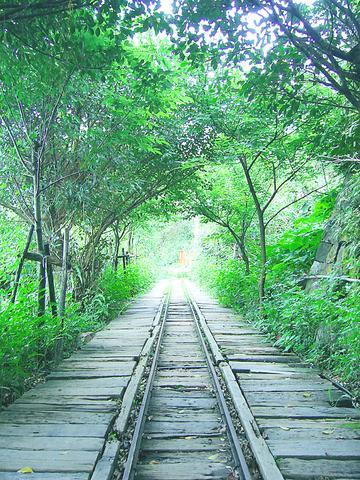
PHOTO: GAVIN PHIPPS, TAIPEI TIMES
Not that the soft yellowish corrosion-resistant element was the only precious metal mined at Jinghuashih. The area's copper deposits were once so extensive that the town was the hub of the Asian copper mining industry and its deposits of silver outweighed those of its gold.
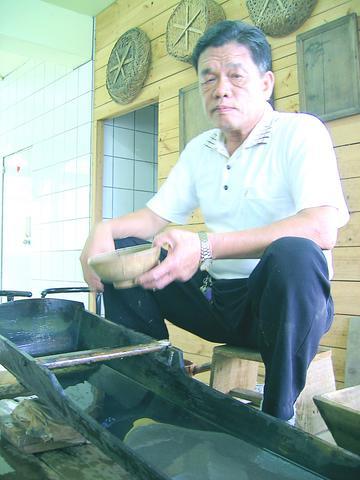
PHOTO: GAVIN PHIPPS, TAIPEI TIMES
Large deposits of precious metals were first discovered in Jinguashih in 1890. From the late 1800s until as recently as 1987, when mining operations ceased, over 2 million tonnes of precious metals had been exploited from the extensive catacomb of tunnels that covered a combined area of nearly 450km.
Jointly financed by the Taipei County Government (台
The first stage in the park's development to be opened to the public includes a museum, an ecology center and pathways that follow the route once used by the mine's narrow-gauge railway. Developers expect stage two of the project, which will include renovation of half a dozen Japanese colonial dormitories and a mansion once used by Japan's Emperor as a summer retreat, to be completed later this year and opened early next year.
Along with museum-styled exhibitions and pleasant, meandering pathways, the park will also allow visitors to venture into and walk through an old mine shaft and features Southeast Asia's largest air-filtration system, which has been restored and is now a central and unavoidable feature of the new park.
While the project looks set to transform Jinguashih from a sleepy backwater into a bustling tourist hotspot, residents of Chiufen are concerned that the development will mean a drop in the number of visitors to their town, which for two decades has survived and thrived on tourism.
"I've heard about it and I'm worried. People will see the development as a `new' thing and, of course, it will be the fashionable place to go," said a chain-smoking car park attendant who declined to give his name. "There's nothing new here. And look at the place, there's no room to build any new tourist facilities even if we wanted to."
Tseng Shui-chih (曾
"Of course I'm upset. For nearly 20 years Chiufen has been a hugely popular tourist destination. We've received little, if any, funding from the government, but have brought in huge amounts of capital for the county," said Tseng. "They've invested all this money into Jinguashih in order to develop a new tourist infrastructure when we already have one. It's as if [county government] has forgotten about us."
According to Taipei County Government employee and Director of the soon to be completed park, Chiang Min-chin (江
"I think people are being a bit anxious when they say that the park will kill off Chiufen as a tourist destination. It's so famous that tourists will still go there regardless of the construction of the park," said Chiang. "The project is not solely about Jinguashih, but rather a positive step in the right direction for both towns."
Jinguashih's gold, silver and copper deposits might have dried up a long time ago, but visitors to the town who find themselves suffering from a case of gold fever can still try their luck. Panning for gold in the numerous rivers that run through the hamlet, according to the park's Jack Wu (吳
While substantial funding has been given to reinventing the town as a joyful tourist retreat, there is a much darker side to Jinguashih's history.
From November 1942 until the surrender of Japanese Imperial Army on Taiwan in August 1945, the township was home to the infamous Kinkaseki POW camp.
"We certainly don't plan to ignore the town's less positive history," said Chiang. "Working alongside the [POW Camps Memorial Society] we plan to establish a permanent exhibition focusing on this issue. After all, it is a part of the town's history that cannot be ignored."
Large numbers of these POWs were put to work in the mines that held the largest copper alloy deposits to be found anywhere within the Japanese Empire. Over 1,000 British Commonwealth and Allied troops were interned at Kinkaseki at one time or another and all were subject to inhuman treatment, denied the most basic of medical facilities and flogged by their jailers, some of who were Taiwanese, if they failed to reach their daily quota.
"I think it is certainly necessary and good to include a part on the POWs in the story of Jinguashih and the mines," said Director of the Taiwan POW Camps Memorial Society Michael Hurst MBE in an e-mail. "The main reason why the story is not that well known is because the Japanese wanted to keep what happened in Kinkaseki Camp -- and all of the other camps on Taiwan -- a secret from the local population.
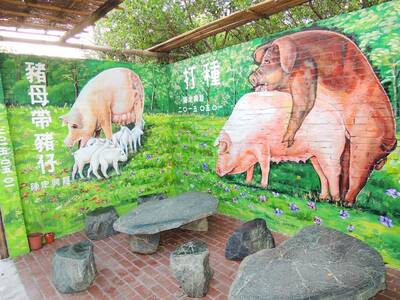
May 6 to May 12 Those who follow the Chinese-language news may have noticed the usage of the term zhuge (豬哥, literally ‘pig brother,’ a male pig raised for breeding purposes) in reports concerning the ongoing #Metoo scandal in the entertainment industry. The term’s modern connotations can range from womanizer or lecher to sexual predator, but it once referred to an important rural trade. Until the 1970s, it was a common sight to see a breeder herding a single “zhuge” down a rustic path with a bamboo whip, often traveling large distances over rugged terrain to service local families. Not only
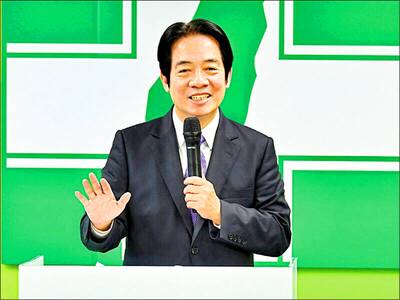
Ahead of incoming president William Lai’s (賴清德) inauguration on May 20 there appear to be signs that he is signaling to the Chinese Communist Party (CCP) and that the Chinese side is also signaling to the Taiwan side. This raises a lot of questions, including what is the CCP up to, who are they signaling to, what are they signaling, how with the various actors in Taiwan respond and where this could ultimately go. In the last column, published on May 2, we examined the curious case of Democratic Progressive Party (DPP) heavyweight Tseng Wen-tsan (鄭文燦) — currently vice premier
The last time Mrs Hsieh came to Cihu Park in Taoyuan was almost 50 years ago, on a school trip to the grave of Taiwan’s recently deceased dictator. Busloads of children were brought in to pay their respects to Chiang Kai-shek (蔣中正), known as Generalissimo, who had died at 87, after decades ruling Taiwan under brutal martial law. “There were a lot of buses, and there was a long queue,” Hsieh recalled. “It was a school rule. We had to bow, and then we went home.” Chiang’s body is still there, under guard in a mausoleum at the end of a path

Last week the Directorate-General of Budget, Accounting and Statistics (DGBAS) released a set of very strange numbers on Taiwan’s wealth distribution. Duly quoted in the Taipei Times, the report said that “The Gini coefficient for Taiwanese households… was 0.606 at the end of 2021, lower than Australia’s 0.611, the UK’s 0.620, Japan’s 0.678, France’s 0.676 and Germany’s 0.727, the agency said in a report.” The Gini coefficient is a measure of relative inequality, usually of wealth or income, though it can be used to evaluate other forms of inequality. However, for most nations it is a number from .25 to .50


 RSS
RSS