


The launch of bargain basement wines over the past 10 years has boosted US wine sales, but many question whether these "super value" wines can survive the passing of the global grape glut that spawned them.
The fate of the most well-known of these cheap wines, "Two Buck Chuck," which retails for just US$1.99 in California, cropped up repeatedly in seminars at this week's wine trade fair in Chicago -- Vinexpo Americas 2004.
Made by the Bronco Winery Company at its headquarters in Ceres in California's Central Valley, the two-dollar wines have shaken up the market, dragging prices down, but attracting a huge amount of public interest and media attention in the process.
Some of the brand's boosters argue that it has brought new consumers into the wine market, but most wine analysts at the show agreed that it has merely cannabalized existing wine sales, or pushed up consumption among afficionados.
Its critics, like Brian Rosen, an independent wine retailer based in Chicago, view it as a novelty -- and one he hopes will pass and soon.
"It's a fad, a way to soak up excess grape production," said Rosen, who owns Sam's Wine and Spirits, the largest specialty wine and liquor store in the US.
"Everyone loves a bargain."
In 2003, Bronco sold 4 million cases of Two Buck Chuck (real name Charles Shaw), up from 1.8 million cases in 2002, according to figures compiled by the Adams Beverage Group in Norwalk, Connecticut.
Some of the sales growth can be ascribed to its growing national distribution footprint. In 2002, the year the wine launched, Bronco only made the products available in California, but last year, it rolled it out to another 12 states.
The wines are only available through a boutique supermarket chain called Trader Joe's which signed an exclusive distribution deal with Bronco.
Meanwhile, Rosen said he worries that the wines, which have garnered a reputation for inconsistency, could sour new-comers on the pleasures of wine drinking.
"If you don't do it right at the beginning, you are going to lose them," he said.
Other observers see sour grapes in statements like that.
"It's a good thing to get wine on the shelves in supermarkets and stores that cater to the mass market," said John Gillespie, president of the Wine Market Council, a trade advocacy and promotion agency in St. Helena, California.
"It's the American way."
In fact, at least a third of all wine sold in the US is done so through discount, grocery, drug or warehouse stores, according to the Wine Institute of San Francisco.
And the big supermarket chains, where a whopping 90 percent of Americans shop, are jumping on the bandwagon with their own-brand offerings.
Late last year, the Target Corporation started placing its own private-label wine in select California and Florida stores. Made by winemakers Trinchero Family Estates, the wine is packaged in a color-coded Cube and comes in Chardonnay, Pinot Grigio, Merlot and Shiraz.
Wal-Mart markets a brand made by the California wine-producers E.J. Gallo; under the brand Alcott Ridge Vineyards label. Sav-On and Albertsons have Timberwood, their own label and also a Gallo product, and Trader Joe's has Purple Moon.

In late October of 1873 the government of Japan decided against sending a military expedition to Korea to force that nation to open trade relations. Across the government supporters of the expedition resigned immediately. The spectacle of revolt by disaffected samurai began to loom over Japanese politics. In January of 1874 disaffected samurai attacked a senior minister in Tokyo. A month later, a group of pro-Korea expedition and anti-foreign elements from Saga prefecture in Kyushu revolted, driven in part by high food prices stemming from poor harvests. Their leader, according to Edward Drea’s classic Japan’s Imperial Army, was a samurai

The following three paragraphs are just some of what the local Chinese-language press is reporting on breathlessly and following every twist and turn with the eagerness of a soap opera fan. For many English-language readers, it probably comes across as incomprehensibly opaque, so bear with me briefly dear reader: To the surprise of many, former pop singer and Democratic Progressive Party (DPP) ex-lawmaker Yu Tien (余天) of the Taiwan Normal Country Promotion Association (TNCPA) at the last minute dropped out of the running for committee chair of the DPP’s New Taipei City chapter, paving the way for DPP legislator Su
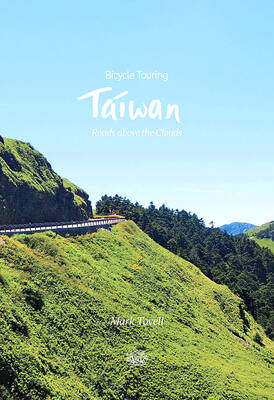
It’s hard to know where to begin with Mark Tovell’s Taiwan: Roads Above the Clouds. Having published a travelogue myself, as well as having contributed to several guidebooks, at first glance Tovell’s book appears to inhabit a middle ground — the kind of hard-to-sell nowheresville publishers detest. Leaf through the pages and you’ll find them suffuse with the purple prose best associated with travel literature: “When the sun is low on a warm, clear morning, and with the heat already rising, we stand at the riverside bike path leading south from Sanxia’s old cobble streets.” Hardly the stuff of your

Located down a sideroad in old Wanhua District (萬華區), Waley Art (水谷藝術) has an established reputation for curating some of the more provocative indie art exhibitions in Taipei. And this month is no exception. Beyond the innocuous facade of a shophouse, the full three stories of the gallery space (including the basement) have been taken over by photographs, installation videos and abstract images courtesy of two creatives who hail from the opposite ends of the earth, Taiwan’s Hsu Yi-ting (許懿婷) and Germany’s Benjamin Janzen. “In 2019, I had an art residency in Europe,” Hsu says. “I met Benjamin in the lobby


 RSS
RSS