


Taiwan's foremost avant-garde artist Wu Mali
(
In Taiwan, Wu has given Taiwan's avant-garde art a measure of genuine life and significance undreamt of by her counterparts elsewhere.
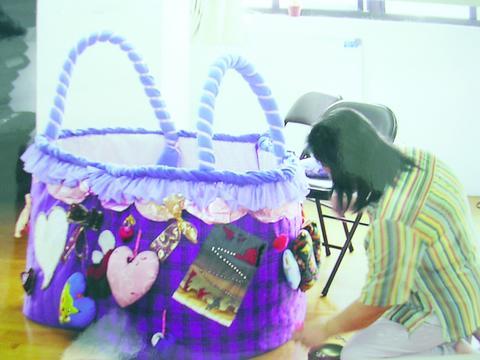
PHOTO COURTESY OF TAIPEI WOMEN AWAKENING ASSOCIATION
In what was considered a landmark occasion, Marcel Duchamp once declared a urinal as artwork for his New York exhibition. The museum, in accepting his "definition," further fueled the notion that artists were the high priests of culture. Artists since Duchamp have attempted ever newer concepts, actions and installations, resulting over past decades in an alarming abuse of nature and resources.
Stifling productions by the Bulgarian artist Christo wrap up entire islands or hills in pink canvas. But displays like these do not actually benefit anyone other than the project teams. They fail to move viewers or, even less, make us change our perception of the world. Such widely publicized projects always cost millions in paid and unpaid man-hours and materials, not to mention trauma, even death to flora and wildlife, and inconvenience workers and visitors to the targets.
Unfortunately, top art administrators are often themselves men seeking "exciting" exhibits reflecting, as it were, their own fantasies of brutality and violence. The Christo syndrome lately engendered British shocker Damien Hirst, who soared to fame by standing real sheep and horses in huge glass tanks filled with formaldehyde. Art spawned by masculine mindsets often celebrates inequality and dominion.
The avant-garde ranks itself elite, but Wu has miraculously done the very opposite. In poignant projects, she reveals the globally rooted destructive patriarchal mindset through the women it has so deeply affected.
Asked by Taipei City, she joined Taipei Women Awakening Association (台北市婦女新知協會) to work creatively with their abundant fabric. Wu engaged with mothers and wives who, except for one college art major, had never felt that "art was part of life."
They gathered for weekly meetings, got teachers for sewing skills, social workers to discuss community issues, and gradually built up a meaningful outlook that enriched and eventually transformed their lives. There Wu designed a fabric project aptly titled, Bedcover of the Soul (
Like Christo, Wu speaks of fabric as skin, but skin for Wu is no cover to wrap up something and separate it from others. For Wu, skin is the interface between soul and universe -- for inter-relating, for mutuality, for integration.
The process of creating this work entailed several months of intense labor on the part of everyone involved. The members of the Creative Textile Workshop women belonged to different age groups and social classes. Along with Wu, psychological counselor Lin Fang-hao (
This DVD now travels around Taiwan to awaken dormant feelings and inspire self-awareness and growth among viewers of all ages, classes, and both genders.
It is a powerful video, revealing a subtle process. We share in the stitching sisterhood and follow their self-discovery. In a nurturing environment, they began speaking of deeply repressed feelings, bringing up topics untouched at home. They acknowledged a sense of alienation from the world of their fathers and husbands; they wept over the endless waiting that "filled" their days, of being a person who makes life for the family -- but not for herself.
Then we see their Bedcovers of the Soul. One was sewn with dead leaves, "I long deeply for Death. Death of this life, so that a new life can begin." Another applied lacey fragments bounded by the outlines of a tight-necked bottle. One loose fragment flies outside, but remains attached to the bottle by a string, "My soul dreams of escape. But try as I might, wherever I go, I remain chained to my home."
Wu's bedcover was a huge fluffy red broken heart cushion with broken bits of red fluff that, once moved, revealed beneath a pair of huge fluffy white wings -- of flight, of benediction and succor. Here the essence of womanhood is revealed as Genetrix who, through suffering, heals and nurtures.
At a recent Taipei video-showing, someone in the audience asked to screen it at the coming Asia-Pacific NGO Forum in Bangkok on the Beijing Platform for Action (BPFA) titled "Celebrating women's gains ... Confronting emerging gender issues" in July.
Watching Taiwanese women emerge from traditional mental confines and become able to see themselves and society in a new light, the man at the show said, would help other Asian women waken to their vibrant inner life -- so simply accessible without preposterous patriarchal costs -- once the heart and mind is gently opened.
For information on where to buy the DVD, contact the Taipei Women Awakening Association at (02) 2351-1678.

In late October of 1873 the government of Japan decided against sending a military expedition to Korea to force that nation to open trade relations. Across the government supporters of the expedition resigned immediately. The spectacle of revolt by disaffected samurai began to loom over Japanese politics. In January of 1874 disaffected samurai attacked a senior minister in Tokyo. A month later, a group of pro-Korea expedition and anti-foreign elements from Saga prefecture in Kyushu revolted, driven in part by high food prices stemming from poor harvests. Their leader, according to Edward Drea’s classic Japan’s Imperial Army, was a samurai

The following three paragraphs are just some of what the local Chinese-language press is reporting on breathlessly and following every twist and turn with the eagerness of a soap opera fan. For many English-language readers, it probably comes across as incomprehensibly opaque, so bear with me briefly dear reader: To the surprise of many, former pop singer and Democratic Progressive Party (DPP) ex-lawmaker Yu Tien (余天) of the Taiwan Normal Country Promotion Association (TNCPA) at the last minute dropped out of the running for committee chair of the DPP’s New Taipei City chapter, paving the way for DPP legislator Su

It’s hard to know where to begin with Mark Tovell’s Taiwan: Roads Above the Clouds. Having published a travelogue myself, as well as having contributed to several guidebooks, at first glance Tovell’s book appears to inhabit a middle ground — the kind of hard-to-sell nowheresville publishers detest. Leaf through the pages and you’ll find them suffuse with the purple prose best associated with travel literature: “When the sun is low on a warm, clear morning, and with the heat already rising, we stand at the riverside bike path leading south from Sanxia’s old cobble streets.” Hardly the stuff of your

Located down a sideroad in old Wanhua District (萬華區), Waley Art (水谷藝術) has an established reputation for curating some of the more provocative indie art exhibitions in Taipei. And this month is no exception. Beyond the innocuous facade of a shophouse, the full three stories of the gallery space (including the basement) have been taken over by photographs, installation videos and abstract images courtesy of two creatives who hail from the opposite ends of the earth, Taiwan’s Hsu Yi-ting (許懿婷) and Germany’s Benjamin Janzen. “In 2019, I had an art residency in Europe,” Hsu says. “I met Benjamin in the lobby


 RSS
RSS