


There are exciting times ahead in the world of electronic entertainment, although they can be hard to identify in the din and cacophony of the Electronic Entertainment Exposition (E3).
The industry's biggest trade fair kicked off with an ear-splitting preview in Los Angeles on Tuesday as row after row of game makers and hardware manufacturers showed off their latest offerings with the help of scantily clad models, booming gunfire that would scare even hardened troops and graphics that edge ever-closer to the hyper-realistic holy grail of computer gaming.
E3 organizers said around 400 exhibiting companies from 70 countries are at this year's show, the 10th annual, which sprawls over more than 48,000m2.
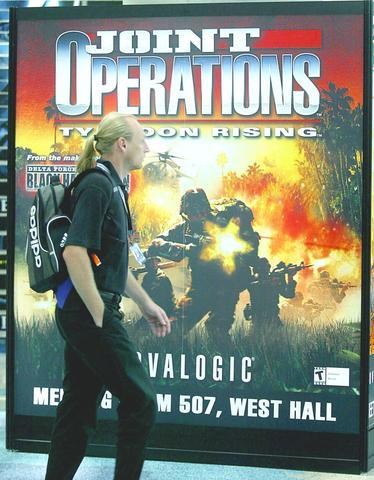
PHOTO: DPA
The size of the gathering testifies to its popularity. The NPD Group, which tracks the industry, said videogame retail sales in the US -- including software, hardware, personal-computer games and accessories -- totalled US$11.2 billion last year with worldwide sales estimated to be double that figure. And that was in a down year, when sales were low because major consoles are getting long in the tooth and customers began waiting for the new models to hit the showrooms.
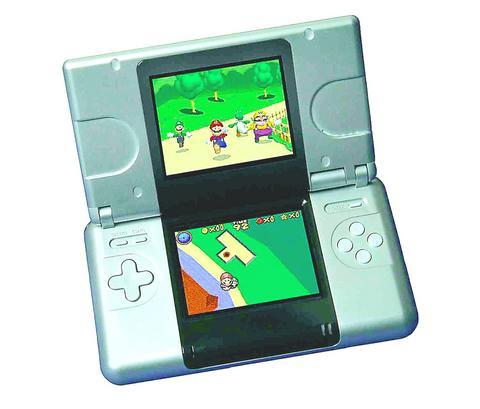
Most of the big news from the four-day confab was well-known in advance. There are upgrades for Microsoft's Xbox console, which is gradually gaining on Sony's PlayStation 2; product announcements from Nintendo and Sony about new portable gaming consoles that will spark a new handheld war for the hearts of male teens and the pockets of their parents; and a host of new game announcements, including new versions of such old faves as Doom and Halo.
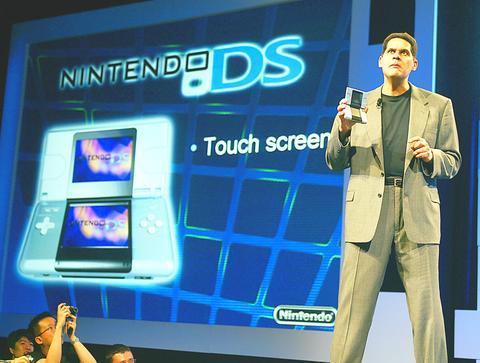
PHOTO: REUTERS
The new consoles that will debut at the end of next year will feature revolutionary new processors that will improve graphic power and allow the consoles to take their rightful place in the digital-entertainment networks that are becoming ever more common in tech-savvy homes.
To keep sales up until then, Sony announced it was dropping the price of its PS2 to US$149 to attract more soft-core gamers.
Microsoft, meanwhile, was intent on improving the already impressive features of its Xbox. It unveiled a live videoconferencing feature for its consoles, allowing up to five players to see and speak to each other as they blast away.
Another significant announcement for the Xbox was the news that publishing giant Electronic Arts will finally start to produce games for it.
Since conventional wisdom states that any console is only as good as the games it plays, the deal gives a real boost to Microsoft's dream of surpassing Sony as the industry's leading
console.
"This is what gamers have been clamoring for in the past couple of years," said Cameron Ferroni, general manager of Xbox Live at Microsoft, with only a hint of hype.
Usually sober analysts raved that the deal might actually help Microsoft surpass Sony in console sales for the first time in history.
It could also prove a huge boost to Microsoft Chairman Bill Gates, who hopes that the Xbox can eventually offset Microsoft's slower growth in software sales for personal computers.
Since its 2000 debut, the Xbox has sucked up to US$2 billion from Microsoft's massive coffers, trailing the best-selling PS2 in distant second place with sales of 15 million units compared to 70 million units for the Sony.
But recent industry figures have shown the Xbox to be gaining momentum, and in April, it sold about the same number of consoles as Sony. The Xbox was a huge gamble for Microsoft, and it's finally starting to pay off, said Matt Rosoff, an analyst at the
independent research firm Directions on Microsoft.
Such a trend would be ominous for Sony, whose executives are well aware of how ruthlessly Microsoft plays catch-up. Similar tactics helped Microsoft drive Internet pioneer Netscape out of business, and with Sony relying on the PS2 for most of its profits, the writing is on the wall for the iconic Japanese company.
Sony has said it hopes that its entry into the handheld gaming market might give birth to a new cash cow and is even touting its PSP, which it is displaying for the first time in Los Angeles, as the Walkman of the 21st century.
The comment refers to Sony's then-revolutionary portable cassette player of the late 1970s that epitomized the company's leadership of consumer electronics. But Sony has largely missed out so far on the latest wave of portables. From PDAs (personal digital assistants) to MP3 players and handheld games, the Japanese giant has been a digital also-ran. But with the ability to play movies, games and music, the PSP marks Sony's bold attempt to leapfrog the entire field.
Business 2.0 magazine has already dubbed the machine the iPod killer, predicting that it will mark the beginning of the end for Apple Computer's dominant MP3 player. But first it will have to beat a new device from Nintendo, which virtually owns the mobile game space with its Game Boy Advance and which plans to extend its dominance with the Game Boy Double Screen, which features two LCD screens and two microprocessors and promises to introduce a completely new style of gaming.
The market will have to wait until next year at least to see who wins these fascinating battles. But one thing is for sure: As always in the electronic entertainment industry, some of the most exciting contests will continue to take place behind the screens.

In late October of 1873 the government of Japan decided against sending a military expedition to Korea to force that nation to open trade relations. Across the government supporters of the expedition resigned immediately. The spectacle of revolt by disaffected samurai began to loom over Japanese politics. In January of 1874 disaffected samurai attacked a senior minister in Tokyo. A month later, a group of pro-Korea expedition and anti-foreign elements from Saga prefecture in Kyushu revolted, driven in part by high food prices stemming from poor harvests. Their leader, according to Edward Drea’s classic Japan’s Imperial Army, was a samurai

The following three paragraphs are just some of what the local Chinese-language press is reporting on breathlessly and following every twist and turn with the eagerness of a soap opera fan. For many English-language readers, it probably comes across as incomprehensibly opaque, so bear with me briefly dear reader: To the surprise of many, former pop singer and Democratic Progressive Party (DPP) ex-lawmaker Yu Tien (余天) of the Taiwan Normal Country Promotion Association (TNCPA) at the last minute dropped out of the running for committee chair of the DPP’s New Taipei City chapter, paving the way for DPP legislator Su

It’s hard to know where to begin with Mark Tovell’s Taiwan: Roads Above the Clouds. Having published a travelogue myself, as well as having contributed to several guidebooks, at first glance Tovell’s book appears to inhabit a middle ground — the kind of hard-to-sell nowheresville publishers detest. Leaf through the pages and you’ll find them suffuse with the purple prose best associated with travel literature: “When the sun is low on a warm, clear morning, and with the heat already rising, we stand at the riverside bike path leading south from Sanxia’s old cobble streets.” Hardly the stuff of your

Located down a sideroad in old Wanhua District (萬華區), Waley Art (水谷藝術) has an established reputation for curating some of the more provocative indie art exhibitions in Taipei. And this month is no exception. Beyond the innocuous facade of a shophouse, the full three stories of the gallery space (including the basement) have been taken over by photographs, installation videos and abstract images courtesy of two creatives who hail from the opposite ends of the earth, Taiwan’s Hsu Yi-ting (許懿婷) and Germany’s Benjamin Janzen. “In 2019, I had an art residency in Europe,” Hsu says. “I met Benjamin in the lobby


 RSS
RSS