


As landfills go, Charles Symons said one cloudless recent afternoon, this has been one of the best. He was gazing fondly at a 40m-high pile of yellow sand. Its south face was under patient assault by a front-end loader; its backside besieged by a man toting a high-pressure fire hose. They and others have been working here, around the clock, since 1997.
By next May, the sand pile, once a veritable mountain stretching hundreds of yards in every direction, will be gone. Symons' company will be a little richer. And, for better or worse, Johannesburg's storied history will be one sand pile poorer.

PHOTO: NY TIMES
Symons' company, Crown Gold Recoveries, is, with a handful of others, erasing this city's gold-mine dumps. It is a decades-long job: across the Witwatersrand reef, the long, narrow gold field running east to west just below downtown, there are about 240 of these huge dumps, covering 270km2 of once fertile earth.
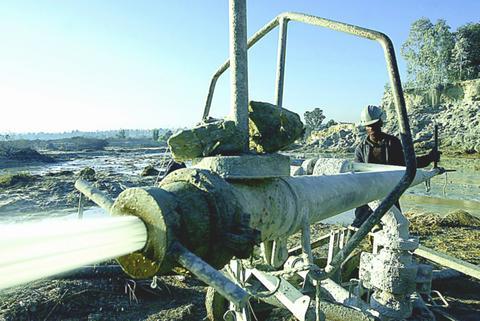
PHOTO: NY TIMES
Many will be delighted to see them go. Over the decades, the dumps have been both blights and hazards, so laden with heavy metals that few plants can survive on them; so unstable that dry winter winds can bathe the city in toxic dust clouds; so perilous that children periodically vanish in slides and cave-ins.
Yet many Johannesburg residents maintain a perverse attachment to them. Since the first discovery in 1886, the Witwatersrand has produced half the world's gold. Vast reserves are said to remain, but are too deep or inaccessible for miners to extract, and most of the area's mining petered out by the 1970s.
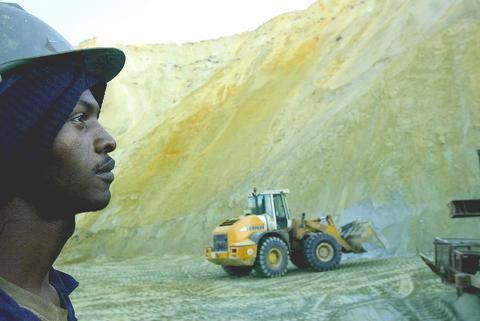
PHOTO: NY TIMES
The dumps -- fine-ground quartz sands rising as high as 90m, and "slimes dams" of dried-up quartz slurry -- are so huge that they can easily be seen from space. They are the most visible legacy of a century of mining, which built this city -- the remains of millions of tonnes of ore, hauled from hundreds of meters below the surface by uncounted numbers of laborers.
Some are but a few blocks from Johannesburg's skyscrapered center. One is home to a locally famous drive-in. Others are used by daring youths for dirt-biking, downhill sand-boarding and four-wheel expeditions.
"They're part of our identity -- it's hard to imagine Johannesburg without them," said Flo Bird, the chairwoman of the Parktown and Westcliffe Heritage Trust.
Bird, who calls the mounds "wonderfully stunning," compares them to the Grand Canyon, a ligament-snapping stretch of the imagination if ever one existed. "Of course," she added, "they're wildly polluted. And if you live near them, they're actually dangerous."
That said, it is not pollution, but money, that has drawn companies like Crown to the dumps. As ore was found deeper underground and became more expensive to retrieve, scientists took a second look at the mine tailings and found a mother lode of gold that the unsophisticated technologies of decades past had overlooked.
In the mid-1980s, a few companies began mining the tailings dumps themselves, converting the sand mountains, scoop by scoop, into a watery slurry, which is piped to processing plants on the city's south and east sides for gold extraction.
There, treated with cyanide and mixed with activated carbon and other chemicals, the quartz dust yields a bonanza -- roughly 1.4 ounces of pure gold per tonne of sand, on average, or a little less than US$600 worth at today's rates. In an average month, Symons said, the company produces about US$4.2 million in gold and clears a profit of about US$300,000.
That is hardly all that the sands yield. In reducing the dumps to hillocks, Symons said, "we've found everything -- dead bodies, locomotive parts, you name it."
Not long ago, workers found a perfectly preserved cache of glass-and-marble bottles from the early 20th century, discarded then as trash but prized now as antiques. On a recent day, near the bottom of the pile's south face, broad streaks of black were clearly visible against the yellow quartz dust -- century-old remains, Symons said, of the coal once used to fire the mine's steam-engine machinery.
Bird said preservationists had advanced any number of plans over the years to make better use of the dumps, from recreation areas to an Olympic Games complex, to a huge greenbelt splitting the city's less affluent south side.
Like New Yorkers who never make it to the top of the Empire State Building, "the vast majority of South Africans are not going to have the opportunity to go to game reserves," she said, "and right here in the middle of the city was our opportunity to remedy that."
That may still be. But it is more likely that the underlying land will become industrial parks, golf courses and shopping centers -- a few of the uses found for already cleared dump sites.
The pace of the dumps' disappearance rests entirely on the price of gold and the value of the rand on foreign-currency exchanges: in tough times, the front-end loaders shut down, waiting for the reclaiming operations to regain profitability. It could take a half-century to level most of the city's gold dumps, Symons said. Or it could take a century.
"To answer that question is to say how long is a piece of string," he said. "If the gold price doesn't behave, then we could be gone quite quickly."

In late October of 1873 the government of Japan decided against sending a military expedition to Korea to force that nation to open trade relations. Across the government supporters of the expedition resigned immediately. The spectacle of revolt by disaffected samurai began to loom over Japanese politics. In January of 1874 disaffected samurai attacked a senior minister in Tokyo. A month later, a group of pro-Korea expedition and anti-foreign elements from Saga prefecture in Kyushu revolted, driven in part by high food prices stemming from poor harvests. Their leader, according to Edward Drea’s classic Japan’s Imperial Army, was a samurai

The following three paragraphs are just some of what the local Chinese-language press is reporting on breathlessly and following every twist and turn with the eagerness of a soap opera fan. For many English-language readers, it probably comes across as incomprehensibly opaque, so bear with me briefly dear reader: To the surprise of many, former pop singer and Democratic Progressive Party (DPP) ex-lawmaker Yu Tien (余天) of the Taiwan Normal Country Promotion Association (TNCPA) at the last minute dropped out of the running for committee chair of the DPP’s New Taipei City chapter, paving the way for DPP legislator Su
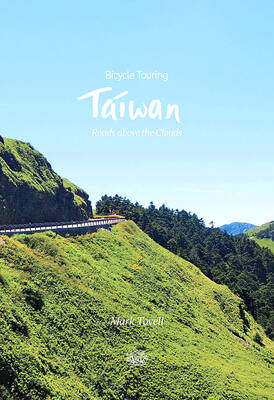
It’s hard to know where to begin with Mark Tovell’s Taiwan: Roads Above the Clouds. Having published a travelogue myself, as well as having contributed to several guidebooks, at first glance Tovell’s book appears to inhabit a middle ground — the kind of hard-to-sell nowheresville publishers detest. Leaf through the pages and you’ll find them suffuse with the purple prose best associated with travel literature: “When the sun is low on a warm, clear morning, and with the heat already rising, we stand at the riverside bike path leading south from Sanxia’s old cobble streets.” Hardly the stuff of your
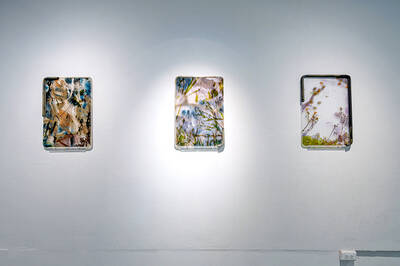
Located down a sideroad in old Wanhua District (萬華區), Waley Art (水谷藝術) has an established reputation for curating some of the more provocative indie art exhibitions in Taipei. And this month is no exception. Beyond the innocuous facade of a shophouse, the full three stories of the gallery space (including the basement) have been taken over by photographs, installation videos and abstract images courtesy of two creatives who hail from the opposite ends of the earth, Taiwan’s Hsu Yi-ting (許懿婷) and Germany’s Benjamin Janzen. “In 2019, I had an art residency in Europe,” Hsu says. “I met Benjamin in the lobby


 RSS
RSS