


Village of Stone is a relatively light-weight novel set in China. The 30-year old author, who now lives in London, is a filmmaker and writer. Though one of her films has been screened on British TV, this is her first novel to appear in an English translation.
The book isn't light-weight on account of the incidents that occur. These include childhood abuse by a deaf-mute man, sex with a school-teacher resulting in an abortion, and the death of her long-estranged father from cancer following an operation that removes part of his throat.
It's light-weight, instead, because the number of significant characters is limited, the way they're treated lacks depth and the point of view embraced is only that of the narrator, who is for much of the story a child. Even so, the book does have a clarity and straight-forwardness that isn't entirely unattractive.
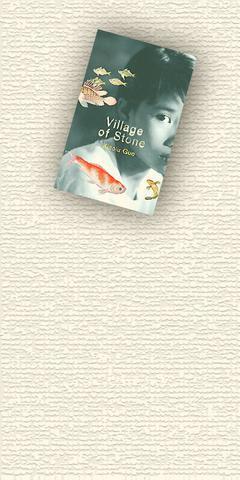
Coral Jiang is born in a fishing village in southern China. It's a bleak and unalluring spot, consisting largely of rock and mud, and looking out on a brown sea subject in summer to devastating typhoons. The villagers pile stones on their roofs to keep them from being ripped off by high winds -- hence the book's title.
From the start, home life is hard. Coral lives with her grandparents, and her grandfather kills himself shortly after the story begins. Fishermen gaze at the yellowish water and repeat homely maxims about only three inches of wood protecting them from a meeting with the gods of the underworld. The deaf-mute begins to feel inside Coral's dress when she's seven, and it's not that many years later that school chemistry lessons become enlivened by the attentions of a willowy teacher called Mr. Mou. When she allows him to have his way with her it's as much out of a charitable desire to let him prove his manhood as anything else.
But the novel opens on the first floor of a 25-floor apartment building in Beijing's Haidian district where the narrator, now 28, is living with her boyfriend Red, a good-natured lad who prefers introducing his friends to the art of Frisbee, rather than looking for a job. When a gigantic salted eel arrives by mail from her birthplace, a tenuous connection between the two halves of Coral's life is established. Afterward, the story alternates between one setting and the other.
There's every reason to think substantial portions of this book are autobiographical. Xiaolu Guo is described by her publishers as having been born in a fishing village in the south of China, and herself thanks someone who lived in a 25-story building "for showing me the basement experience, and love."
The problem with autobiographically
-based novels is that they rarely possess the excitement and dynamism of stories conjured up out of the imagination. Life tends not to take the single dramatic trajectory, low and fast as a Frisbee, that a thrillingly constructed plot can assume. This book begins with the arrival of the salted eel and ends when the entire creature has been consumed in a sequence of soups, stews, casseroles and fry-ups. The couple become so knowledgeable in the arcane field of eel recipes that they even think of opening up a small restaurant. Instead, Red gets a job as a writer on a sports magazine, as a result of his extensive knowledge of the mysteries of the Frisbee.
There's no doubt that some scenes in this unassuming book have a sharp kick to them. The chapter where the author goes for her abortion is all the more effective for being terse and clipped in tone. The doctor pointing out that surgical abortion is the quicker option but that these days the vacuum method is the procedure of choice, and then going on to list the risk factors, is chilling by reason of its blandly clinical tone. It's effectively capped by Coral's response "Which one is cheaper?" Similar scenes punctuate a text marked by an assiduous application to the school of Ernest Hemingway, no bad model for any writer, though a notoriously difficult one to imitate.
Taiwan makes an appearance when Red is described as humming a tune by the local pop singer Zhao Chuan in the shower: "I'm just a little bird who wants to fly, but I never seem to get too high/ I'm still searching for a bit of sky." Cross-strait cultural links, you feel, will never be the same again.
In a cynical mood, I could opt to say that there's just about enough material in this novel for three short stories. And even on the most charitable of days it's impossible to avoid the conclusion that the author has been fortunate to have her work published by an arm of the international corporate giant Random House. One imagines they envisage a largely teenage readership for this tale of adolescent woe followed by a degree of success in young adulthood (the narrator is successfully holding down a job in a video-rental store when the story opens). The author's actual success as a filmmaker and published novelist is, of course, far in excess of this.
Given the book's modest level of accomplishment, the publisher's claim that it's "a novel of breathtaking beauty" is merely the latest example of the profit-hungry exaggerations that very large publishers are increasingly addicted to. It's probably a matter of someone in a sales and promotion department feeling their job's at risk if they don't hype the latest product sufficiently absurdly. These corporate hirelings' worries as to what they'll say when a real masterpiece emerges must trouble their sleep.
This, in other words, is a readable but un-world-shattering piece of work that if it were set in Cleveland, Ohio would have already been rejected by a hundred publishers. China, though, once despised and rejected, is now the flavor of the month. But there's corporate values for you. Tomorrow it could be Easter Island.

In late October of 1873 the government of Japan decided against sending a military expedition to Korea to force that nation to open trade relations. Across the government supporters of the expedition resigned immediately. The spectacle of revolt by disaffected samurai began to loom over Japanese politics. In January of 1874 disaffected samurai attacked a senior minister in Tokyo. A month later, a group of pro-Korea expedition and anti-foreign elements from Saga prefecture in Kyushu revolted, driven in part by high food prices stemming from poor harvests. Their leader, according to Edward Drea’s classic Japan’s Imperial Army, was a samurai

The following three paragraphs are just some of what the local Chinese-language press is reporting on breathlessly and following every twist and turn with the eagerness of a soap opera fan. For many English-language readers, it probably comes across as incomprehensibly opaque, so bear with me briefly dear reader: To the surprise of many, former pop singer and Democratic Progressive Party (DPP) ex-lawmaker Yu Tien (余天) of the Taiwan Normal Country Promotion Association (TNCPA) at the last minute dropped out of the running for committee chair of the DPP’s New Taipei City chapter, paving the way for DPP legislator Su

It’s hard to know where to begin with Mark Tovell’s Taiwan: Roads Above the Clouds. Having published a travelogue myself, as well as having contributed to several guidebooks, at first glance Tovell’s book appears to inhabit a middle ground — the kind of hard-to-sell nowheresville publishers detest. Leaf through the pages and you’ll find them suffuse with the purple prose best associated with travel literature: “When the sun is low on a warm, clear morning, and with the heat already rising, we stand at the riverside bike path leading south from Sanxia’s old cobble streets.” Hardly the stuff of your

Located down a sideroad in old Wanhua District (萬華區), Waley Art (水谷藝術) has an established reputation for curating some of the more provocative indie art exhibitions in Taipei. And this month is no exception. Beyond the innocuous facade of a shophouse, the full three stories of the gallery space (including the basement) have been taken over by photographs, installation videos and abstract images courtesy of two creatives who hail from the opposite ends of the earth, Taiwan’s Hsu Yi-ting (許懿婷) and Germany’s Benjamin Janzen. “In 2019, I had an art residency in Europe,” Hsu says. “I met Benjamin in the lobby


 RSS
RSS