


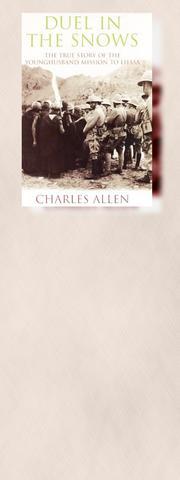
It's now a hundred years since the British military expedition led by Francis Younghusband set out from India for Tibet. As if to mark the anniversary comes this book, subtitled The True Story of the Younghusband Mission to Lhasa, by a writer who has penned many books on South Asia in the colonial period. He has searched through all the personal diaries, published memoirs, official dispatches and so forth, and come up with as detailed a re-creation of the expedition as will probably ever be possible.
The assault was an extraordinary affair. There were over 3,000 fighting men, plus several porters for each of them, hauling food, clothing, tents and guns up from the sub-tropical jungles of Sikkim to the stony wastes of the Himalayan upland. The whole straggling contingent arrived on the Tibetan border in mid-December, just as winter was getting into its stride.
The author has managed to slip in, presumably at the last moment, a comparison with the recent Iraq war. What weapons of mass destruction were there, he writes, Russian rifles were in Tibet 100 years ago. Neither were found, but the suspicion that they were present provided in each case a justification for war. In 1904 it was believed by some that the Russians had made a secret agreement with China over Afghanistan, and that Russians rifles were everywhere in the mystic and reclusive Himalayan state, threatening British India with destruction.
The government in London under Arthur Balfour -- a man who, according to A.N.Wilson, had acquired the nickname Clara at Cambridge and enjoyed being spanked by his friend Lady Elcho -- wasn't particularly disposed to believe this. But the British Viceroy in India, Lord Curzon, certainly saw it as a suitable pretext for sending a military force. The arrest by the Tibetans of two Sikkim merchants, and even the rustling of some yaks close to the border, were convenient back-up complaints. And so it was that Colonel Younghusband set off, with 10,000 mules, 3,000 drivers, and 67 shirts for his own personal use, up onto the roof of the world.
Particularly notable among this book's predecessors are two volumes, Bayonets in Lhasa (1961) by the celebrated Central Asian traveler Peter Fleming, and the hugely entertaining and vivid biography Younghusband: The Last Great Imperial Adventurer by Patrick French (1994), a book well worth reading, whether you are interested in its subject or not.
Just what a bizarre figure Younghusband was is fully shown in this latter book. French shows how, following his debonair Tibetan adventure, the by then celebrated adventurer became a combination of patriot and religious mystic, founding a "Fight for Right" movement that sought to vindicate WWI as a moral mission, and writing books promoting both free love and a new religion uniting the principles of Christianity, Buddhism, Hinduism and Islam. He also embarked, in his 80s, on a love affair which he hoped would produce a new Messiah, a "God-Child", possibly female. (This would-be God-the-Father saw no reason why the next Christ, his own offspring, should not be a woman).
His expedition to Lhasa, however, had not been without its brutality. It was a military operation, after all, despite the bevy of botanists, antiquarians, archeologists and Tibetologists that had accompanied it. There were several important engagements in which considerable numbers of Tibetans were killed, mostly by the terrifying power of the new Maxim machine-gun, with the invading force sustaining few casualties. In one such incident the Tibetans, who had sporadically attacked the invading force with ancient muskets, had simply walked away, trusting in the power of their religious amulets to protect them. A Maxim gun mowed them down like grass.
The final outcome of the affair was that the British left after a year, obtaining an agreement from the Tibetans to pay the equivalent of
?500,000 over 75 years to cover half the cost of their impoverished country's invasion. A British trade officer was established in the country, and a frontier valley was to host a British force until the indemnity was paid off. In the event the indemnity was later reduced by two-thirds, and the British stay in the Chumbi Valley reduced to a mere 36 months.
When the expedition arrived back in India, 400 mule-loads of "rare and valuable manuscripts of Lamaist sacred works, images, religious paraphernalia of all descriptions, armor, weapons, paintings and porcelain" were put on display in the India Museum in Calcutta. Much of this was undoubtedly looted, though some -- how much, surmises Allen, can never now be known -- may have been bought legitimately in local markets. Such is the paradoxical nature of history that this material now provides a major source of information on ancient Tibet when so much else was destroyed by Red Guards during China's Cultural Revolution.
This book will make absorbing reading for anyone wanting to know all there is to be known about the 1904 to 1905 Tibet expedition. But for sheer style, humor and memorable detail, nothing can replace Patrick French's superb and endlessly re-readable Younghusband, a combined biography and personal travelogue now in Flamingo paperback, and one of the greatest modern books on any Asian subject.
In late October of 1873 the government of Japan decided against sending a military expedition to Korea to force that nation to open trade relations. Across the government supporters of the expedition resigned immediately. The spectacle of revolt by disaffected samurai began to loom over Japanese politics. In January of 1874 disaffected samurai attacked a senior minister in Tokyo. A month later, a group of pro-Korea expedition and anti-foreign elements from Saga prefecture in Kyushu revolted, driven in part by high food prices stemming from poor harvests. Their leader, according to Edward Drea’s classic Japan’s Imperial Army, was a samurai

The following three paragraphs are just some of what the local Chinese-language press is reporting on breathlessly and following every twist and turn with the eagerness of a soap opera fan. For many English-language readers, it probably comes across as incomprehensibly opaque, so bear with me briefly dear reader: To the surprise of many, former pop singer and Democratic Progressive Party (DPP) ex-lawmaker Yu Tien (余天) of the Taiwan Normal Country Promotion Association (TNCPA) at the last minute dropped out of the running for committee chair of the DPP’s New Taipei City chapter, paving the way for DPP legislator Su
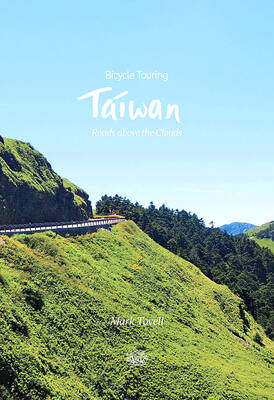
It’s hard to know where to begin with Mark Tovell’s Taiwan: Roads Above the Clouds. Having published a travelogue myself, as well as having contributed to several guidebooks, at first glance Tovell’s book appears to inhabit a middle ground — the kind of hard-to-sell nowheresville publishers detest. Leaf through the pages and you’ll find them suffuse with the purple prose best associated with travel literature: “When the sun is low on a warm, clear morning, and with the heat already rising, we stand at the riverside bike path leading south from Sanxia’s old cobble streets.” Hardly the stuff of your
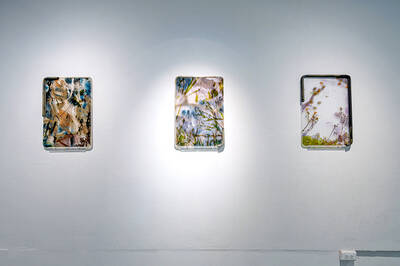
Located down a sideroad in old Wanhua District (萬華區), Waley Art (水谷藝術) has an established reputation for curating some of the more provocative indie art exhibitions in Taipei. And this month is no exception. Beyond the innocuous facade of a shophouse, the full three stories of the gallery space (including the basement) have been taken over by photographs, installation videos and abstract images courtesy of two creatives who hail from the opposite ends of the earth, Taiwan’s Hsu Yi-ting (許懿婷) and Germany’s Benjamin Janzen. “In 2019, I had an art residency in Europe,” Hsu says. “I met Benjamin in the lobby


 RSS
RSS