


For many of Taiwan's foreign community, sitting through traditional Chinese opera is at best a minor penance, and at worse a couple of hours of unremitting hell. Most often such performances -- lasting between two and three hours -- are sat through as an offering on the altar of cultural awareness, and while bouts of physical virtuosity may be applauded, there is often little else that can appeal to a Western audience.
The Kenneth Pai (
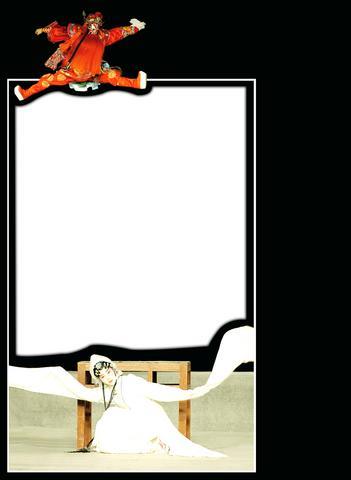
PHOTO COURTESY OF CKS CULTURAL CENTER
Kunqu, the operatic form in which The Peony Pavilion is presented, is regarded by many as one of the oldest living operatic traditions of China. The form's inclusion in the UNESCO inaugural "Masterpieces of the Oral and Intangible Heritage of Humanity" list (March 18, 2001) does not do a lot to inspire confidence, in circles outside the cultural cognoscenti. That kunqu shares a listing with Kuttiyattam Sanskrit Theatre and Georgian Polyphonic Singing as an art form which is of "outstanding value, [has] roots in cultural tradition, [is] an affirmation of cultural identity, source of inspiration and intercultural exchange, contemporary cultural and social role, [shows] excellence in the application of skills, [is a] unique testimony of living cultural tradition, and risk of disappearing" is not necessarily a great motivation to drop more than NT$6,000 for a nine-hour performance over three days.

PHOTO: IAN BARTHOLOMEW, TAIPEI TIMES
That kunqu has been recognized by a body such as UNESCO is obviously a good thing for all involved in this art form, but it is perhaps more important that someone like novelist Kenneth Pai has decided to put his very considerable international reputation behind the revival of this art form. For Pai, this production of The Peony Pavilion is the culmination of a lifetime's dedication to kunqu, one that has only been achieved due to his own unique position in the Chinese literary
pantheon.
The Peony Pavilion, also known as The Return of the Soul, is a classic of the kunqu repertoire and a number of scenes such as "Wandering in the Garden" and "Waking from a Dream" are regularly performed in compilations of opera highlights.
The complete opera, with 55 scenes and an approximate performance time of 20 hours is now virtually never seen in its entirety. (Though the form's appeal is underlined by the sellout performance in July 1999 at the Lincoln Center, New York of a complete 20-hour production.)
The current production is an abridgement of this gargantuan work, weighing in at 28 scenes that will be performed over approximately nine hours divided over three evenings. A major part of Pai's involvement in this production has been in the editing of the opera to bring it down to manageable size.
"Everything we have is in the original," said Pai, to emphasize that no transitional passages had been introduced during the editorial process. Although Kenneth Pai is arguably the greatest of contemporary Chinese writers, he has had no wish to tamper with the original lyrics. The main purpose behind his abridgement is to allow the huge work to be presented in something resembling its entirety, so that the overall dramatic structure remains intact.
The story of The Peony Pavilion is exceedingly involved, but at its most basic, revolves around the love between Liu Meng-mei, a young student, and Tu Li-niang, the daughter of a high official. In the first of three main sections, Tu has a dream in which she falls in love with Liu. When she awakes and discovers that her love was just a dream, she is inconsolable and dies of a broken heart. In the second section, Liu visits the garden in which Tu had her dream and discovers a painting of her that she hid there before she died. He falls in love with her and learning that her grave is nearby, has her disinterred and discovers that she is still alive. In the third section, Tu sends Liu to find her father, but who is mistaken for the desecrator of his daughter's grave, is whipped and only finally
vindicated.
The opera rings all the changes on the romantic theme and it is hardly surprising that it has been compared to Romeo and Juliet. Pai sums up the three sections as being a dream of love, love between man and spirit, and human love. It is an exploration of romantic love and is written with a degree of passion that is well outside the stereotype of Chinese sexual conservatism.
The lyrics for kunqu opera are probably the most literary of all Chinese opera lyrics, an important reason for the appeal that kunqu has continued to exercise over writers and literati through the ages and on Pai in particular. At a speech at the National Central University last week, Pai emphasized the importance that students of literature have exerted in the preservation of kunqu.
But ultimately, The Peony Pavilion is part of a theatrical rather than a literary tradition and to be fully appreciated needs to be seen in performance to be truly appreciated. Given that kunqu talent is relatively thin on the ground, a huge performance such as The Peony Pavilion presented great difficulties. Pai himself imposed conditions on the selection of the male and female lead singers that added significantly to the problems as well as the significance of the current production.
As The Peony Pavilion is about young lovers, Pai wanted young people to perform the leading roles, rather in the spirit of Baz Luhrmann's Romeo + Juliet which used a 17-year-old Claire Danes and a 22-year-old Leonardo DiCaprio in the title roles. In the long performance about youth, beauty and love, Pai wanted his protagonists to at least be young and beautiful, if not actually in love, rather than drawing on veteran middle-aged performers.
"But the quality of their performances was obviously a problem," Pai said, and while Luhrmann was able to circumvent the enormous pressure placed on Shakespearean actors in leading roles for his young charges through short or multiple takes, Pai had no such options. Having cast his two leading roles, Pai needed to find someone to train them, and given his stature in the Chinese cultural world, was able draw on the talents of Chang Ji-ching (
Pai said he sees this production as a high-level transmission of kunqu from one generation to the next in an environment that does not encourage it. "Teaching outside the troupe you are attached to is discouraged, and in any case, many of the masters see training young performers as something of a thankless task," Pai said.
In this production of The Peony Pavilion, Pai has sought to span both tradition and modernity. He insists that in many respects, his "youth edition" of The Peony Pavilion is extremely conservative in terms of presentation, abjuring ornate stage settings and lighting effects.
"We have used the technology of modern theater in moderation," he said, allowing the personalities of the singers to shine out in the full passion of their romantic involvement. "After all, it is a story about young love. It is something that young people should be able to enjoy," Pai said.
The packed audiences that have filled university lecture halls around the country when Pai has spoken about his new production over the last few weeks suggest that he has achieved his goal.
Performance notes:
What: The Peony Pavilion
Who: Kenneth Pai and the Suzhou Kun Opera
When: Book 1: April 29, May 1; Book 2: April 30, May 2; Book 3: May 1,2
Where: National Theater Taipei
Tickets: All sold out.
Other Events: A highlights performance of kunqu opera will be performed at the Metropolitan Hall tonight at
7:30pm; an international conference on The Peony Pavilion will take place at the International Conference Center on April 27, April 28.
Detailed information about the conference is available at the Academia Sinica Web site www.litphil.sinica.edu.tw

In late October of 1873 the government of Japan decided against sending a military expedition to Korea to force that nation to open trade relations. Across the government supporters of the expedition resigned immediately. The spectacle of revolt by disaffected samurai began to loom over Japanese politics. In January of 1874 disaffected samurai attacked a senior minister in Tokyo. A month later, a group of pro-Korea expedition and anti-foreign elements from Saga prefecture in Kyushu revolted, driven in part by high food prices stemming from poor harvests. Their leader, according to Edward Drea’s classic Japan’s Imperial Army, was a samurai

The following three paragraphs are just some of what the local Chinese-language press is reporting on breathlessly and following every twist and turn with the eagerness of a soap opera fan. For many English-language readers, it probably comes across as incomprehensibly opaque, so bear with me briefly dear reader: To the surprise of many, former pop singer and Democratic Progressive Party (DPP) ex-lawmaker Yu Tien (余天) of the Taiwan Normal Country Promotion Association (TNCPA) at the last minute dropped out of the running for committee chair of the DPP’s New Taipei City chapter, paving the way for DPP legislator Su

It’s hard to know where to begin with Mark Tovell’s Taiwan: Roads Above the Clouds. Having published a travelogue myself, as well as having contributed to several guidebooks, at first glance Tovell’s book appears to inhabit a middle ground — the kind of hard-to-sell nowheresville publishers detest. Leaf through the pages and you’ll find them suffuse with the purple prose best associated with travel literature: “When the sun is low on a warm, clear morning, and with the heat already rising, we stand at the riverside bike path leading south from Sanxia’s old cobble streets.” Hardly the stuff of your

Located down a sideroad in old Wanhua District (萬華區), Waley Art (水谷藝術) has an established reputation for curating some of the more provocative indie art exhibitions in Taipei. And this month is no exception. Beyond the innocuous facade of a shophouse, the full three stories of the gallery space (including the basement) have been taken over by photographs, installation videos and abstract images courtesy of two creatives who hail from the opposite ends of the earth, Taiwan’s Hsu Yi-ting (許懿婷) and Germany’s Benjamin Janzen. “In 2019, I had an art residency in Europe,” Hsu says. “I met Benjamin in the lobby


 RSS
RSS