


Chienguo Brewery is the smallest of four breweries in Taiwan and the first large-scale brewing operation on the island. Built in 1919, during the Japanese colonial period, the brewery's first batches of Gaosha Beer (高砂麥酒) were being rolled out a year later to the delight of soldiers and civilians alike.
Officially, the brewery is no longer open to tours, but groups can arrange visits through the Taiwan Tobacco and Liquor Company (TTL). The Taipei Times arranged an extended tour of the facilities on the condition that no photographs be taken.
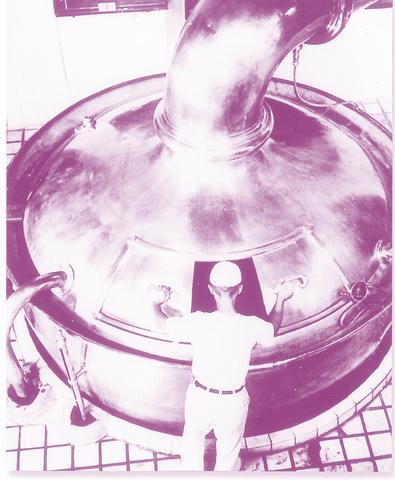
PHOTO COURTESY OF TTL
"What we do here is secret," said Tsao Wei-ching (曹維清), a brewmaster who's worked at Chienguo for the past 25 years and who would take time out of his schedule to serve as tour guide. But first, a toast: "Welcome to Chienguo Brewery," Tsao says. "Gan bei!"
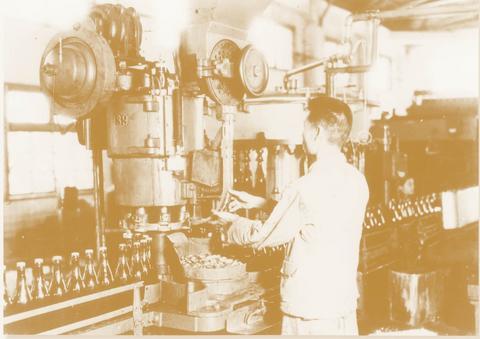
Touring a brewery is a hell of a thing to do at 8am. Visitors are greeted by the thwack sound of a newborn bottle of beer being opened regardless of the time of day. Any thought you may have had that being a brewer is an enviable job vanishes with the gases wafting up and out of the fermentation vats.
"Before Gaosha, all the beer in Taiwan was imported from Japan," Tsao explains at the start of the tour. "But before long, Gaosha was being shipped back to Japan and eventually became just as popular as Sapporo Beer."
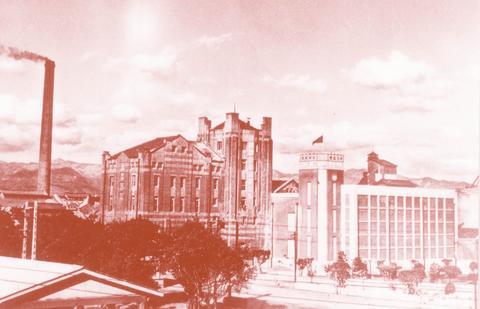
To understand how important the brewery was to the Japanese, it was built using the same bricks used to build the Japanese Governor's Palace, now the Presidential Building.
In 1945, with the arrival of Nationalist troops from China, the brewery became the Taipei Beer Company and was the sole brewer of Taiwan Beer until a second brewery was opened years later and it was renamed the Taipei Second Brewery. It was given its present name in 1975.
Many changes
But its name was not the only thing to change over the years. From the late 1940s to the 1950s on-site facilities included a nursery school and a large elementary school for the children of brewery employees. Additional buildings were added and some older facilities were dismantled to make room for the modernization of the brewery.
That modernization culminated in 1992, when the brewery became largely automated and brewmasters were replaced with computers. That same year saw the brewery's peak of production with 700 employees brewing, bottling, capping, labeling and shipping 144 million bottles of beer. ["Take one down, pass it around, 139,999,999 bottles of beer on the wall!"]
Other changes included the elimination of both kegs and the smaller 0.35-liter bottles in favor of the current 0.6-liter variety, though other breweries in Taiwan continue to package their product in these larger sizes.
The most recent change has come in the form of competition. The introduction of beers from China, most notably Tsingtao, has impinged on Taiwan Beer's previous monopoly. But the home brew maintains 80 percent of Taiwan's US$6.5 billion market, according to TTL statistics.
However, the dip in market share has contributed to the scaling back of production at Chienguo. In fact, the place was almost shut down four years ago, though the official reason given was because of noise and pollution complaints from the neighboring community. Instead, production was scaled back, part of the land was given over to the construction of junior high school, and the Taipei City Government Cultural Affairs Bureau designated the remaining property an historical landmark. It is now staffed by 95 people producing 2 million bottles a year.
More changes are on the horizon. Taipei's Cultural Affairs Bureau is brewing plans of its own to turn the site into a recreational area with operational brewing facilities on a limited scale. The building that hides the facilities built in 1919 is to be razed and the original buildings refurbished.
The one thing that has not changed over the years, according to Tsao, is the recipe. Like its predecessor, Gaosha, Taiwan Beer is a lager and undergoes a cold-fermentation process that allows the yeast to settle and be removed, giving the finished product greater carbonation and a golden coloring rather than a hazy amber. Also like Gaosha, Taiwan Beer has penglai rice (蓬萊白米) added to it, along with the malt and hops. This, Tsao explains, is what gives Taiwan Beer its award-winning taste. It won the gold medal at the World Selection for Beer in Geneva in both 1978 and 1988 and earned a silver medal in the Brewing Industry International Awards in 2002.
The tour finishes in the back of the brewery grounds under a canopy of corrugated metal, where a matrix of machines, pipes and conveyor belts converge: a bottle washer that scrubs the labels and sanitizes thousands of bottles at a time, a beer filler and capper that produces 550 bottles of beer per minute, a pasteurizer that showers those bottles in hot water for an hour, and finally a labeler and caser that readies the bottles for store shelves.
In an office overlooking the whole operation, several brewers take their lunch breaks, enjoying bian dang and, not surprisingly, bottles of beer. Here, the tour ends as it began, with a toast: "To Taiwan Beer! The best beer in the world!" Tsao says.

In late October of 1873 the government of Japan decided against sending a military expedition to Korea to force that nation to open trade relations. Across the government supporters of the expedition resigned immediately. The spectacle of revolt by disaffected samurai began to loom over Japanese politics. In January of 1874 disaffected samurai attacked a senior minister in Tokyo. A month later, a group of pro-Korea expedition and anti-foreign elements from Saga prefecture in Kyushu revolted, driven in part by high food prices stemming from poor harvests. Their leader, according to Edward Drea’s classic Japan’s Imperial Army, was a samurai

The following three paragraphs are just some of what the local Chinese-language press is reporting on breathlessly and following every twist and turn with the eagerness of a soap opera fan. For many English-language readers, it probably comes across as incomprehensibly opaque, so bear with me briefly dear reader: To the surprise of many, former pop singer and Democratic Progressive Party (DPP) ex-lawmaker Yu Tien (余天) of the Taiwan Normal Country Promotion Association (TNCPA) at the last minute dropped out of the running for committee chair of the DPP’s New Taipei City chapter, paving the way for DPP legislator Su
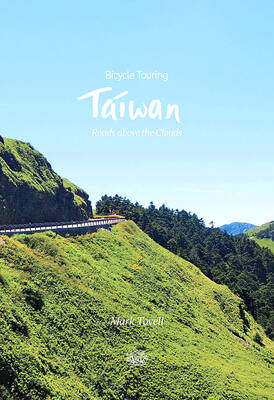
It’s hard to know where to begin with Mark Tovell’s Taiwan: Roads Above the Clouds. Having published a travelogue myself, as well as having contributed to several guidebooks, at first glance Tovell’s book appears to inhabit a middle ground — the kind of hard-to-sell nowheresville publishers detest. Leaf through the pages and you’ll find them suffuse with the purple prose best associated with travel literature: “When the sun is low on a warm, clear morning, and with the heat already rising, we stand at the riverside bike path leading south from Sanxia’s old cobble streets.” Hardly the stuff of your
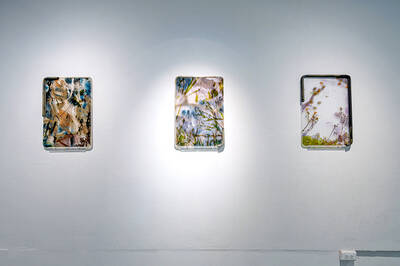
Located down a sideroad in old Wanhua District (萬華區), Waley Art (水谷藝術) has an established reputation for curating some of the more provocative indie art exhibitions in Taipei. And this month is no exception. Beyond the innocuous facade of a shophouse, the full three stories of the gallery space (including the basement) have been taken over by photographs, installation videos and abstract images courtesy of two creatives who hail from the opposite ends of the earth, Taiwan’s Hsu Yi-ting (許懿婷) and Germany’s Benjamin Janzen. “In 2019, I had an art residency in Europe,” Hsu says. “I met Benjamin in the lobby


 RSS
RSS