


Englishmen rather than mad dogs are at the center of this book, a social history of colonial Malaya from 1880 to 1960.
A major feature of the life of the educated English in the last 150 years could be said to have been the opposition between the professionals -- judges, colonial administrators, civil servants -- and the mockers, typically metropolitan artists and socialites. The former upheld society and the empire, while the latter sat back and laughed at them. But this opposition, which reflected the feud between the sports-playing "hearties" and the languid "esthetes" in British public schools, wasn't an unremitting hostility. At root, the two groups came from the same families and mixed socially. Thus Noel Coward's song about mad dogs and Englishmen going out in the midday sun, from which this book takes its title, while undoubtedly satirizing Empire-building Britons, was also laughed at, danced to, and probably even sung at festive dinners, by the imperial administrators themselves.
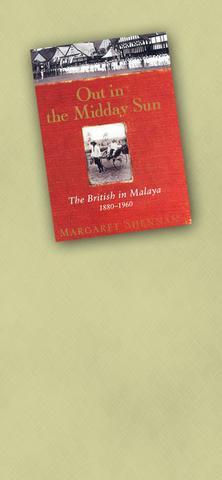
Coward -- a languid esthete if ever there was one -- also coined the lethal aphorism, "Malaya is a first-rate country for second-rate people." It's an expression Margaret Shennan quotes more than once, though with disapproval. But it reflected a sentiment widespread in the UK in the first half of the 20th century. Malaya, it was thought, was a good enough place for engineers, rubber-planters and Scotsmen, but it couldn't hold a candle to India, that jewel in the crown of British imperialism.
Somerset Maugham only reinforced the prejudice when he traveled in the land in the 1920s, listening to his hosts' tales on the verandah over many a stengah, and then writing up their gossip as short stories portraying them as bored, drunken and lecherous, far from home under an impossible tropical sun.
Shennan's book is, by contrast, a balanced affair. She has interviewed many surviving administrators, planters and members of their families, in addition to studying the printed sources. British rule appears here to have been authoritarian, softened -- or disguised -- by humor. Horrific incidents included a mutiny in Singapore in 1915 which ended with the execution of 37, two in front of a large crowd of spectators. One of the soldiers in the firing squad was described afterwards as having been "very shaky." Yet another man wrote home about the uprising in general "We had a great deal of fun out of it, and the whole thing has been very interesting and amusing." (He was probably trying to stop his family from worrying).
There were, however, celebrated cases that genuinely put the wind up the Raj, opening its impeccability to question. One such was the trial and conviction for murder of Ethel Proudlock in 1911. She had shot another Briton who she claimed had tried to rape her one Sunday evening when her husband was dining out. But it may have been that they were lovers, and she'd discovered that he also had a Chinese mistress (as her husband had had before his marriage). Either way, she was eventually pardoned by the Sultan of Selangor -- itself an event not without its problems for the protocol-sensitive British -- and immediately sailed back home. Ten years later Maugham heard about the case and turned it into a story entitled The Letter..
Many Britons, though, considered Malaya -- especially Singapore and Penang -- as a form of paradise, dubbing the Malays "Nature's gentlemen." Yet life can't always have been easy. This was an era when respectable expatriates wore their European clothes regardless of the heat -- gloves, for example, were compulsory for dancing -- and there was no air-conditioning. And the jungle, then as now, was characterized by impenetrable vegetation, leeches, steep slopes, interminable rain, and the dank odor of decay.
The 1920s and 1930s constituted the golden age for these expatriates. After that the Japanese invasion, followed by the Communist insurgency, turned life into a nightmare. Many Britons were released from jail in 1945 only to find themselves on isolated plantations in siege conditions, their houses surrounded by barbed wire and floodlights, their phone lines cut and an ambush threatening round every muddy corner. During the two months Graham Greene was in Malaya at the end of 1950 (a visit not mentioned in this book) there were 6,000 terrorist incidents -- children killed, trains blown up, the throats cut of rubber planters and their Malay employees alike.
Margaret Shennan has been long connected with what is now Malaysia. She was born in Kuching and brought up near Penang. Her overall attitude is that these expatriates were no better and no worse than their peers back home.
There was much to praise in their influence, though also much to mock in their lifestyle.
British conceptions of justice were neither superior not inferior to the local ones, she argues. The British brought principles of 貨air play,?whereas the traditional Malay rulers felt it looked better to punish the wrong man than to leave a crime unsolved. On the other hand the spread of
Western habits encouraged the decay of a traditional way of life that had bestowed much contentment.
Such contrasts could be seen in the details of everyday life. The British ate with knives and forks, whereas the Malays would use their hands. When challenged on the issue of hygiene, the Malays would reply that their fingers hadn't been in anyone else's mouth, and moreover could never be stolen. Again, whereas the foreigners often described the locals as 趺azy,?many Malays considered it better to retain their independence rather than fill their pockets with cash which they had little use for.
This book is engaging, fascinating to read, and probably in essence fair and just. Today Malaysia boasts the Petronas Towers, currently the second and third highest buildings in the world, and the ethos of English ladies taking tea on the verandah while manic birds shriek in the nearby forest seems almost as remote as ancient Byzantium.

In late October of 1873 the government of Japan decided against sending a military expedition to Korea to force that nation to open trade relations. Across the government supporters of the expedition resigned immediately. The spectacle of revolt by disaffected samurai began to loom over Japanese politics. In January of 1874 disaffected samurai attacked a senior minister in Tokyo. A month later, a group of pro-Korea expedition and anti-foreign elements from Saga prefecture in Kyushu revolted, driven in part by high food prices stemming from poor harvests. Their leader, according to Edward Drea’s classic Japan’s Imperial Army, was a samurai

The following three paragraphs are just some of what the local Chinese-language press is reporting on breathlessly and following every twist and turn with the eagerness of a soap opera fan. For many English-language readers, it probably comes across as incomprehensibly opaque, so bear with me briefly dear reader: To the surprise of many, former pop singer and Democratic Progressive Party (DPP) ex-lawmaker Yu Tien (余天) of the Taiwan Normal Country Promotion Association (TNCPA) at the last minute dropped out of the running for committee chair of the DPP’s New Taipei City chapter, paving the way for DPP legislator Su
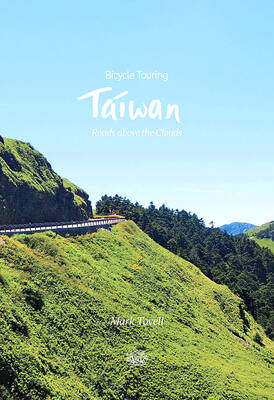
It’s hard to know where to begin with Mark Tovell’s Taiwan: Roads Above the Clouds. Having published a travelogue myself, as well as having contributed to several guidebooks, at first glance Tovell’s book appears to inhabit a middle ground — the kind of hard-to-sell nowheresville publishers detest. Leaf through the pages and you’ll find them suffuse with the purple prose best associated with travel literature: “When the sun is low on a warm, clear morning, and with the heat already rising, we stand at the riverside bike path leading south from Sanxia’s old cobble streets.” Hardly the stuff of your
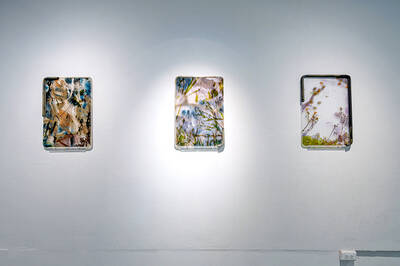
Located down a sideroad in old Wanhua District (萬華區), Waley Art (水谷藝術) has an established reputation for curating some of the more provocative indie art exhibitions in Taipei. And this month is no exception. Beyond the innocuous facade of a shophouse, the full three stories of the gallery space (including the basement) have been taken over by photographs, installation videos and abstract images courtesy of two creatives who hail from the opposite ends of the earth, Taiwan’s Hsu Yi-ting (許懿婷) and Germany’s Benjamin Janzen. “In 2019, I had an art residency in Europe,” Hsu says. “I met Benjamin in the lobby


 RSS
RSS