


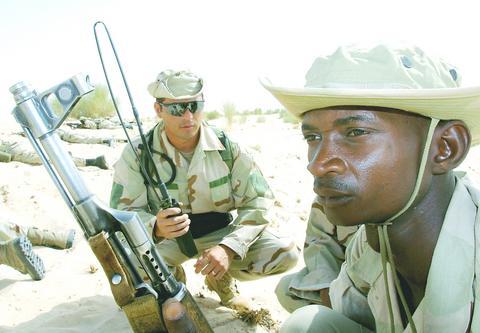
Lying in the sand, their AK-47s trained on some scrap metal and cardboard cut-outs, the Malian platoon held their fire as three donkeys stumbled into the kill zone.
"There are burros in my line of vision," an American voice crackled over the radio. "We don't want to kill nobody's livestock."
The elite US Special Forces who have been teaching Timbuktu's 512th Motorized Infantry Company to destroy enemy camps like to be thought of as "warrior diplomats," culturally sensitive and a cut above the rest of the military.
PHOTO: NY TIMES
In the inhospitable terrain of the Sahara Desert, bouncing across the dunes in a Land Rover chasing stubborn donkeys out of danger is the least they can do for the local economy.
But many Tuaregs -- light-skinned turban-clad nomads who have lived and worked in the desert for generations -- say the presence of US troops threatens both their livelihoods and a delicate balance of power in the Sahara.
US forces are training local troops in the region because Washington fears militant Islamic preachers, driven out of their native Algeria, are trying to recruit fresh forces in a traditionally moderate region for attacks on their homeland.
PHOTOS: REUTERS
The training for the army in Mali and neighboring Mauritania -- soon to be given to troops in Niger and Chad as well -- is supposed to help the West African countries police vast swathes of thinly-patrolled wilderness.
Yet some who make regular trips along ancient trading routes and speak with herders and caravan drivers at watering holes said the US activity was attracting bandits from the far reaches of the desert.
"Before the Americans came there were no terrorists in Mali," said Ibrahim Ag Mohamed, who guides tourists across the dunes from Timbuktu, a sand-swept town founded on a main caravan route in the 11th century.

"Since the American army came to Timbuktu, two groups of tourists have been stopped by armed bandits and asked if there were Americans among them," he said, his face lit by a shaft of sunlight filtering through the doorway of his mud-brick house.
The first group was stopped near Araouane, once a fabled oasis six days by camel north of Timbuktu, while the second was traveling from Mauritania to the salt mines at Taoudenni, a further nine days to the north, he said.
Another guide who had been with one of the groups told the same story, saying the bandits spoke Arabic, not the Tamashek language of the Tuaregs, and had left them alone when they realized none of the tourists were American.
"The bandits who are in Mali are Algerians who made an agreement with Tuareg groups in the north that they would not cause any harm to Mali," he said.
"But we are still afraid. They are bandits, terrorists. People who risk their lives to harm others."
US officials say the Salafist Group for Preaching and Combat (GSPC), a hardline Algerian Islamic militant group that has pledged allegiance to al Qaeda, is trying to re-arm and recruit further south after being forced out of its homeland.
Malian Colonel Younoussa Barazi Maiga said his forces had chased up to a hundred GSPC members out of his country in January. He said they were armed with the same weaponry as his men -- aging Chinese and Russian Kalashnikovs.
US officials say the group, thought to have been behind the kidnapping of 32 European tourists in Algeria last year, could try to topple the governments both in Algeria and Mauritania.
Some of Timbuktu's residents agree, although many Tuaregs -- who themselves fought a rebellion against the Malian government between 1990 and 1996 -- are reluctant to discuss the "secrets of the desert" in public.
In the market town, where salt tablets are exchanged for rice, millet, sugar and tea, they say they are afraid of the US troops and fear their conversations might be overheard by off-duty Malian soldiers. Several say they take a detour home to avoid surveillance cameras where the US troops live.
"We have seen the Americans and we're afraid because they're armed. We don't know why they're here," said Agaly Ag Mohamed, a caravan driver setting off for Taoudenni with around 25 camels.
But in the privacy of their homes, some are more forthcoming.
"The head of the group who took the hostages is still in Mali, near to Boughessa (a village northeast of Timbuktu). He took water at a well there not long ago, according to caravan drivers who've been there," one guide said.
"Apparently since the hostage-taking they have grown to 3,000 people, because they have the means, they have a lot of money. Malians who didn't have jobs or had problems in their community went to join them, went where there are arms."
US officials say their mission in the region is purely a peacekeeping and humanitarian one, but not all the desert's dwellers are convinced.
A top US general said last month the military aimed to establish common practices and agreements around Africa allowing it fast access to emerging threats without permanent bases.
American officers acknowledge the training has established contacts which could be useful for other missions in the future.
"A year from now, or in two, or three, these guys can come back and don't think for a second they [the Malians] won't remember them," a spokeswoman for the US Special Forces said, as they handed out ice-cold sodas and cigars to the Malians in the desert heat.

In late October of 1873 the government of Japan decided against sending a military expedition to Korea to force that nation to open trade relations. Across the government supporters of the expedition resigned immediately. The spectacle of revolt by disaffected samurai began to loom over Japanese politics. In January of 1874 disaffected samurai attacked a senior minister in Tokyo. A month later, a group of pro-Korea expedition and anti-foreign elements from Saga prefecture in Kyushu revolted, driven in part by high food prices stemming from poor harvests. Their leader, according to Edward Drea’s classic Japan’s Imperial Army, was a samurai

The following three paragraphs are just some of what the local Chinese-language press is reporting on breathlessly and following every twist and turn with the eagerness of a soap opera fan. For many English-language readers, it probably comes across as incomprehensibly opaque, so bear with me briefly dear reader: To the surprise of many, former pop singer and Democratic Progressive Party (DPP) ex-lawmaker Yu Tien (余天) of the Taiwan Normal Country Promotion Association (TNCPA) at the last minute dropped out of the running for committee chair of the DPP’s New Taipei City chapter, paving the way for DPP legislator Su
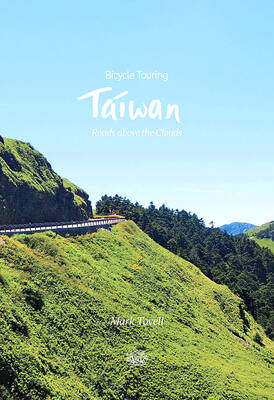
It’s hard to know where to begin with Mark Tovell’s Taiwan: Roads Above the Clouds. Having published a travelogue myself, as well as having contributed to several guidebooks, at first glance Tovell’s book appears to inhabit a middle ground — the kind of hard-to-sell nowheresville publishers detest. Leaf through the pages and you’ll find them suffuse with the purple prose best associated with travel literature: “When the sun is low on a warm, clear morning, and with the heat already rising, we stand at the riverside bike path leading south from Sanxia’s old cobble streets.” Hardly the stuff of your

Located down a sideroad in old Wanhua District (萬華區), Waley Art (水谷藝術) has an established reputation for curating some of the more provocative indie art exhibitions in Taipei. And this month is no exception. Beyond the innocuous facade of a shophouse, the full three stories of the gallery space (including the basement) have been taken over by photographs, installation videos and abstract images courtesy of two creatives who hail from the opposite ends of the earth, Taiwan’s Hsu Yi-ting (許懿婷) and Germany’s Benjamin Janzen. “In 2019, I had an art residency in Europe,” Hsu says. “I met Benjamin in the lobby


 RSS
RSS