


In the countdown to the March 20 presidential election, the two competing camps are not only trading barbs about black gold and corruption, but striving to drown out each other musically. Green- and blue-
flagged campaign trucks blare out at full volume invigorating campaign songs to the most remote corners of the country as they make their rounds along every street.
"Election campaigns in Taiwan are much more interesting than in other countries, especially in their use of music," said Nancy Guy, professor at the Department of Music of the University of California, San Diego, who is in Taiwan researching campaign music. "The commissioning of original campaign songs is a uniquely Taiwanese phenomenon."
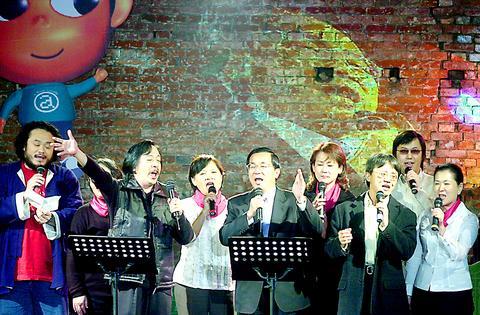
President Chen Shui-bian (陳水扁) has a long history of using campaign songs and paved his way to Taipei City Hall in 1994 by singing Taipei, New Hometown (台北新故鄉) and Spring Blossoms. (春天的花蕊) These two songs, with lyrics like: "Putting new branches on the old tree/Making every twig stretch toward the sky" and, "You're the most beautiful flower in spring/I'm not afraid to get caught in the rain for you," mark the start of the use of original pop-style music for election campaigns.
Ten years later both the DPP and the KMT-PFP camps are taking campaign music to new levels. In January, the DPP released an album of seven original songs and one hit single collection of songs used in previous campaigns, the largest production of musical products for a campaign. Around the same time, the Lien Chan (連戰) and James Soong (宋楚瑜) presidential campaign released the pan-blue parties' first campaign music album of six original songs and three remakes of older songs. Both camps released KTV versions and provide downloadable cellphone ring tones on their Web sites.
The KMT-PFP's Bring Taiwan Together! album is a change from its previous practice of recycling old patriotic songs. The six original compositions all have Taiwanese-language lyrics.
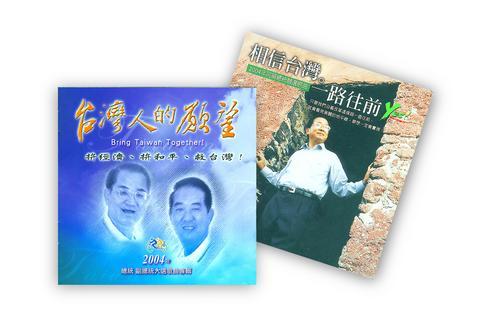
PHOTO: SEAN CHAO, TAIPEI TIMES
"The KMT used to adopt songs like Praise the Republic of China (中華民國頌) in campaigns, but times have changed. Campaigning as an opposition party, we want to appeal to certain ethnic groups that we've been trying to win over," said Justin Chou (周守訓), spokesman of the KMT and one of the four singers in Orange Blue, the chorus performing on the album.
"We hope that the songs move Taiwanese and they can sing along to them. For voters of different musical tastes, we have included styles such as heavy metal, dance, hip hop, Southern Taiwanese melodies, orchestral, easy-listening and traditional marching music, all sung in Taiwanese," Chou said.
"At first we were not going to include any Mandarin songs until we noticed that the pop classic Tomorrow Will Be Better (明天會更好) matched our campaign. We also adopted The True Colors of Hakka, which is well-known in Hakka communities, and arranged some songs in an Aboriginal style, to express our stand on ethnic harmony and the solidarity issue. As for the lyrics, there's no more Long Live the Republic of China, there's only ordinary citizens' discontent," Chou said.
Cheng Wen-tsan (鄭文燦), media section chief of the Chen Shui-bian presidential campaign headquarters said, "The DPP has always led the trend [in regard] campaign music. We have been able to produce songs that are good enough to become pop music hits. Moreover, we show our party's spirit in them. The KMT's campaign music does not live up to their image.
"Their party platforms have not changed, their character has not changed and yet they have changed their musical styles. It's dong shi hsiao ping [an ugly woman who imitates the demeanor of a natural-born beauty only to make her look even worse.] But we don't mind them copying us. Only good things get imitated," Cheng said.
Guy, who has collected campaign music from Taiwan for over a decade, recalls that in the 1990s, it was the DPP that started recording campaign music albums that included Taiwanese, Hakka and Aboriginal languages.
"It was their way of showing that they care about the diversified culture in Taiwan. They were also the first to stress musical performances in election campaigns in the 1990s. Since the year 2000, they still make much more music. On my last visit to Taiwan during the 2002 mayoral campaign, they gave me a whole package of CDs [at the DPP candidate] Lee Yin-yuan's (李應元) rally, but when I went to [the KMT candidate] Ma Ying-jeou's (馬英九) rally, I received only one CD. The difference made a deep impression on me," Guy said in a telephone interview. "Now the KMT is also using original music and Taiwanese and Hakka songs. It's quite ironic that they have adopted their rival's strategy."
Chou did not deny that the KMT-PFP has copied the DPP and said that campaign songs work well in motivating voters.
"We never try to sound similar to, or different from our rival ... We always consider the other camp's strong points. The KMT used to frequently feature the national flag and anthem in election campaigns, and the DPP has also used the ROC flag and anthem in its campaign commercials. The point is that the songs consolidate our voter base and we have succeeded in this. Our supporters become inspired when we play the songs at our rallies," Chou said.
Outside campaign rallies, not too many KMT-PFP supporters are fans of their album, which has sold less than 20,000 copies. The number contrasts sharply with the DPP's 100,000 sold, as of early March, when the album sold out, according to the DPP's Cheng.
"We have a record number of songs this time. The melodies are a continuation of the emotional strength of previous songs, and we have included songs in Taiwanese, Hakka and there's also one song in the Beijing dialect. These songs are a nice mix. Young people like the song about baseball, and the Beijing-dialect song has a more pop music feel," Cheng said.
With both camps now promoting themselves in Taiwanese, were they equally "localized" now or was it just a campaign strategy?
"In the 1990s, it was easy to tell that those who campaigned with ethnic-language songs genuinely wanted to reach out to different ethnic communities. But now it has become a political football. We don't know if people who do it now genuinely care about the multicultural identity of Taiwan," Guy said.
Ideological issues are faintly hinted at in both camps' songs. The KMT's The Wishes of Taiwanese (台灣人的願望) encourages listeners to see themselves as Taiwanese with lyrics like, "We have one heart/You and I are both Taiwanese" and "Regardless of the strife in the past/No matter whether you're from the mainland, Hakka or Fujianese."
The DPP's Believe in Taiwan (相信台灣) calls for a national effort to reform while implying Taiwanese are unhappy with China's constant interference, with lyrics like, "We're all children of Taiwan/We love each other/We take care of our family business/No need for other people to worry about us."
"The songs express our reliance on Taiwan and our deep feeling for this island," Cheng said.
On the pan-blue camp's inclusion of the self-promoting Vote for Lien and Soong, Save Taiwan on their album, with the lyrics "vote for blue," Cheng was disapproving. "That's really bad taste. We want quality music and beautiful lyrics."
The pan-blue camp, on the other hand, has reservations about the DPP's frequent use of the word "Formosa" for Taiwan in their lyrics. "Yes, Taiwan is Formosa and Formosa is Taiwan. However, the 23 million people here know the name Taiwan, but not everyone knows Formosa. If some people want to use some peculiar name or Dutch [sic] name for Taiwan, they are free to do so, but we believe that Taiwan is the name everyone identifies with," the KMT's Chou said.
"Formosa is Taiwan, but using the name calls attention to Taiwan's complex identity and its history, which is very different from China's history," said Guy on the DPP strategy of calling Taiwan
Formosa.
Although some people questioned her politics when they found Guy had participated in the DPP's campaign rallies, she insisted that as a US citizen, she has no involvement in Taiwan politics. Campaign music does not influence her, she claimed. Neither did she think they would sway voters. "Campaign songs only bring out what you already believe. People interpret the songs from their established ideologies," she said.
Taiwan’s overtaking of South Korea in GDP per capita is not a temporary anomaly, but the result of deeper structural problems in the South Korean economy says Chang Young-chul, the former CEO of Korea Asset Management Corp. Chang says that while it reflects Taiwan’s own gains, it also highlights weakening growth momentum in South Korea. As design and foundry capabilities become more important in the AI era, Seoul risks losing competitiveness if it relies too heavily on memory chips. IMF forecasts showing Taiwan widening its lead over South Korea have fueled debate in Seoul over memory chip dependence, industrial policy and

And so, in the wake of US President Donald Trump’s trip to the People’s Republic of China (PRC), all the experts on the Strait of Hormuz suddenly became experts on US-China-Taiwan relations. The Internet has certainly expanded human knowledge. Lots of these sudden experts made noise this week about Trump’s words after the meeting with PRC dictator Xi Jin-ping (習近平). Trump is going to sell out Taiwan! Longtime Taiwan commentator J. Michael Cole summed the situation up neatly in the Guardian: “We need to keep in mind that he has a tendency to say many things — sometimes contradicting himself within
There is considerable frustration and confusion among many, both in Taiwan and abroad — including in Washington — as to why the Chinese Nationalist Party (KMT) seems so dead set on using their legislative leverage to slash defense spending and disrupt the ability of the ruling Democratic Progressive Party (DPP) administration to function. Are they pawns of the Chinese Communist Party (CCP)? Are they traitors? In reality, there are multiple reasons. In the first column in this series on this subject, “Donovan’s Deep Dives: How and why the TPP and KMT help Beijing” (Sat May 16, page 12), we examined three

It took 12 years and months of standing in the same mountain location for director Liang Chieh-te (梁皆得) to capture a few seconds of footage: Taiwan’s largest resident raptor locking talons with its mate and spinning through the air in a courtship ritual. With only about 1,000 left in the wild and very short flight windows, the mountain hawk-eagle remains among Taiwan’s most elusive birds. The species generally produces only one offspring per year. Using forest cameras, the film crew and research teams document the arduous process the monogamous pairs go through for the chick to hatch and grow up, weathering


 RSS
RSS