


Silvia Chang's (
One of the rare women filmmakers in Chinese-language films, Chang has managed to make a movie every two to three years since 1986. Apart from her directing work, she runs her own artist-management business, while once in a while still acting in a few Hong Kong movies and also releasing records as a singer. And every now and then, her so-called "chick movies" will come out as impressive surprises, such as this 2004 Berlin Film Festival entry, 20, 30, 40.
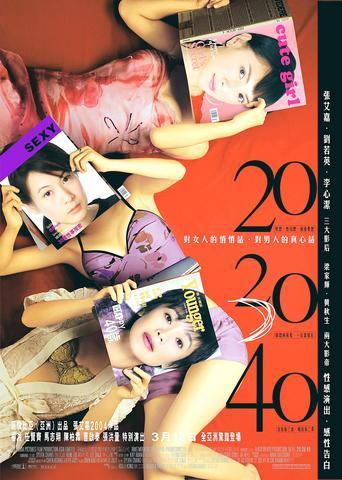
In keeping with the trend of romantic comedies trying to mirror Sex and the City or Bridget Jones' Diary, which honestly reveal the awkwardness, defeat and cruelty women face in the games of love, 20, 30, 40 movie offers a Chinese version on these by-now familiar themes.
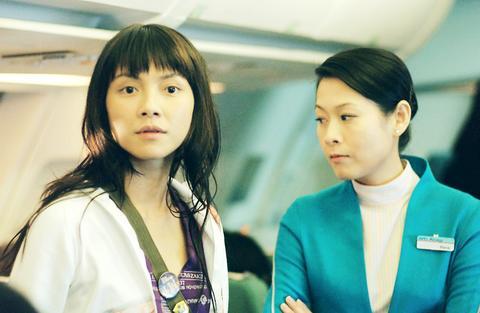
PHOTO COURTESY OF COLUMBIA ASIA
20, 30, 40 meets its expectations, being an honest, cute, semi-feminist movie about women in Taipei.
The 30-something woman Hsiang-hsiang (Rene Liu (劉若英)) is a flight attendant torn between two men -- one a musician in New York, who is not mature enough to settle down, the other a mature doctor, but married. Hsiang-hsiang is always reminded of her mom's reasons for forcing her to learn piano. "One day your man will leave you, so at least you can teach piano."
The 40-something Lily (Silvia Chang) takes a flight tended by Hsiang-hsiang back to Taipei, with her husband and 17-year-old daughter. A happy wife and mother who owns a flower shop, Lily finds out about her husband's mistress and decides on an immediate divorce. On the same flight is Jie (Lee Sin-jie, (李心潔)), a 20-something Malaysian girl coming to Taiwan to become a singer. She is teamed up with a Hong Kong girl by a sloppy, down-on-her-luck producer-songwriter and she is unsure about her future.
The most honest and moving story between the three women is the 40-something Lily, portrayed by director Chang herself. Trying to prove that she's still attractive, she spends wild nights at Taipei's Carnegie's and dates a young man whose two obsessions are sex and sports, the former of which wears out her middle-aged bones.
As a director, Chang this time has a more open, easy and mature eye when looking at a woman's life, than her 1999 film Tempting Heart (心動), which was an equally touching, though slightly forced, story about a nostalgic romance. Lily's story generates the most laughs as well as tears.
Also impressive is Jie's story, performed and written by Lee Sin-jie, wth obvious autobiographical elements. An ambiguous feeling grows between Jie and Tung, the Hong Kong girl, who tries to seduce her. Jie is not sure if she's jealous when she sees Tung suddenly find a boyfriend. Also uncertain is her bumpy singer dream, because no one wants to make a record for the duo.
Rene Liu makes full use of her solid acting skills, but her story is a bit thinner than those of the other two women.
And as for men in this movie, no doubt they are minor characters, but Silvia Chang scored a casting coup, getting both Tony Leung Kar-fai (
20, 30, 40 may not be Silvia Chang's best movie so far, but it is by far the most honest and sincere work about women's loves and lives in Taipei.


Taiwan’s English education system is being pulled apart by three opposing forces. Bilingual Nation 2030 pulls students toward English and global communication. Artificial Intelligence (AI) readiness pulls them toward digital judgment, verification and AI-mediated work. But Taiwan’s old exam culture pulls them back toward memorization, grammar drills, timed reading and correct answers. If the education system keeps using old exams to define success, it risks producing graduates who are neither genuinely bilingual nor genuinely AI-ready, but trained for tasks machines can already perform. The first force is Bilingual Nation 2030. Launched in 2018, the policy aimed to “help Taiwan’s workforce connect

“Taiwan’s Opposition Leader Comes to US With a Message Straight Out of Beijing” read a May 31 headline in the Wall Street Journal. Top US administration officials and members of Congress almost certainly read the WSJ, and if there was a bullet point takeaway that people in Washington should absorb ahead of Chinese Nationalist Party (KMT) Chair Cheng Li-wun’s (鄭麗文) arrival in DC on June 9, that headline is it. The last few columns have discussed this very topic, and the timing is not coincidental. While those top officials likely do not read the Taipei Times, judging by the number

With weighty, anxiety-inducing geopolitical topics dominating the headlines, checking in on the wild and weird state of local politics can take some of the edge off. This November’s elections will determine who will be in charge of fixing potholes in your neighborhood, not the potholes in Taiwan’s complicated geopolitical space. Recently, after an online interview with a Taipei-based journalist, I commented that Taipei journalists never go further than the MRT can take them. He laughed and agreed. Naturally, the Taipei mayoral race is eating up much of the press attention. TAIPEI CITY Democratic Progressive Party (DPP) candidate Puma Shen (沈伯洋) has
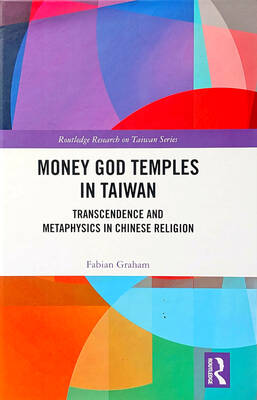
As someone who normally steers clear of books with “transcendence” or “metaphysics” in their subtitles, this reviewer — a casual observer of local belief systems since the 1990s — found Fabian Graham’s Money God Temples in Taiwan a challenging read. Those who’ve only dipped their toes into temple culture will likely need to parse several sections with special care if they’re to keep up with the author, a British ethnographic researcher whose previous books have investigated religious practices among ethnic Chinese in Southeast Asia. This scholarly volume examines a facet of Taiwan’s religious landscape that didn’t exist a century ago, and


 RSS
RSS