


When the Mongol warlord Genghis Khan set out to conquer the world around the turn of the 13th century he realized his soldiers would need extraordinary sustenance and gave his herbal medicine experts and cooks the task of coming up with a food equal to the task.
This is said to the be the origin of the "unforgettable pot," which may now be sampled at 11 Tien Xiang Huei Wei restaurants dotted around Taiwan and Japan. The original recipe was a secret closely guarded by Khan's immediate family, but is said to have eventually fallen into the hands of some restaurant owners in China and has now been modified for local tastes.
It is a uniquely aromatic and satisfying hot pot, quite different from the norm and does not require extra sauces. A soup is only as good as its stock and the primordial unforgettable pot is created by boiling up big pig bones and old hens for a considerable time. During this process a combination of 68 plants and spices are added in the correct proportions, strained and refined, to form the amber nectar which is delivered in a big pot to the table.
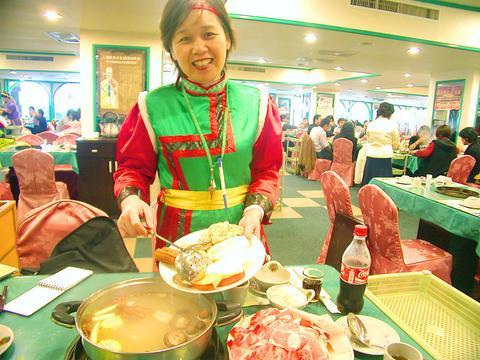
PHOTO: JULES QUARTLY, TAIPEI TIMES
Identifiable elements in the soup include Chinese medicinal herbs such as goqi (枸杞) and hong zao (紅棗), ginger, fruits such as dragon eyes (龍眼), water chestnuts, lots of garlic, leeks, mushrooms, a root called dangsen (黨蔘) and small beans or doushi (豆豉). You can then order various meats and vegetables and other ingredients of your choice. These are added to the potion, stewed and then, when ready, ladled into your bowl for consumption.
The result is a unique and powerful taste, deep and musky, slightly sweet and spicy, without being hot. It is not hard to imagine the high plateaus, sweeping grasslands and deserts of Mongolia at this point, though I have never visited them. Large panels featuring the endless blue skies and great plains of the country are a feature of the restaurant.
The large, open-plan space is not remarkable, with its odd green color-scheme, industrial-grade carpet and incongruous Chinese pink silk chairs, but after you taste the food, the ambience becomes secondary. A gong is sounded when you walk in and leave, brightly dressed waitstaff in bright poster color silks, with bandannas and tassles, glide around taking orders, pour tea and dispense soup. This is a great theme restaurant, even for those who are not keen on hot pot.
Do check out the jinsi lienbing (金絲戀餅), which are small fried cakes that unravel like silk and melt in the mouth. They are a hand-made speciality of the house and were originally created by a Qing-dynasty concubine to please her emperor. Finally, even though there are around 50 tables, do make reservations in advance. If you don't, be prepared to wait up to an hour to be seated.


Taiwan’s English education system is being pulled apart by three opposing forces. Bilingual Nation 2030 pulls students toward English and global communication. Artificial Intelligence (AI) readiness pulls them toward digital judgment, verification and AI-mediated work. But Taiwan’s old exam culture pulls them back toward memorization, grammar drills, timed reading and correct answers. If the education system keeps using old exams to define success, it risks producing graduates who are neither genuinely bilingual nor genuinely AI-ready, but trained for tasks machines can already perform. The first force is Bilingual Nation 2030. Launched in 2018, the policy aimed to “help Taiwan’s workforce connect

“Taiwan’s Opposition Leader Comes to US With a Message Straight Out of Beijing” read a May 31 headline in the Wall Street Journal. Top US administration officials and members of Congress almost certainly read the WSJ, and if there was a bullet point takeaway that people in Washington should absorb ahead of Chinese Nationalist Party (KMT) Chair Cheng Li-wun’s (鄭麗文) arrival in DC on June 9, that headline is it. The last few columns have discussed this very topic, and the timing is not coincidental. While those top officials likely do not read the Taipei Times, judging by the number
With weighty, anxiety-inducing geopolitical topics dominating the headlines, checking in on the wild and weird state of local politics can take some of the edge off. This November’s elections will determine who will be in charge of fixing potholes in your neighborhood, not the potholes in Taiwan’s complicated geopolitical space. Recently, after an online interview with a Taipei-based journalist, I commented that Taipei journalists never go further than the MRT can take them. He laughed and agreed. Naturally, the Taipei mayoral race is eating up much of the press attention. TAIPEI CITY Democratic Progressive Party (DPP) candidate Puma Shen (沈伯洋) has
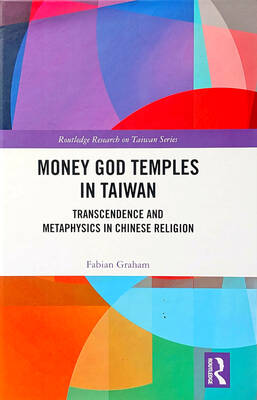
As someone who normally steers clear of books with “transcendence” or “metaphysics” in their subtitles, this reviewer — a casual observer of local belief systems since the 1990s — found Fabian Graham’s Money God Temples in Taiwan a challenging read. Those who’ve only dipped their toes into temple culture will likely need to parse several sections with special care if they’re to keep up with the author, a British ethnographic researcher whose previous books have investigated religious practices among ethnic Chinese in Southeast Asia. This scholarly volume examines a facet of Taiwan’s religious landscape that didn’t exist a century ago, and


 RSS
RSS