


Shortly after the 1968 Soviet invasion of Prague, in the former Czechoslovakia, composer Karel Husa felt so enraged by the assault that he wrote Music for Prague 1968 while residing in the US.
A powerful composition, Husa completed the piece in less than two months and dedicated it to the people of Prague. Originally banned by the Communist government, Music for Prague went unheard in its namesake city until the 1989 election of a non-Communist government.

PHOTO COURTESY OF TAIPEI SIRENS WINDS CONCERT BAND
Now one of the most popular pieces in Husa's repertoire, Music for Prague has been performed numerous times around the world and will be presented this evening by The Taipei Sirens Winds Concert Band

Tonight's performance is the spring offering of the Sirens quarterly concert series (based on the four seasons). While this is not the first time they have performed Husa's famous piece, it is a first under the direction of Zhang, who having studied the Czech composer's work for some time, believes it to be a monumental work for wind music.
"It is a challenging piece of technical music. As a 20th century composition it is not written in traditional tonal music and demands a great deal of its musicians," Zhang said. Correspondingly it conveys a great deal of emotion to its listeners by using music to recreate the atmosphere of fear during the Soviet invasion.
While Husa's is not the only piece of music being performed tonight, it is the evening's main attraction. Zhang also promises a diverse collection of music that includes selections from celebrated works such as Bill Whelan's Riverdance, Franz Lehar's The Merry Widow and Ghosts by Stephen McNeff, which tells the life-stories of seven ghosts notorious throughout European history. As a special appearance the Sirens have also invited Yan Ching-shyan
"We are aiming for diversity so we chose a range of pieces and hope to present an alternative program to a regular band concert," Zhang said.
Performance notes:
What: Taipei Sirens Winds Concert Band will perform Music for Prague 1968 tonight at 7:30pm at the National Concert Hall (
Where: The National Concert Hall is located at 21-1 Zhongshan S Rd, Taipei (
How much: Tickets range in price from NT$200 to NT$700 and can be booked through the box office at (02) 2343 1364.


Taiwan’s English education system is being pulled apart by three opposing forces. Bilingual Nation 2030 pulls students toward English and global communication. Artificial Intelligence (AI) readiness pulls them toward digital judgment, verification and AI-mediated work. But Taiwan’s old exam culture pulls them back toward memorization, grammar drills, timed reading and correct answers. If the education system keeps using old exams to define success, it risks producing graduates who are neither genuinely bilingual nor genuinely AI-ready, but trained for tasks machines can already perform. The first force is Bilingual Nation 2030. Launched in 2018, the policy aimed to “help Taiwan’s workforce connect

“Taiwan’s Opposition Leader Comes to US With a Message Straight Out of Beijing” read a May 31 headline in the Wall Street Journal. Top US administration officials and members of Congress almost certainly read the WSJ, and if there was a bullet point takeaway that people in Washington should absorb ahead of Chinese Nationalist Party (KMT) Chair Cheng Li-wun’s (鄭麗文) arrival in DC on June 9, that headline is it. The last few columns have discussed this very topic, and the timing is not coincidental. While those top officials likely do not read the Taipei Times, judging by the number

With weighty, anxiety-inducing geopolitical topics dominating the headlines, checking in on the wild and weird state of local politics can take some of the edge off. This November’s elections will determine who will be in charge of fixing potholes in your neighborhood, not the potholes in Taiwan’s complicated geopolitical space. Recently, after an online interview with a Taipei-based journalist, I commented that Taipei journalists never go further than the MRT can take them. He laughed and agreed. Naturally, the Taipei mayoral race is eating up much of the press attention. TAIPEI CITY Democratic Progressive Party (DPP) candidate Puma Shen (沈伯洋) has
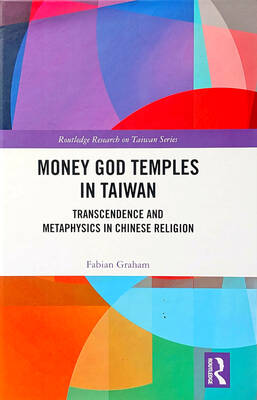
As someone who normally steers clear of books with “transcendence” or “metaphysics” in their subtitles, this reviewer — a casual observer of local belief systems since the 1990s — found Fabian Graham’s Money God Temples in Taiwan a challenging read. Those who’ve only dipped their toes into temple culture will likely need to parse several sections with special care if they’re to keep up with the author, a British ethnographic researcher whose previous books have investigated religious practices among ethnic Chinese in Southeast Asia. This scholarly volume examines a facet of Taiwan’s religious landscape that didn’t exist a century ago, and


 RSS
RSS