


Poor old KMT presidential hopeful Lien Chan (
The DPP also proved itself prone to being lampooned over the past week with its latest series of newspaper and billboard advertisements that are trying to boost the vote rate for the referendum set to take place at the same time as the presidential election. Pop Stop was waiting for the MRT and noticed people giggling and pointing at a DPP billboard, which features an attractive model of about 30 dressed in a school uniform that makes her look suspiciously like someone out of a Japanese fetish magazine with a slogan that reads: "My first time. The whole world is watching." The same ad ran as a full front-page on Sunday's The Great Daily News

PHOTO: TAIPEI TIMES
The DPP has also jumped on the Infernal Affairs
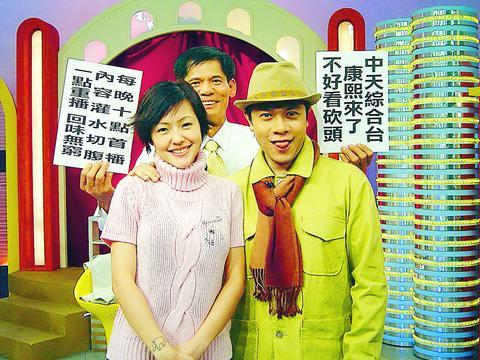
PHOTO: TAIPEI TIMES
And in non-political news, two weeks ago, Pop Stop reported that Taiwan's boy band 5566 had ripped off the cover of Japanese band SMAP album for their own album. This week, Next Magazine (壹週刊) has uncovered yet another case of blatant cover-art copying, this time by the boy band R&B. The picture in question shows the five boys showering together at a sauna and is almost a photocopy of a photo used by Japanese boy band V6 for their own photo collection. This shouldn't be a surprise to anyone, though. When planning Mando-pop albums, it's standard practice for producers to hand songwriters Western pop music CDs and essentially tell them to copy certain songs for local singers. It seems logical that this practice would spill over into the cover art.
Chinese business news Web site icxo.com and the World Human Resources Laboratory released a list last week of the top stars in China, Hong Kong and Taiwan, according to personal worth. Among the men, Jackie Chan
On the women's side, Zhang Ziyi


Taiwan’s English education system is being pulled apart by three opposing forces. Bilingual Nation 2030 pulls students toward English and global communication. Artificial Intelligence (AI) readiness pulls them toward digital judgment, verification and AI-mediated work. But Taiwan’s old exam culture pulls them back toward memorization, grammar drills, timed reading and correct answers. If the education system keeps using old exams to define success, it risks producing graduates who are neither genuinely bilingual nor genuinely AI-ready, but trained for tasks machines can already perform. The first force is Bilingual Nation 2030. Launched in 2018, the policy aimed to “help Taiwan’s workforce connect

“Taiwan’s Opposition Leader Comes to US With a Message Straight Out of Beijing” read a May 31 headline in the Wall Street Journal. Top US administration officials and members of Congress almost certainly read the WSJ, and if there was a bullet point takeaway that people in Washington should absorb ahead of Chinese Nationalist Party (KMT) Chair Cheng Li-wun’s (鄭麗文) arrival in DC on June 9, that headline is it. The last few columns have discussed this very topic, and the timing is not coincidental. While those top officials likely do not read the Taipei Times, judging by the number

With weighty, anxiety-inducing geopolitical topics dominating the headlines, checking in on the wild and weird state of local politics can take some of the edge off. This November’s elections will determine who will be in charge of fixing potholes in your neighborhood, not the potholes in Taiwan’s complicated geopolitical space. Recently, after an online interview with a Taipei-based journalist, I commented that Taipei journalists never go further than the MRT can take them. He laughed and agreed. Naturally, the Taipei mayoral race is eating up much of the press attention. TAIPEI CITY Democratic Progressive Party (DPP) candidate Puma Shen (沈伯洋) has
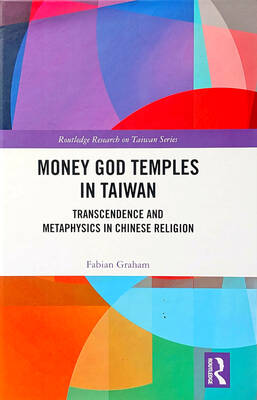
As someone who normally steers clear of books with “transcendence” or “metaphysics” in their subtitles, this reviewer — a casual observer of local belief systems since the 1990s — found Fabian Graham’s Money God Temples in Taiwan a challenging read. Those who’ve only dipped their toes into temple culture will likely need to parse several sections with special care if they’re to keep up with the author, a British ethnographic researcher whose previous books have investigated religious practices among ethnic Chinese in Southeast Asia. This scholarly volume examines a facet of Taiwan’s religious landscape that didn’t exist a century ago, and


 RSS
RSS