


Taiwan's famed dance troupe, Cloud Gate (
Written and first staged in 2001, Lin's Bamboo Dream is rated as one of his best, most inspiring and picturesque works. A technical and philosophical masterpiece that premiered three years ago, Lin has not only revitalized the work, but has added a live orchestra for the first time.
"When we first staged [Bamboo Dream] we had the music on CD. When the music is on CD it is stable and never changes, which for the dancers is good as the music never alters and they know what is going to happen," Lin said. "With a live orchestra the music is here and there so to speak. It's never the same and it creates energy, which is the key to creating an intimacy between movement and music."

PHOTOS: CHIANG YING-YING, TAIPEI TIMES
Helping to create this intimacy will be the National Symphony Orchestra, which, with the help of a lone flutist, will be performing music written by Estonian neo-classical composer Arvo Part, who is a composer Lin has "loved for many years."
"His music is very lyrical and really beautiful and possesses good rhythm. And as the work is non-
narrative the music is an essential part of the performance," Lin said.
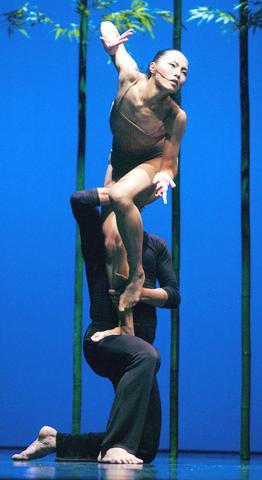
Formed in 1973, Cloud Gate was the first contemporary dance troupe to be established in Greater China. Taking its name from a legendary dance that, according to scholars dates back 5,000 years and is the oldest-known dance in China, the troupe broke new ground and shocked traditionalists as it was one of the first troupes to employ both male and female modern dancers. Before Lin established the troupe, male contemporary dance was unheard of in Taiwan.
Since the early 1970s, the 25-member dance troupe's shock value has disappeared and Cloud Gate is now considered one of the world's leading contemporary groups, receiving rave reviews and admiration wherever it performs. It is recognized for its ground-breaking dance styles, in which performers combine aspects of tai chi, Chinese Opera, modern western dance and ballet, in order to create eclectic works that transform myth, folklore and religious esthetics into vivid contemporary dance spectacles.
Some of the troupe's most recent performances include last years Legacy -- Revival, a reworking of Lin's debut masterpiece, Legacy, which was first staged on Dec. 16, 1978 -- the day the US severed diplomatic ties with Taipei in favor of Beijing -- and raises questions through dance about Taiwan's identity. A year earlier Cloud Gate astounded audiences with the engaging and challenging, Smoke, a show that made use of a minimalist set and projections to lull audiences into a dream-like landscape.
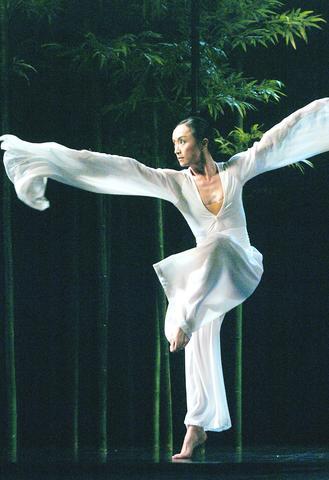
For Lin's latest production, the choreographer has returned to employing lavish sets. Bamboo Dream sees Cloud Gate making full use of a set that depicts an abstract bamboo grove made of real bamboo.
"The set is not the grandest one we've ever used but it is the most interactive. The dancers interact with it and it becomes a non-static part of the performance through which the dancers are guided and which guides the dancers movements," Lin said. "It reflects nature, which has a soothing effect and possess dreamlike qualities with which we portray the four seasons."
Divided into seven scenes, Bamboo Dream evokes imagery not only of the four seasons, but also touches on weather conditions and moods evoked by the seasons. The dancers portray these moods through sensual choreographic compositions inspired by tai chi, European dance and classical ballet.
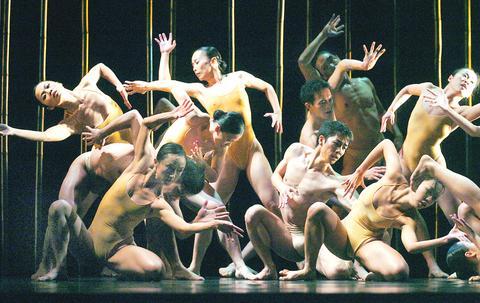
"The movements are very sensual and I'd say erotic, but not exotic. There's no linear storyline to the production. It is open to individual interpretation," Lin said. "I have created food for the eye, something soothing at election time when its is very hectic and chaotic."
Performance notes:
Where: Cloud Gate and the National Symphony Orchestra will perform Bamboo Dream at the National Theatre (
Where: All performances begin at 7:45pm with the exception of Sunday, March 14, when the performance begins at 4pm.
Where else: On April 17 and April 18 Cloud Gate will perform Bamboo Dream at Taichung's Chungshan Hall (
Cloud Gate moves to Kaohsiung on April 23 and April 24, when it will perform Bamboo Dream at the Chih-Der Hall (
Cost: Tickets for Taipei performances cost between NT$400 and NT$2,000 and are available direct from the CKS Cultural Center Box Office. Tickets for Taichung and Kaohsiung performances cost from NT$300 to NT$1,500 and are available direct from the box offices of both venues. Tickets for all performances are available from Acer Ticketing Outlets nationwide.


Taiwan’s English education system is being pulled apart by three opposing forces. Bilingual Nation 2030 pulls students toward English and global communication. Artificial Intelligence (AI) readiness pulls them toward digital judgment, verification and AI-mediated work. But Taiwan’s old exam culture pulls them back toward memorization, grammar drills, timed reading and correct answers. If the education system keeps using old exams to define success, it risks producing graduates who are neither genuinely bilingual nor genuinely AI-ready, but trained for tasks machines can already perform. The first force is Bilingual Nation 2030. Launched in 2018, the policy aimed to “help Taiwan’s workforce connect

“Taiwan’s Opposition Leader Comes to US With a Message Straight Out of Beijing” read a May 31 headline in the Wall Street Journal. Top US administration officials and members of Congress almost certainly read the WSJ, and if there was a bullet point takeaway that people in Washington should absorb ahead of Chinese Nationalist Party (KMT) Chair Cheng Li-wun’s (鄭麗文) arrival in DC on June 9, that headline is it. The last few columns have discussed this very topic, and the timing is not coincidental. While those top officials likely do not read the Taipei Times, judging by the number

With weighty, anxiety-inducing geopolitical topics dominating the headlines, checking in on the wild and weird state of local politics can take some of the edge off. This November’s elections will determine who will be in charge of fixing potholes in your neighborhood, not the potholes in Taiwan’s complicated geopolitical space. Recently, after an online interview with a Taipei-based journalist, I commented that Taipei journalists never go further than the MRT can take them. He laughed and agreed. Naturally, the Taipei mayoral race is eating up much of the press attention. TAIPEI CITY Democratic Progressive Party (DPP) candidate Puma Shen (沈伯洋) has
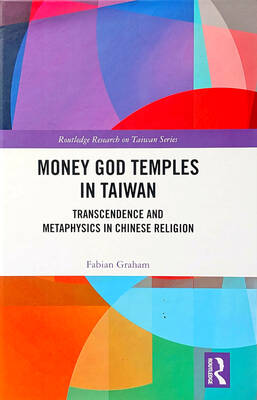
As someone who normally steers clear of books with “transcendence” or “metaphysics” in their subtitles, this reviewer — a casual observer of local belief systems since the 1990s — found Fabian Graham’s Money God Temples in Taiwan a challenging read. Those who’ve only dipped their toes into temple culture will likely need to parse several sections with special care if they’re to keep up with the author, a British ethnographic researcher whose previous books have investigated religious practices among ethnic Chinese in Southeast Asia. This scholarly volume examines a facet of Taiwan’s religious landscape that didn’t exist a century ago, and


 RSS
RSS