


After my Insider's Guide to Bali was first published in 1989, friends sometimes asked me what books on Indonesia they should take with them to that vast country. I recommended three, C.J. Koch's novel The Year of Living Dangerously, Bill Dalton's Indonesia Handbook, and Brian May's brooding analysis The Indonesian Tragedy. Now, though, I would also recommend this new one. Indeed, Theodore Friend's Indonesian Destinies may well be the best book on Indonesia there is.
The author is a veteran American academic and foreign affairs expert who has previously written a prize-winning work on US-Philippine relations. Here he turns his attention to the world's fourth largest country in terms of population, a place he's been visiting since 1967.

It's important to establish right at the start how unusual a book this is. Friend mixes history with personal reminiscence in a way that allows him to peel back the layers of the country in a quite exceptional way. Thus you'll read about his experiences among the Toraja people of Sulawesi, and in the process learn about his "unpredictable left knee, reconstructed after a blindside clip in a soccer game severed two ligaments," and how it's still holding up at 67 as he clambers down slippery, 1,000-year-old rice terraces. Then, before you know where you are he's sitting in the Indonesian equivalent of the White House explaining the November 2000 Bush-Gore deadlock to President Wahid.
It's impossible for a non-specialist reviewer to be dogmatic, but you can be confident that all the major Indonesian events of the last 50 years are covered: East Timor (where London Financial Times journalist Sander Thoens was shot dead off the back of a motorcycle-taxi and his face subsequently "flayed back to the skull"), catastrophic forest fires that have devastated "seven or eight Vermonts," the policy of transmigration (encouraging people to move from Java to less populated, and frequently far less hospitable, islands), the secessionist
movement in Aceh, the matriarchal traditions of the Minangkabau, Christian-Muslim strife (most recently on Ambon in the province of Maluku), the killing of possibly half a million communists and others in 1965 to 1966, relations with Malaysia (which shares Borneo with Indonesia), and the 2002 Bali night-club bombing.
Needless to say Friend wasn't able to witness all these things, but it's quite astonishing how many of the major players he's met over the years, whether it's Jimmy Carter at 75 -- bouncy step, bright eye, balanced mind -- or a veteran democracy activist. Indeed, one of Friend's most endearing characteristics is that he doesn't evaluate people's testimonies according to their status. The signs are that he's a Christian, and he certainly displays the appropriate egalitarianism that weighs all souls equally, irrespective of their standing in the world's eyes.
The following gives a taste of the book's flavor. "I was back in Jakarta for the first time in four years. My wife, by the grace of God, good doctors and nurses, and sheer guts, had survived a serious cancer. Now, October 1997, free to travel, I was asked for my impressions by a senior Indonesian employee of the World Bank."
What he chooses to talk about to him are forest fires -- possible corporate involvement in starting them, the environmental degradation they cause, and the effect they have on orangutangs. This is typical. Friend is an authority on Indonesia's financial affairs, but nothing will convince him that money is all that matters in life. He's too intelligent, his heart too generous and his mind too comprehensive, for that. (Sadly his wife died from other causes last summer).
The situation of the Indonesian Chinese gets close attention -- encouraged to change their names to Indonesian-sounding ones, even to abandon their traditional religion (Suharto imposed a ban, now lifted, on the observance of Chinese religion in public), and even today still subject to unpredictable attacks.
The book is organized in three chunks, covering Sukarno's era, then Suharto's, and finally the post-Suharto years. The colonial, and earlier, history of what Europeans once referred to as "the Spice Islands" is also there, but, like so much else, interleaved between other things.
Among the Indonesian characteristics the book covers are its huge geographical extent and diversity, its consequent vulnerability to break-away movements or demands for regional autonomy, and the power of the supernatural -- notably the quasi-shamanistic Javanese puppet theater -- over the minds of its leaders.
Reading Indonesian Destinies is like riding a rollercoaster or looking into a kaleidoscope. You never know what to expect around the next bend or after the next shake of the tube. For a sample, take a look between pages 212 and 218 at the extraordinary story of Gordon Bishop, a New York City "poet, businessman and journalist" in the section entitled (in an allusion to Mark Twain) "Manhattan Yankee at the Sultan's Court." It's vivid, startling, undogmatic, and highly evocative of the entire paradoxical country.
At the heart of this impressive book lies Theodore Friend's vision that it's the ordinary comforts of life that people need most, things which warm and nourish the soul. By this he means security of home, respect of friends, the feel of a pair of comfortable old shoes and the freedom to smile at your neighbor even though he practices different rituals. Deprive people of these and they're in danger of acting like barbarians, and no one is born a barbarian. This feels like the author's philosophy, and as you read this book you slowly come to understand that it characterizes every page.
Above everything else, Friend clearly adores being in Indonesia. Asia is full of foreigners who've found some corner of the continent that constitutes a spiritual home. Not everyone arrives consciously looking for it, bit it's amazing how many succeed in finding one.
This is a generous, sad, guardedly hopeful, but above all else genially sympathetic book. There are many intriguing photographs, and the book has been sumptuously produced by Harvard University's Belknap Press.

In late October of 1873 the government of Japan decided against sending a military expedition to Korea to force that nation to open trade relations. Across the government supporters of the expedition resigned immediately. The spectacle of revolt by disaffected samurai began to loom over Japanese politics. In January of 1874 disaffected samurai attacked a senior minister in Tokyo. A month later, a group of pro-Korea expedition and anti-foreign elements from Saga prefecture in Kyushu revolted, driven in part by high food prices stemming from poor harvests. Their leader, according to Edward Drea’s classic Japan’s Imperial Army, was a samurai

The following three paragraphs are just some of what the local Chinese-language press is reporting on breathlessly and following every twist and turn with the eagerness of a soap opera fan. For many English-language readers, it probably comes across as incomprehensibly opaque, so bear with me briefly dear reader: To the surprise of many, former pop singer and Democratic Progressive Party (DPP) ex-lawmaker Yu Tien (余天) of the Taiwan Normal Country Promotion Association (TNCPA) at the last minute dropped out of the running for committee chair of the DPP’s New Taipei City chapter, paving the way for DPP legislator Su
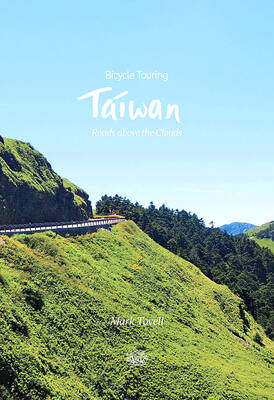
It’s hard to know where to begin with Mark Tovell’s Taiwan: Roads Above the Clouds. Having published a travelogue myself, as well as having contributed to several guidebooks, at first glance Tovell’s book appears to inhabit a middle ground — the kind of hard-to-sell nowheresville publishers detest. Leaf through the pages and you’ll find them suffuse with the purple prose best associated with travel literature: “When the sun is low on a warm, clear morning, and with the heat already rising, we stand at the riverside bike path leading south from Sanxia’s old cobble streets.” Hardly the stuff of your

Located down a sideroad in old Wanhua District (萬華區), Waley Art (水谷藝術) has an established reputation for curating some of the more provocative indie art exhibitions in Taipei. And this month is no exception. Beyond the innocuous facade of a shophouse, the full three stories of the gallery space (including the basement) have been taken over by photographs, installation videos and abstract images courtesy of two creatives who hail from the opposite ends of the earth, Taiwan’s Hsu Yi-ting (許懿婷) and Germany’s Benjamin Janzen. “In 2019, I had an art residency in Europe,” Hsu says. “I met Benjamin in the lobby


 RSS
RSS