


Photographica Australis, a traveling exhibition of photography by 15 contemporary Austrian artists, has reached its last stop in Taipei. Currently showing at the Taipei Fine Arts Museum (
Organized by the Australian Centre for Photography, Photographica Australis aims to help Asian viewers take note of the diversity of Austrian culture.
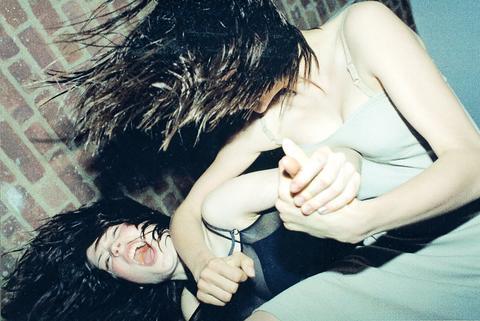
PHOTO COURTESY OF TFAM
"The title of the exhibition is in Latin as a reference to the scientific naming of plants in biology. While bio-diversity is important in nature, cultural diversity is of equal importance," said Alasdair Foster, curator of the exhibition.
In presenting a wide spectrum of Australian photography, Foster includes different generations of artists working with various techniques and sub-genres, but has excluded big names such as Bill Henson and Tracey Moffatt. "These artists are important in Australia, but not necessarily known internationally. In mapping the wholeness of a culture, you can't look at only those at the top. Therefore I have juxtaposed younger and older artists here for you to get a better picture of Australian photography," Foster said.
The are three sections to the show "Bio-diversity," the first section, is a compact showcase of the ideas, styles and methodologies prevalent in Australia today.
In Esperanto of Vision, Phillip George uses digital manipulation to create a panorama of a coast near Sydney, where the first European immigrants landed on the continent. Iconographic images of different cultures are combined to form its landscape. China's Great Wall sits on the distant mountains, ancient Greek architecture faces the waves, with ancient Indian statues nearby. The cultures living in today's Australia, the images seem to suggest, are exactly the same as those in other parts of the world millennia ago.
Martin Walch's Six Traces in Four Dimensions invites visitors to take a look at the landscape of a mining site in Tasmania through stereo viewers. The work is a reaction to Australian environmentalists' call to stop mining in the area on account of the damage mining does to its natural landscape. In Walch's view, the Tasmania landscape is artificial in essence. The man-made environment is simply the area's primordial form. The environmentalist has too sentimental a notion of ecology, he suggests. To stress the point, laser beams sweep the landscape to create images of rivers and mountains covered with strips of light.
The second section "Art and Suburbia" deals with the making of art in the interacting contexts of art history and suburban life.
Glenn Sloggett is known for his love of irony and contradiction. Sloggett's Untitled Series documents in a tongue-in-cheek manner sights on the suburban streets. There is a budget-burial company van with the slogan "cheaper and deeper" across its window and a rundown corner shop whose signboard claims that it serves Melbourne's best cappuccino among other street oddities.
The "Intersection" section explores the construction of meaning and the formation of identity. The work that reflects the themes best may be Brenda Croft's Contact/Warra Warra, a collage about the first European immigrants' mistaking native phrase "Warra Warra" for "welcome," when the Aborigines were actually telling them to "go away."
The history of the interaction between Aborigines and European immigrants is a recurring background to the works, but the artists' mature photographic techniques and entrancing creative expressions are probably the most enjoyable aspects of the exhibition.

Taiwan’s English education system is being pulled apart by three opposing forces. Bilingual Nation 2030 pulls students toward English and global communication. Artificial Intelligence (AI) readiness pulls them toward digital judgment, verification and AI-mediated work. But Taiwan’s old exam culture pulls them back toward memorization, grammar drills, timed reading and correct answers. If the education system keeps using old exams to define success, it risks producing graduates who are neither genuinely bilingual nor genuinely AI-ready, but trained for tasks machines can already perform. The first force is Bilingual Nation 2030. Launched in 2018, the policy aimed to “help Taiwan’s workforce connect
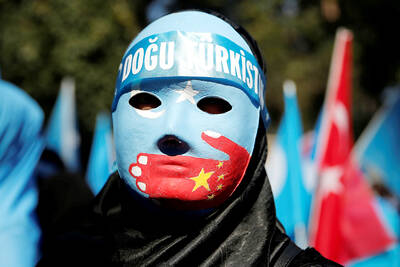
It seems every few days one bumps into one of those “real man” comments in which Taiwan is urged to “face reality” or similar, and “make a deal,” with the speaker implying that soon it will be too late. “Deal” advocates always present themselves as having a superior grip on reality, and the manly ability to make the “hard choice.” Their testosterone-laden language often echoes that of Taiwan sellout advocates. Note that such commentary always specifies a process (“make a deal, work with, make progress”), never the end state of what occupation by a violent authoritarian colonialist state will entail. In
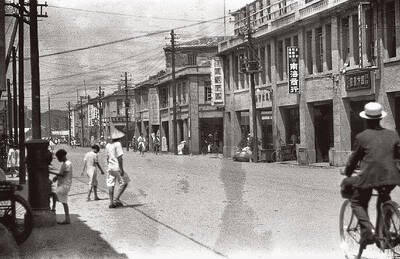
June 1 to June 7 "If all Taiwanese were as afraid of dying as you, then what would happen?” Physician Shih Chiang-nan (施江南) reportedly said this to his wife Chen Chiao-tung (陳焦桐) after she urged him to stop intervening on behalf of Taiwanese soldiers stranded overseas after serving in the Japanese Army during World War II. Shih had clashed with high-ranking officials over the issue, engaged in several heated arguments with Taiwan governor-general Chen Yi (陳儀) and allegedly shouted at general Ko Yuan-fen (柯遠芬), chief of staff of the Taiwan Garrison Command, over

“Taiwan’s Opposition Leader Comes to US With a Message Straight Out of Beijing” read a May 31 headline in the Wall Street Journal. Top US administration officials and members of Congress almost certainly read the WSJ, and if there was a bullet point takeaway that people in Washington should absorb ahead of Chinese Nationalist Party (KMT) Chair Cheng Li-wun’s (鄭麗文) arrival in DC on June 9, that headline is it. The last few columns have discussed this very topic, and the timing is not coincidental. While those top officials likely do not read the Taipei Times, judging by the number


 RSS
RSS