


A-Shen (
"Betting on number games can be boring," he said. "And we were all disappointed to hear that baseball players gamble more than they play. Politicians at least want to win, that much you can bet on!"
And bet he has. Weeks before the presidential election of 2000, he put NT$100,000 on Chen Shui-bian (
ILLUSTRATION MOUNTAIN PEOPLE
But beyond gambling, the 52-year-old A-Shen says that Taiwan's democratization has made him more politically active than he was during the martial law era, and that hardly a day goes by that he's not tuned in to the nation's ongoing presidential race.
"It's too soon to know who'll win the election," he says. "But I'll get a hunch sooner or later."
GAMBLING FEVER
What starts as wagering among friends may ultimately influence the fate of the nation. While that may sound far-fetched, law enforcement authorities and at least one camp of political pundits worry that it might prove true.
The concern is not with bar room bets or wagers being made at the water cooler. Gambling, after all, is something of a national pastime. Instead, the concern lies in the high-stakes election wagers being placed within organized crime circles.
Law enforcement authorities cite the activities of Taiwan's four largest bookmakers, known only by their surnames; Lin in Taipei County, Hsieh in Taichung County, Gao in Tainan, and Wang in Kaohsiung. (Gamblers, in turn, cite law enforcement authorities for complicity and even direct participation in bookmaking. "You want to find a bookie?" said one gambler, "Ask a cop!")
Working for them are a network of mid- and lower-level bookies whose perennial punters are said to number up to half a million. They're almost exclusively men over 30, not necessarily wealthy, but often single and with disposable income.
The usual racket is "mark six" (
The structure of this network is a kind of pyramid marketing scheme, a "mouse organization" (
Anyone who has, say, NT$100,000 riding on the blue camp winning the election by half a million votes has incentive to find as many other potential blue camp supporters as he can who are willing to make a similar bet. The possible result: Half a million people or more bet on and vote for the same candidate, potentially tipping the balance in an election still too close to call.
The concern is enough to have caused the president to pay a personal visit to Wang Chen-keng (
Media speculated that Wang and Chen's "secret meeting" on Jan. 30 had the president attempting to level the playing field by requesting more favorable odds.
More recently, Chen visited an even bigger vote captain, independent legislator Yen Ching-piao (
The root of Chen's concern is the fact that bookmakers currently favor the blue camp winning by 500,000 to 700,000 votes and have set 1:1 odds.
This is surely a source of happiness for blue camp contender Lien Chan (
That of course didn't happen and the fact that bookmakers were wrong then has called into question the accuracy of their assessments now.
Professor of political science at Soochow University Emile Sheng (
"A lot of these odds are decided subjectively, reflecting the political orientation of the bookie," Sheng said. "If they support Chen or Lien they will come out with odds more favorable to their side. It also comes down to the personal connections of the bookies."
Sheng points to a far more accurate barometer of Taiwan's political climate in the cornfields of Iowa.
A real-money, educational futures market sponsored by the state university, the Iowa Electronic Market sells contracts in political and economic events. Four years ago, it sold contracts for Taiwan's presidential election in a "vote share" market, in which the value of shares were determined as US$1.00 times the share of votes won by each candidate. Market participants were obliged to examine candidates' futures just as they would, say, pork futures. At the time of contract liquidation before the election, Chen's contracts were valued at 0.39, Soong's at 0.375 and Lien's at 0.26, remarkably close to the actual share of votes received by each candidate (Chen won 39.3 percent of the vote, Soong 36.8 percent, and Lien 23 percent).
"With the Iowa market, nobody set the odds," Sheng said. "It's a free market and the force of the market decided the final price. In Taiwan, the bookies set their prices through subjective
evaluation."
Accuracy, Sheng explains, isn't important to Taiwan's bookmakers. "In Taiwan, the operating logic is that it doesn't matter if you're accurate or not as long as people accept your odds. This logic is very different from in the US."
FOOL'S MARKET
If A-Shen had trouble finding favorable odds in the past, he'll have the same trouble in this election. The roster of bets being offered by bookmakers are likely to start with improbabilities and end with near impossibilities. A look at past elections offers clues to what will be offered in the coming weeks.
In the Taipei mayoral election of 2002, the first of four choices on offer among bookies had Mayor Ma beating his opponent, Lee Ying-yuan (
"Even the best bet was ridiculous," A-Shen said. "There are only two million voters in Taipei City -- the bookies don't tell you that. You were not only betting that Ma would get 75 percent of the vote, you were betting that everyone would go out and vote!"
A-Shen said he's holding out for the candidates themselves to get involved and saw Chen's visits to Wang and Yen as an indication that the odds may soon swing the other way. "I'm waiting for long, 1:10 odds on Chen," he said. "A-Bian is smart. Betting against him would be stupid."
WANNA MAKE A BET?
The hardest part of placing a big-money wager on the presidential election may be finding a bookmaker with whom to place it.
"In northern Taiwan, there certainly are very few," said Soochow University's Emile Sheng. "My feeling is that it would be easier to find one in the south of the island." While Sheng, a political science professor, said he wouldn't know where to begin looking, some of the frequent gamblers interviewed for this report suggested inquiring with a law enforcement official.
"The biggest bookmaker I know is a chief of police," said one punter who, for reasons that ought to be perfectly understandable, asked not to be named.
Even if you do find one, you may never meet your bookie except over the phone. Winnings are delivered by the little guys that work under him. Losing bets are collected by the bigger guys that work under him.
Once you've got your man, you may not find his odds all that agreeable. Bookmakers usually have a "portfolio" of four or five bets they're pushing -- say, 1:0.5 on the blue camp winning by 700,000 votes, 1:1 on it winning by 800,000, and so on. Their interest is not just in balancing their books, but maximizing their earnings by selling suckers on improbable scenarios. If you don't like the odds you're offered, you might consider making a bet on the voting returns in a specific county or city (see map graphic).
If you place a winning bet, part of your earnings will go toward paying your bookie for his trouble, usually 10 percent. Of that amount, lower and mid-level bookies each take 20 percent and the man bankrolling it all takes the remaining 60 percent. Don't expect anyone to be interested in taking your measly NT$10,000 wager. Minimum bets with these organizations are usually NT$100,000 or more. Big boys play with millions.
The good news, gamblers say, is that no one will ask you for money up front. But if you lose, expect the phone to ring.
Lastly, you should also know that Chapter 4, Article 266 of the Criminal Code prohibits all forms of gambling except for in the case of "temporary amusement." The good news here is that you'll only be fined NT$3,000 if you're caught -- that's less than a third of the "service charge" you paid the bookmakers.
And what if you can't cover your losses? The anonymous punter above advised against seeking refuge in the law: "The cop you talk to might be your bookie."

In late October of 1873 the government of Japan decided against sending a military expedition to Korea to force that nation to open trade relations. Across the government supporters of the expedition resigned immediately. The spectacle of revolt by disaffected samurai began to loom over Japanese politics. In January of 1874 disaffected samurai attacked a senior minister in Tokyo. A month later, a group of pro-Korea expedition and anti-foreign elements from Saga prefecture in Kyushu revolted, driven in part by high food prices stemming from poor harvests. Their leader, according to Edward Drea’s classic Japan’s Imperial Army, was a samurai

The following three paragraphs are just some of what the local Chinese-language press is reporting on breathlessly and following every twist and turn with the eagerness of a soap opera fan. For many English-language readers, it probably comes across as incomprehensibly opaque, so bear with me briefly dear reader: To the surprise of many, former pop singer and Democratic Progressive Party (DPP) ex-lawmaker Yu Tien (余天) of the Taiwan Normal Country Promotion Association (TNCPA) at the last minute dropped out of the running for committee chair of the DPP’s New Taipei City chapter, paving the way for DPP legislator Su

It’s hard to know where to begin with Mark Tovell’s Taiwan: Roads Above the Clouds. Having published a travelogue myself, as well as having contributed to several guidebooks, at first glance Tovell’s book appears to inhabit a middle ground — the kind of hard-to-sell nowheresville publishers detest. Leaf through the pages and you’ll find them suffuse with the purple prose best associated with travel literature: “When the sun is low on a warm, clear morning, and with the heat already rising, we stand at the riverside bike path leading south from Sanxia’s old cobble streets.” Hardly the stuff of your
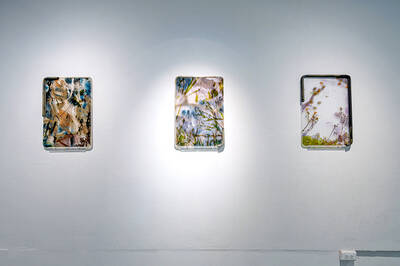
Located down a sideroad in old Wanhua District (萬華區), Waley Art (水谷藝術) has an established reputation for curating some of the more provocative indie art exhibitions in Taipei. And this month is no exception. Beyond the innocuous facade of a shophouse, the full three stories of the gallery space (including the basement) have been taken over by photographs, installation videos and abstract images courtesy of two creatives who hail from the opposite ends of the earth, Taiwan’s Hsu Yi-ting (許懿婷) and Germany’s Benjamin Janzen. “In 2019, I had an art residency in Europe,” Hsu says. “I met Benjamin in the lobby


 RSS
RSS