


Spellbound Aura is not just a photography exhibition. It is an exhibition about photography, all its possibilities and its influences on other media," said Yao Ruei-chung (姚瑞中), co-curator of Spellbound Aura: The New Vision of Chinese Photography (出神入畫: 華人攝影新視界) currently on show at the Museum of Contemporary Art, Taipei (台北當代藝術館).
As the difference between photographers and artists have blurred, the exhibition includes sculptures, installations, videos and an oil painting. Yao teamed up with Zhu Chi (朱其) in selecting working from 25 artists from China, Taiwan and Hong Kong to show the latest developments in photography in the greater-Chinese world.
"In photography, anything is possible these days. There is unlimited freedom but also greater challenges," said Huang Tzi-chin (黃子欽), an artist at the show.
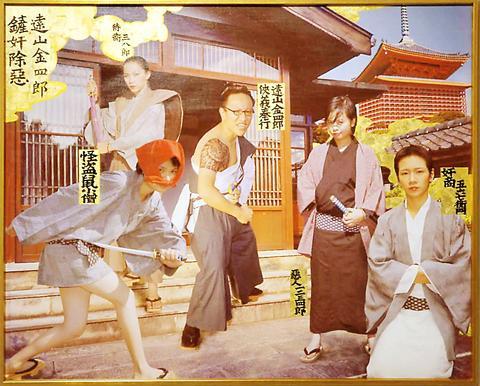
PHOTO COURTESY OF MOCA
"All the three places [China, Taiwan and Hong Kong] have developed into matured economies and all the artists have become versed in digital images and made use of performance art concepts in their works. This exhibition is aimed at presenting these trends in the greater-Chinese world," Zhu said.
Photographers from the two sides of the Taiwan Strait may both use similar technologies and share an inclination toward carefully staged tableaus, but their artistic expressions and subject matters are different.
Zhu sees strong personal styles in the works of young Taiwanese artists. Chen Ching-yao (陳擎耀) and Lee Shih-yi (李詩儀), who, for example, deal with sex and imported Japanese pop culture respectively in narrative photo series that starred themselves in costumes. Their colors are more "groovy" and their moods are hedonistic, Zhu said.
Chinese artists appear more concerned with the clash between traditional culture and modern life. Miao Xiaochun (繆曉春), for example, dresses up as Confucius walking through the streets of one of China's tens of thousands of medium-size cities. He walks past a sculpture factory, filled with large statues of ancient Chinese and Roman personalities. The sculptures stand in awkward contrast with the gray electric poles and shabby shops next to the factory. Miao's Confucius seems fragile and out of place in the dirt-co-lored landscape.
"China is changing fast into a commercial society. Everyone is seeking fast money. Manufacturers produce sub-standard goods to cater to the fast-expanding market. The products are sometimes so badly made that even the manufacturers cannot stand them. Roman statues are one of the fashionable products churned out to cater to the consumers of cheap glamor," Zhu said, explaining the background of Miao's work.
"The fast pace of China's social, economic and cultural changes have been a weighty issue that calls out for artists to deal with. In recent years, artists have changed too. They have realized that these changes are irrevocable and may not necessarily be negative. They just want to point out the issues without expressing their stance on them," Zhu said.
Spellbound Aura: The New Vision of Chinese Photography will run through May 2 at Museum of Contemporary Art, Taipei, 39 Changan W Rd, Taipei (台北市長安西路39號).
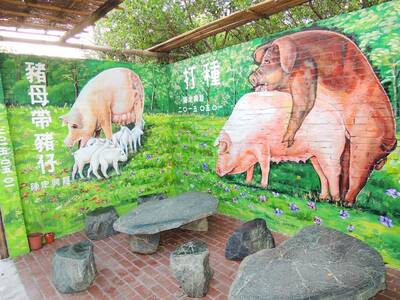
May 6 to May 12 Those who follow the Chinese-language news may have noticed the usage of the term zhuge (豬哥, literally ‘pig brother,’ a male pig raised for breeding purposes) in reports concerning the ongoing #Metoo scandal in the entertainment industry. The term’s modern connotations can range from womanizer or lecher to sexual predator, but it once referred to an important rural trade. Until the 1970s, it was a common sight to see a breeder herding a single “zhuge” down a rustic path with a bamboo whip, often traveling large distances over rugged terrain to service local families. Not only
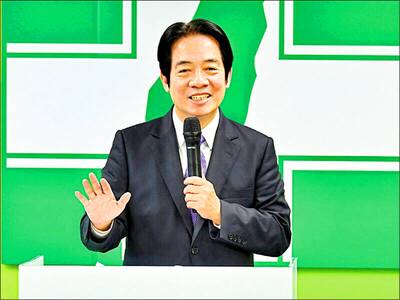
Ahead of incoming president William Lai’s (賴清德) inauguration on May 20 there appear to be signs that he is signaling to the Chinese Communist Party (CCP) and that the Chinese side is also signaling to the Taiwan side. This raises a lot of questions, including what is the CCP up to, who are they signaling to, what are they signaling, how with the various actors in Taiwan respond and where this could ultimately go. In the last column, published on May 2, we examined the curious case of Democratic Progressive Party (DPP) heavyweight Tseng Wen-tsan (鄭文燦) — currently vice premier
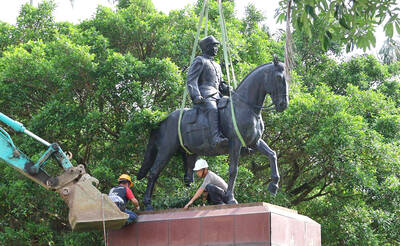
The last time Mrs Hsieh came to Cihu Park in Taoyuan was almost 50 years ago, on a school trip to the grave of Taiwan’s recently deceased dictator. Busloads of children were brought in to pay their respects to Chiang Kai-shek (蔣中正), known as Generalissimo, who had died at 87, after decades ruling Taiwan under brutal martial law. “There were a lot of buses, and there was a long queue,” Hsieh recalled. “It was a school rule. We had to bow, and then we went home.” Chiang’s body is still there, under guard in a mausoleum at the end of a path

Last week the Directorate-General of Budget, Accounting and Statistics (DGBAS) released a set of very strange numbers on Taiwan’s wealth distribution. Duly quoted in the Taipei Times, the report said that “The Gini coefficient for Taiwanese households… was 0.606 at the end of 2021, lower than Australia’s 0.611, the UK’s 0.620, Japan’s 0.678, France’s 0.676 and Germany’s 0.727, the agency said in a report.” The Gini coefficient is a measure of relative inequality, usually of wealth or income, though it can be used to evaluate other forms of inequality. However, for most nations it is a number from .25 to .50


 RSS
RSS