


Masked men burst into the house of Iman Bagalova's daughter shortly after she moved back to Chechnya from a refugee camp.
"They taped up her mouth, they taped up her husband's hands. Then they stole everything, the television, the clothes, her jewellery. They even stole her shampoo," Bagalova said, brushing away tears of rage as she launched into her story.
"I have a 15-year-old son. How can I take him back to that?"
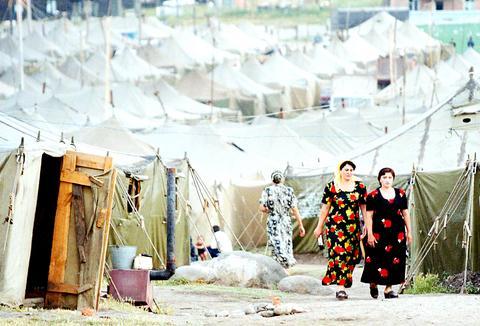
PHOTO: REUTERS
Bagalova lives in Rassvet camp, a muddy factory yard housing 165 tents near the border of Chechnya. She is one of thousands of Chechens still living under canvas four years after Vladimir Putin, then prime minister, sent troops to smash the region's separatist
government.
President Putin -- who faces re-
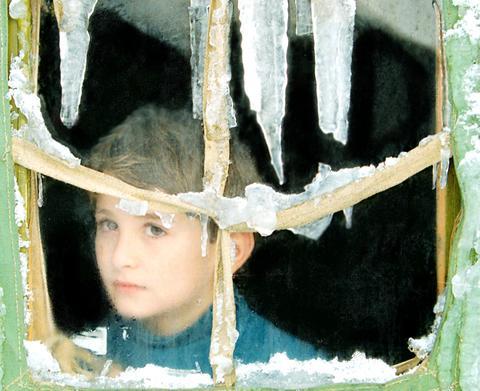
PHOTO: REUTERS
election next month -- refuses to negotiate with separatists, who kill troops on a near-daily basis, and insists the region is returning to normal. Authorities, keen to close down the tent camps, have been pressing refugees to go home for more than a year.
Washington expressed its concern last month in a sign of growing world attention to a conflict now more than nine years old. Refugees fear the camps are only being closed because they are clear symbols that there is no let-up in the violence.
"They are giving us a deadline to leave the camps by March. Why? Because on March 14 Putin has his election and he wants to show the world everything is fine down here," said Malika, 45, as she dismantled her tent in the Bart camp, nestled beneath the snow-covered Caucasus mountains.
Humiliated by armed rebels in a 1994 to 1996 war, Russia gave the region de facto independence. But after three years of chaos, Moscow sent the troops back in, vowing to crush separatism for good.
Some 70,000 Chechen refugees live in Ingushetia, a region on Chechnya's western border, and one in 10 lives in faded green tents like Malika.
Bart is no more than a sparse group of tents and huts in a rubbish-strewn field alongside the main road to Chechnya. It is due to close in the next few days.
"They are not actually forcing us to leave Ingushetia," said Malika. "But the Emergencies Ministry and the Chechen Administration say that if we don't do what they want, they won't give us what we need."
Authorities insist refugees, who rely on the government and aid groups for all essentials, may stay in Ingushetia once they leave the camps. But aid workers say little is being done to provide promised alternative housing.
"They are doing things in such a way that they can say there is a viable alternative, but on the ground they will do whatever they can to make sure shelter is not provided," said one aid worker, who asked not to be identified.
Many refugees say they will move to join Chechens living in abandoned buildings -- mainly old factories or collective farms dotted around Ingushetia -- when the tent camps are closed.
But rights groups say refugees outside the tent camps are vulnerable to official pressure to return to Chechnya.
"You can cut the gas or power by telling the owners, who are local people, to pay a huge bill," said Timur Akiyev from rights group Memorial, which has conducted extensive research into accusations of rights abuses by Russian troops in Chechnya.
"Refugees cannot stay in a factory without gas or power, they would freeze to death."
When refugees go back to Chechnya -- where groups like the Memorial cannot work freely -- they are very hard to monitor.
"If there are no more tents, rights groups and journalists will lose interest," said Ruslan Badalev, head of the Chechen Committee of National Salvation, a refugee support group.
"And then there isn't a Chechen problem any more -- the government can say whatever it likes."
Returning refugees receive 350,000 roubles (US$12,250) in compensation for lost property, said Malika Umayeva, deputy administrator of Bart camp, who fled Chechnya shortly after the army poured back into the region in 1999.
The sum is huge for people who have relied on aid from the UN and other humanitarian organizations for four years. But even for officials like her, it is not enough.
"I myself would be too scared to go home. I stayed in Chechnya during the first war between 1994 and 1996, I have already seen too much death," she said.

In late October of 1873 the government of Japan decided against sending a military expedition to Korea to force that nation to open trade relations. Across the government supporters of the expedition resigned immediately. The spectacle of revolt by disaffected samurai began to loom over Japanese politics. In January of 1874 disaffected samurai attacked a senior minister in Tokyo. A month later, a group of pro-Korea expedition and anti-foreign elements from Saga prefecture in Kyushu revolted, driven in part by high food prices stemming from poor harvests. Their leader, according to Edward Drea’s classic Japan’s Imperial Army, was a samurai

The following three paragraphs are just some of what the local Chinese-language press is reporting on breathlessly and following every twist and turn with the eagerness of a soap opera fan. For many English-language readers, it probably comes across as incomprehensibly opaque, so bear with me briefly dear reader: To the surprise of many, former pop singer and Democratic Progressive Party (DPP) ex-lawmaker Yu Tien (余天) of the Taiwan Normal Country Promotion Association (TNCPA) at the last minute dropped out of the running for committee chair of the DPP’s New Taipei City chapter, paving the way for DPP legislator Su

It’s hard to know where to begin with Mark Tovell’s Taiwan: Roads Above the Clouds. Having published a travelogue myself, as well as having contributed to several guidebooks, at first glance Tovell’s book appears to inhabit a middle ground — the kind of hard-to-sell nowheresville publishers detest. Leaf through the pages and you’ll find them suffuse with the purple prose best associated with travel literature: “When the sun is low on a warm, clear morning, and with the heat already rising, we stand at the riverside bike path leading south from Sanxia’s old cobble streets.” Hardly the stuff of your

Located down a sideroad in old Wanhua District (萬華區), Waley Art (水谷藝術) has an established reputation for curating some of the more provocative indie art exhibitions in Taipei. And this month is no exception. Beyond the innocuous facade of a shophouse, the full three stories of the gallery space (including the basement) have been taken over by photographs, installation videos and abstract images courtesy of two creatives who hail from the opposite ends of the earth, Taiwan’s Hsu Yi-ting (許懿婷) and Germany’s Benjamin Janzen. “In 2019, I had an art residency in Europe,” Hsu says. “I met Benjamin in the lobby


 RSS
RSS