


How do you recognize the real Father Christmas? He's the one in the red, of course.
As hundreds of faux Santas across the world lure people to the shops and global corporates like Coca-Cola break open and dust down the Santa brand to speed coins into their tills, the man himself cannot turn a profit.
PHOTO: REUTERS
Santa Park, his official headquarters in Finland's Arctic, has never made an annual net profit and lost 0.5 million euros (US$612,400) last year -- half its turnover -- and drew just 65,000 visitors.
PHOTO: AFP
But 32 year-old Wille Rajala, a local entrepreneur who in September became the park's fourth director in its five years of operations, sees a mass of untapped potential to fast-track it into the black.
"When I saw Santa Park before I was working here, I always felt it was a shame they cannot make this work because clearly there is every possibility to make it work," he said. "We can make the first profit in Christmas 2004."
PHOTO: AFP
Rajala wonders too why there has never been serious talk of listing the 30 percent state-owned company and does not rule out an initial public offering some time in the future.
PHOTO: AFP
"When this business is running properly there will be enough investors to build my dream," he said.
He foresees up to 400,000 visitors coming each year, and on paper, at least, this does not sound like humbug.
Father Christmas is a global draw, with a sled-load of aliases that allow him to moonlight as Jouluvana, Pere Noel, Weihnachtsmann. On Santa Park's opening day, the air was peppered with French, Japanese, English and German voices.
Also, 800km north of Helsinki within the Arctic Circle, Santa Park has little competition for its six months of freezing temperatures and tonnes of snow that provide the authentic Christmas feeling.
Set in a 12,000m2 fallout shelter, the park has an elves' school, children's rides and "Santa's Grotto". Letters simply marked "to Father Christmas" arrive here. It charms adults too.
"We thought we would make our childhood dreams come true," said Michel and Nadine Sterndeback from Hamburg, who do not have kids but came nevertheless. "It was a great moment when we came in and met Father Christmas and had our picture taken."
And yet, Rajala thinks the park is missing the point.
"The ... product has never faced the reality of why people come here," he said. "People come to experience and see real things. Like when you got to the Canary Islands, you want real sand underfoot and to get some sunshine."
A two-million-euro renovation is planned for Santa Park, with Rajala saying the finished product will be more an authentic part of Lapland.
He says too that if people take the time, trouble and expense to make day trips to the park from places like Britain they must be offered more than an all-too-brief meeting with the Big Man. They may also be convinced to stay longer and spend more.
Santa Park has also taken a page from the corporate playbook when it comes to downsizing, moving from 120 full-timers when the park opened in 1998 to just three permanent employees and 20 seasonal staff now.
Taking advantage of the surrounding nature, the park wants to push itself as a part of a "Lapland Safari," included in package deals from tour operators alongside skiing and the Northern Lights in winter or midnight sun trips in summer.
This year, Lapland tourism will be boosted when Levi, some 150km north of Rovaniemi, plays host for the first time to two Alpine ski World Cup races. National carrier Finnair will fly 12,000 Europeans to the region this winter.
"Santa Park is only one place here, and there are so many other wonderful things in Lapland that we must see the big picture," Rajala said.
He says the park's current two-and-a-half to three months a year opening is a drag on potential, and hopes to eventually bring visitors year-round via perennial money makers like conferences, corporate events and concerts.
But all the while the real man at the top plans to stick to what he does best.
"It is not work," Santa said. "[What] is very important is that children smile and see the real Santa Claus."
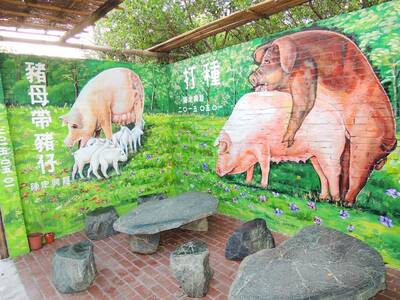
May 6 to May 12 Those who follow the Chinese-language news may have noticed the usage of the term zhuge (豬哥, literally ‘pig brother,’ a male pig raised for breeding purposes) in reports concerning the ongoing #Metoo scandal in the entertainment industry. The term’s modern connotations can range from womanizer or lecher to sexual predator, but it once referred to an important rural trade. Until the 1970s, it was a common sight to see a breeder herding a single “zhuge” down a rustic path with a bamboo whip, often traveling large distances over rugged terrain to service local families. Not only
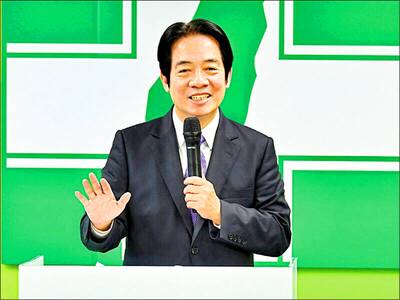
Ahead of incoming president William Lai’s (賴清德) inauguration on May 20 there appear to be signs that he is signaling to the Chinese Communist Party (CCP) and that the Chinese side is also signaling to the Taiwan side. This raises a lot of questions, including what is the CCP up to, who are they signaling to, what are they signaling, how with the various actors in Taiwan respond and where this could ultimately go. In the last column, published on May 2, we examined the curious case of Democratic Progressive Party (DPP) heavyweight Tseng Wen-tsan (鄭文燦) — currently vice premier
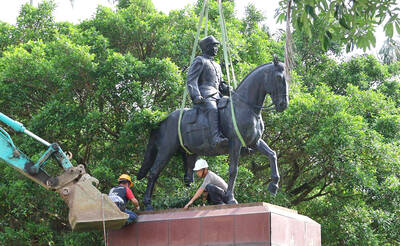
The last time Mrs Hsieh came to Cihu Park in Taoyuan was almost 50 years ago, on a school trip to the grave of Taiwan’s recently deceased dictator. Busloads of children were brought in to pay their respects to Chiang Kai-shek (蔣中正), known as Generalissimo, who had died at 87, after decades ruling Taiwan under brutal martial law. “There were a lot of buses, and there was a long queue,” Hsieh recalled. “It was a school rule. We had to bow, and then we went home.” Chiang’s body is still there, under guard in a mausoleum at the end of a path

Last week the Directorate-General of Budget, Accounting and Statistics (DGBAS) released a set of very strange numbers on Taiwan’s wealth distribution. Duly quoted in the Taipei Times, the report said that “The Gini coefficient for Taiwanese households… was 0.606 at the end of 2021, lower than Australia’s 0.611, the UK’s 0.620, Japan’s 0.678, France’s 0.676 and Germany’s 0.727, the agency said in a report.” The Gini coefficient is a measure of relative inequality, usually of wealth or income, though it can be used to evaluate other forms of inequality. However, for most nations it is a number from .25 to .50


 RSS
RSS