


A word of warning: If you haven't seen the first Infernal Affairs, the highly anticipated sequel Infernal Affairs III, opening today, will be especially confusing. If you have seen the original and the prequel Infernal Affairs II, it will still be confusing, but worth trying to make sense of.
The contemporary police/gangster film Infernal Affairs centers around two duplicitous characters. Andy Lau (劉德華) plays Ming, a triad mole sent to infiltrate the Hong Kong police force; Tony Leung (粱朝偉) plays Yan, a cop deep undercover in the triad underworld. Infernal Affairs II, released just last month, depicts the recruitment of these two as young men while revealing the equally duplicitous nature of their respective elders: Superintendent Wong, played by Anthony Wong (黃秋生), and the triad boss Sam, played by Eric Tsang (曾志偉).
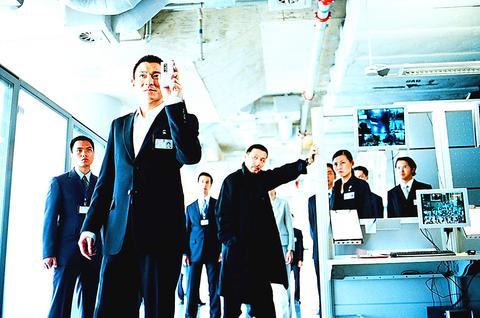
PHOTO COURTESY OF GROUP POWER
This third and final installment of Hong Kong's most ambitious blockbuster franchise takes place a year after the period of this first film with equal time given to flashbacks taking place a few years prior. The abundant flashbacks allow filmmakers Andrew Lau (

PHOTO COURTESY OF GROUP POWER
One of the major reasons for the first film's success was its surplus of big-name stars. Numerous explicit references to The Godfather Trilogy, Part II introduced the epic aspirations of Infernal Affairs, bringing in more stars for more major characters. Part III ups the ante even further, and accommodating the demands of these new characters is primarily what makes the third installment difficult to follow.
Aside from a bigger role for rising star Chapman To (
Lai plays Yeung, the cold-hearted and apprehensive police executive. Chen -- the best actior in Zhang Yimou's (
In the first film, Ming was promoted to the Internal Affairs division to find the triad mole (actually himself) and Part III begins with a committee exonerating him for the bloodshed that left Yan, Superintendent Wong, and another triad mole dead. His next assignment is to continue searching for a triad mole, who has been covering his tracks by systematically executing other moles on the force. Yeung, who holds
clandestine meetings with both Shen and Sam, becomes the target of the IA investigation, with, of course, a strong possibility remaining that the guilty party is Ming himself, even though he longs to become a "good guy."
But the daily suppression of his corrupt past finally proves too much for Ming, and a dominant narrative strand in Part III is his gradual psychological breakdown. We were offered a glimpse into his pathology in the prequel, when the young Ming covets his surrogate mother (Carina Lau,
The psychological drama dovetails with more details of Yan's story, revisiting his therapy sessions with Dr. Lee, played by pop star Kelly Chen (
The film returns to the sleek visual style of the first movie, accentuating a sense of post-industrial Hong Kong in the decor of the police headquarters. But with the introduction of a few Mandarin speaking Chinese characters, as well as references to Taiwanese repatriates and arms dealers, this epic also suggests the growth of a greater China.
A huge window in Yeung's executive office looks out on Victoria Harbor, its view limited to ships and cranes without showing Hong Kong's recognizable skyline.
And so when a Chinese freighter slowly creeps by in the background, coincidently at a crucial climactic moment, we might think we are in Shanghai's Pudong district or the Pearl River Delta. Gone are those good old days from Part II of a freewheeling, colorful Hong Kong.
After all, as Shen tells a
recession-weary Sam flirting with the Chinese market, a Hong Kong gangster will never outlive a Chinese businessman.
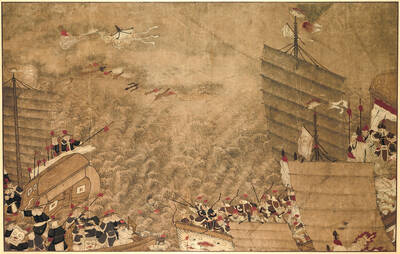
For many centuries from the medieval to the early modern era, the island port of Hirado on the northwestern tip of Kyushu in Japan was the epicenter of piracy in East Asia. From bases in Hirado the notorious wokou (倭寇) terrorized Korea and China. They raided coastal towns, carrying off people into slavery and looting everything from grain to porcelain to bells in Buddhist temples. Kyushu itself operated a thriving trade with China in sulfur, a necessary ingredient of the gunpowder that powered militaries from Europe to Japan. Over time Hirado developed into a full service stop for pirates. Booty could

Politically charged thriller One Battle After Another won six prizes, including best picture, at the British Academy Film Awards on Sunday, building momentum ahead of Hollywood’s Academy Awards next month. Blues-steeped vampire epic Sinners and gothic horror story Frankenstein won three awards each, while Shakespearean family tragedy Hamnet won two including best British film. One Battle After Another, Paul Thomas Anderson’s explosive film about a group of revolutionaries in chaotic conflict with the state, won awards for directing, adapted screenplay, cinematography and editing, as well as for Sean Penn’s supporting performance as an obsessed military officer. “This is very overwhelming and wonderful,” Anderson

Social media addiction has been compared to casinos, opioids and cigarettes. While there’s some debate among experts about the line between overuse and addiction, and whether social media can cause the latter, there is no doubt that many people feel like they can’t escape the pull of Instagram, TikTok, Snapchat and other platforms. The companies that designed your favorite apps have an incentive to keep you glued to them so they can serve up ads that make them billions of dollars in revenue. Resisting the pull of the endless scroll, the dopamine hits from short-form videos and the ego boost and validation

The Siberian crane (Leucogeranus leucogeranus) is an exceptionally attractive bird. Mature specimens have snowy white plumage and wingspans well over 200cm. This critically endangered species wasn’t recorded in Taiwan until December 2014, when a juvenile landed in New Taipei City’s Jinshan District (金山), having apparently gotten separated from its flock during a southward migration from the Russian Arctic to Poyang Lake (鄱陽湖) in China. During the crane’s 17-month sojourn, the area’s rice farmers curtailed their use of agrochemicals. A security detail paid for by the local government prevented dogs and photographers from getting too close to the bird. In November 2021, a


 RSS
RSS