


It's good to be Andy Wong (
Andy, as he is known by most every starlet and pop diva in the Chinese-speaking world, is a hairdresser. Specifically, he is the creative director of Eros 04, Taiwan's highest-profile and most expensive salon, where he holds court with a retinue of chic, curiously-coifed young things who look up to their boss as if he were some mythic being.

PHOTO: SEAN CHAO, TAIPEI TIMES
"Andy will see you now," whispers a girl whose frozen hair looks as if she's standing with her back to a strong wind. Eros has a cool green color scheme, down to the polished cement floor. It's Spartan save for the cozily cushioned chairs and the mirrors that reflect famous faces.
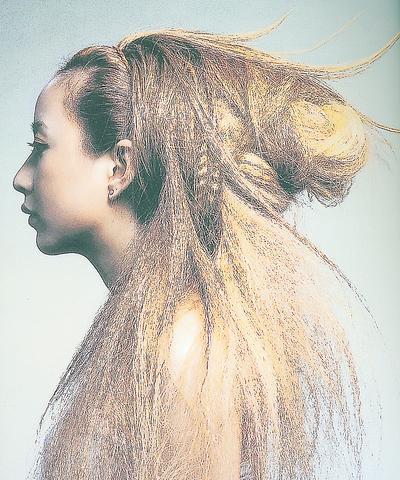
PHOTO COURTESY OF L'OREAL
Clients sneak surreptitious glances at one another, trying to look sexy while draped in a plastic smock with tin foil in their hair. There is the slightly rancid scent of a perm in the air.
Andy's voice and handshake are both warm and strong. He exudes the confidence you'd expect of a person at the top of his game. He has designed for photo spreads in Vogue, Elle, Marie Claire and others. He jets between his salon in Taipei and another, Orient 04, in his native Hong Kong.

PHOTO COURTESY OF MARIE CLAIRE
His client list reads like the guest list of a Golden Horse or Golden Melody awards. He is surrounded by beautiful, wealthy and powerful people that come to him in supplication, pay him handsomely and heap praise on him. He has an assistant named Monkey.
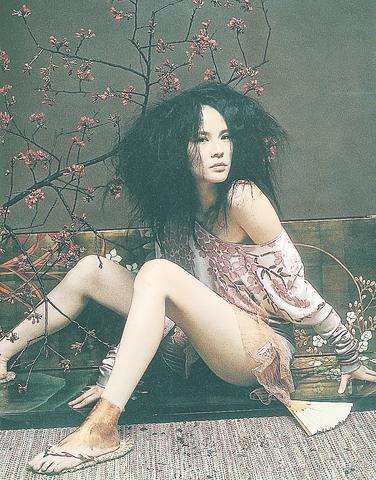
PHOTO COURTESY OF MARIE CLAIRE
"Get us a cup of tea, Monkey," he says, and off Monkey scoots. He stares straight ahead while he speaks as if reading cue cards, though his answers sound
anything but rehearsed.
"Beauty is a person's ability to realize their most special characteristics and bring them to the surface," he says. "I only help them realize it, the clients do the real work."
The clients he's speaking of are the film and music personalities looked up to by a billion Chinese youth; Faith Yang (
"They're clients, yes, but I consider them to be friends first."
They're friends, he explains, because they come to him with split ends and ended relationships and he's able to mend both. "There is an amount of psychology to what I do. A new styling can be the same as a new mental perspective, or a new lease on life."
How much will a new lease on life set you back? A straightforward cut is NT$3,600; perming or dyeing can cost upwards of NT$5,000. It is, according to Sarah Chen (
Without a doubt, Andy is the most sought-after hairdresser, not just for individual clients, but for film and video production as well. By rough estimates, he makes upward of US$500,000 a year, which is an improvement over the HK$500 (NT$2,200) per month he made when he first began cutting hair 20 years ago.
But for all the success he's enjoyed in the salon, he is equally talented with a camera in hand as he is a pair scissors and comb. An exhibition of his photos, taken on a recent visit to Xianjiang, is currently on display on the fourth floor of the Asia World Department Store.
The 40-year-old has also chronicled his life in a new book, Andy in Eros (玩美), released by Crown Publishing. A limited amount of free copies are available to visitors of his
exhibition.
If Andy's definition of beauty is to bring that which is most special in person to the surface, then he is surely himself a beautiful person. His own special characteristic is to make people feel good about themselves and leave his salon in a lighter mood, albeit with a lighter pocketbook. None of them seem to mind.
"I love Andy," said one freshly coiffed beauty stepping lightly out of Eros.
Yes, it's definitely good to be Andy.
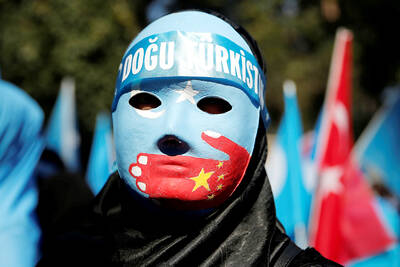
It seems every few days one bumps into one of those “real man” comments in which Taiwan is urged to “face reality” or similar, and “make a deal,” with the speaker implying that soon it will be too late. “Deal” advocates always present themselves as having a superior grip on reality, and the manly ability to make the “hard choice.” Their testosterone-laden language often echoes that of Taiwan sellout advocates. Note that such commentary always specifies a process (“make a deal, work with, make progress”), never the end state of what occupation by a violent authoritarian colonialist state will entail. In

There are shadowy cabals plotting to sell out Taiwan to be annexed by China, by invasion if necessary. Fortunately, they are buffoons. In 2019, former Bamboo Union gangster and founder of the China Unification Promotion Party (CUPP), Chang An-le (張安樂, colorfully known as “White Wolf”), led a protest at the Legislative Yuan against comments made by then-premier Su Tseng-chang (蘇貞昌) that in the event of an attack by China, he would never surrender, but would protect the nation by fighting to the end, even if he only had a broom. Chang had party members bring a wooden casket that they
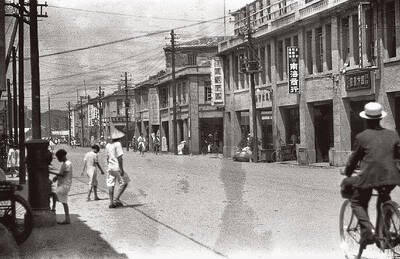
June 1 to June 7 "If all Taiwanese were as afraid of dying as you, then what would happen?” Physician Shih Chiang-nan (施江南) reportedly said this to his wife Chen Chiao-tung (陳焦桐) after she urged him to stop intervening on behalf of Taiwanese soldiers stranded overseas after serving in the Japanese Army during World War II. Shih had clashed with high-ranking officials over the issue, engaged in several heated arguments with Taiwan governor-general Chen Yi (陳儀) and allegedly shouted at general Ko Yuan-fen (柯遠芬), chief of staff of the Taiwan Garrison Command, over
Food prices have often played a major role in Taiwan’s history. The first major wave of migration from China occurred in 1628. A moderate drought, the Ming Dynasty maritime ban that prohibited fishing and trading (intended to reduce piracy) and a temporary tax, conspired to exhaust local resources, leading to famine in Fujian Province. The famed pirate and trader Zheng Zhilong (鄭芝龍), scooped up starving people from Fujian and transported them across the Taiwan Strait, where they settled under the Dutch. Two factors enabled Zheng. First, by 1624 he had settlements around today’s Beigang (北港) in Yunlin County with a small


 RSS
RSS