


Packed into old, vermin-ridden cells, often suffering from disease or mental problems, inmates craft makeshift daggers from canteen forks and resort to self-mutilation to pass the time.
One man decapitates his cellmate with a pocket knife. Another dies when his cellmates set fire to a mattress. Rapes are commonplace and there are too few guards to prevent them.
Such scenes, related by a prison warden, illustrate the "descent to hell" that a new report says is taking place in France's prisons as the number of inmates soars under the government's vote-winning crackdown on crime.
And this despite damning reports three years ago which prompted the then French government to describe its prisons as a national disgrace and vow to improve conditions.
"We had reason to fear a deterioration of the situation denounced in 2000 by two parliamentary assemblies, but we did not imagine having to describe a descent towards hell," wrote Thierry Levy of the French-based International Prisons Observatory (OIP) in the report.
Getting worse
Overcrowding has worsened under the center-right's crime drive, the OIP says, with as many as 61,000 people crammed during the summer into cells meant for 48,000 in crumbling penitentiaries.
Around half of those held have not been convicted but are awaiting trial. There is also an acute shortage of wardens.
"We have prisons filled to double capacity and a shortage of 3,000 guards. At night that means three-hour gaps between cell checks and unfortunately a lot can happen in that time," said Remy Carrier, deputy head of the FO prison guard union.
"It goes from minor disturbances to serious attacks. There was one inmate who decapitated his cellmate with a pocket knife. We often can't intervene in time because of the lack of staff."
Intervening can also put wardens, who are unarmed, in danger. A warden in a Paris prison lost her sense of smell, taste and the hearing in one ear after she was beaten by an inmate earlier this year, Carrier said.
"We are confronted with more and more problems," he added. "When things turn violent, it's the warden who is first in line."
Squalor persists
When Jean-Pierre Raffarin's conservative government took power last year, the prison population totalled 48,600.
The crime crackdown, which Raffarin placed high on his election manifesto to win back voters who had defected to the far-right, has pushed that up to an average of 55,400 this year.
The OIP found four inmates sharing floor space of just three square meters for up to 23 hours a day, leading to squalor, depression, bullying and violence.
Suicides rose 20 percent to 122 last year and numbered 73 in the six months to July this year.
As newspapers seized on the report, Justice Minister Dominique Perben denounced it as "excessive and grotesque".
Bad press over prisons is the last thing the government needs after taking a battering in opinion polls over unpopular pension and health reforms and a failure to react fast enough to a summer heat wave that killed 15,000 mainly elderly people.
Prison wardens say the OIP report is sensationalist and exaggerates staff misconduct. But they agree action is needed and complain that plans to try alternative punishments for petty crime have come to nothing.
More than half of France's 185 prisons are over a century old and some cells are too dilapidated to use. A spate of brazen jailbreaks in recent years underlined how poor security is.
"Our prisons are falling apart as fast as we can repair them. Some establishments simply shouldn't exist," Carrier said.
With a huge gap in state finances, building extra prisons is far down the government's list of priorities. Two new jails opened this year -- but only to replace ones that are closing.
False promises
In January 2000, Veronique Vasseur caused an uproar with a book recounting her experiences as chief doctor at La Sante -- a notoriously grim maximum security detention center in Paris.
She wrote of inmates so depressed they swallowed rat poison, drain cleaner and even forks. Beds were ridden with lice, vermin were rampant and skin diseases rife. Drugs were everywhere.
Three years on, she says reforms debated by the previous government to improve conditions in jails have come to nothing.
"Out of 30 emergency measures recommended three years ago by parliamentarians, practically nothing has been done. Everything I did was in vain," Vasseur told the daily Le Parisien.
Inmates shower three times a week, but wear the same clothes for a week or more. Up to 40 percent have mental problems and many cut themselves or abuse cellmates. Poor medical support means such problems often go unnoticed, the OIP said.
Diseases including tuberculosis, hepatitis C and HIV and pests such as cockroaches and rats are still are problem.
"Each day is a doomed battle against noise, filth, smells, suffocation and thus hate of others and oneself," the OIP said.

Taiwan’s English education system is being pulled apart by three opposing forces. Bilingual Nation 2030 pulls students toward English and global communication. Artificial Intelligence (AI) readiness pulls them toward digital judgment, verification and AI-mediated work. But Taiwan’s old exam culture pulls them back toward memorization, grammar drills, timed reading and correct answers. If the education system keeps using old exams to define success, it risks producing graduates who are neither genuinely bilingual nor genuinely AI-ready, but trained for tasks machines can already perform. The first force is Bilingual Nation 2030. Launched in 2018, the policy aimed to “help Taiwan’s workforce connect

It seems every few days one bumps into one of those “real man” comments in which Taiwan is urged to “face reality” or similar, and “make a deal,” with the speaker implying that soon it will be too late. “Deal” advocates always present themselves as having a superior grip on reality, and the manly ability to make the “hard choice.” Their testosterone-laden language often echoes that of Taiwan sellout advocates. Note that such commentary always specifies a process (“make a deal, work with, make progress”), never the end state of what occupation by a violent authoritarian colonialist state will entail. In

There are shadowy cabals plotting to sell out Taiwan to be annexed by China, by invasion if necessary. Fortunately, they are buffoons. In 2019, former Bamboo Union gangster and founder of the China Unification Promotion Party (CUPP), Chang An-le (張安樂, colorfully known as “White Wolf”), led a protest at the Legislative Yuan against comments made by then-premier Su Tseng-chang (蘇貞昌) that in the event of an attack by China, he would never surrender, but would protect the nation by fighting to the end, even if he only had a broom. Chang had party members bring a wooden casket that they
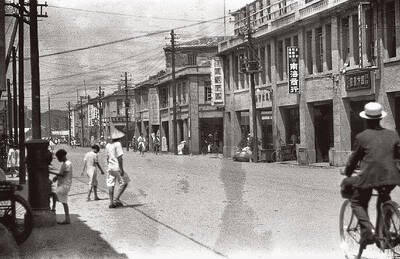
June 1 to June 7 "If all Taiwanese were as afraid of dying as you, then what would happen?” Physician Shih Chiang-nan (施江南) reportedly said this to his wife Chen Chiao-tung (陳焦桐) after she urged him to stop intervening on behalf of Taiwanese soldiers stranded overseas after serving in the Japanese Army during World War II. Shih had clashed with high-ranking officials over the issue, engaged in several heated arguments with Taiwan governor-general Chen Yi (陳儀) and allegedly shouted at general Ko Yuan-fen (柯遠芬), chief of staff of the Taiwan Garrison Command, over


 RSS
RSS