


Before the expectant eyes of music academics, the Research Institute of Musical Heritage (
The country's first archive devoted to ethnomusicology, a relatively new field of musical study in Taiwan and worldwide, appeared to be in a half-finished state despite having taken 13 years to build. There has been criticism that the archive is lacking in research articles and ethnic music publications and was opened ahead of time for political reasons.
The Ethnic Music Archive includes folk music, operas, dance music, religious and contemporary music from around the world, with a focus on ethnic music from Taiwan. Its two-story, 200-ping space is divided into a reading room, audio-visual room, research room and a open-shelf library. It also holds performances and seminars on weekends. Lifetime membership costs NT$100 and allows anyone access to its digital and open-shelf collections.

PHOTO: VICO LEE, TAIPEI TIMES
The setting up of the archive was a long tortuous process. In its original plan, broached by late musicologist Hsu Chang-huei (
Around the same time, the government's financial situation made such a large project unfeasible. In 2000, the new administration adjusted the country's cultural policies toward strengthening "cultural software" instead of hardware, so that the CCA combined the institute with the existing National Traditional Arts Center (
The archive has also been condensed into the less than 200-ping space of a former office building, on loan from the Council of Agriculture, to save construction cost. Its original functions of gathering, researching, and displaying ethnic music materials, remain unchanged.
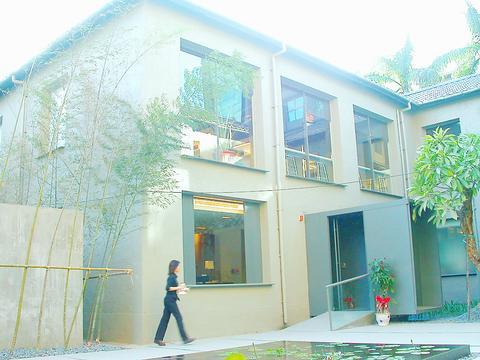
PHOTO: VICO LEE, TAIPEI TIMES
Despite the long delay, the archive's opening is still a positive development in ethnic music research, said Lin Huei-kuan (
Although many in the music field are happy to see the archive finally materialized, it's not without its critics. On Nov. 3, five days after its opening, a Chinese-language daily reported that the archive's digital collection could not be accessed and its printed collection consists only of second-hand materials, all of which are available on the market. The archive, it reported, may have been opened prematurely, for political reasons.
Since the news came out, Hu Wei-chiao (
Huang Yu-cheng (
Ke Chi-lang (
The open-shelf area contains many fine-arts publications unrelated to ethnic music, the Taipei Times found, meaning the actual collection of ethnic music publications is fewer than the 28,000 items claimed. Ke admitted that these books were purchased over a decade ago for a cultural library in the archive's large-scale original form but somehow got transferred here. Ke promised to look into the matter.
Hsu Ruei-kun (
"Professor Hsu [Chang-huei]'s original plan for the archive has been condensed to a very large extent, but it's still better than nothing. I think we should give people at the institute their due credit for making the effort. It's not only helpful to academia but also to the general public," Hsu said.
Ethnic music materials are few and hard to find in Taiwan, said Wang Yin-feng (
"One of the most urgent issues in music academic circles is that each scholar does his or her own research, unaware of what other scholars have done. The archive serves as a gathering ground for their works, and it eases the circulation of information."
However, the volume of the archive's collection, both Wang and Hsu agreed, needs to expand.
"A real archive needs its own first-hand materials, gathered through field work by its own researchers, and that is what the archive lacks at present, because its research team is understaffed," Wang said.
Hsu admitted the opening had been rushed. "It was opened a bit early, but not too early. If we waited until everything was ready to start operation, that day would never have come. You can never say an archive is complete," Hsu said.
"It's true that we don't have everything. But we already have over 20,000 items so why not let people use them as soon as possible? Some people said our shelves were not full, but even if they are, they won't satisfy every reader. It's hard to say when the library will be complete, but we're making efforts step by step," Ke said.
Wang believed that opening the archive will speed the expansion of its collection.
"The opening was a bit rushed but if we waited for the collection to be complete, we don't know how long we would have to wait. Academics have been anxious to see it established for a long time. Its collection is not enough, but at least now that it's opened, it's subject to public scrutiny, and that will probably help beef up the collection more efficiently.
"What it needs now is people's faith in it. If those who have done their field work and research are willing to share their collection with the archive, its collection will grow," Wang said. "Its goal to internationalize its collection and plan for exchanges with ethnic music institutes abroad are in the right direction," Wang said.
The Research Institute of Musical Heritage and its Ethnic Music Archive are located at 26 Hangzhou N Rd, Taipei (

In late October of 1873 the government of Japan decided against sending a military expedition to Korea to force that nation to open trade relations. Across the government supporters of the expedition resigned immediately. The spectacle of revolt by disaffected samurai began to loom over Japanese politics. In January of 1874 disaffected samurai attacked a senior minister in Tokyo. A month later, a group of pro-Korea expedition and anti-foreign elements from Saga prefecture in Kyushu revolted, driven in part by high food prices stemming from poor harvests. Their leader, according to Edward Drea’s classic Japan’s Imperial Army, was a samurai

The following three paragraphs are just some of what the local Chinese-language press is reporting on breathlessly and following every twist and turn with the eagerness of a soap opera fan. For many English-language readers, it probably comes across as incomprehensibly opaque, so bear with me briefly dear reader: To the surprise of many, former pop singer and Democratic Progressive Party (DPP) ex-lawmaker Yu Tien (余天) of the Taiwan Normal Country Promotion Association (TNCPA) at the last minute dropped out of the running for committee chair of the DPP’s New Taipei City chapter, paving the way for DPP legislator Su

It’s hard to know where to begin with Mark Tovell’s Taiwan: Roads Above the Clouds. Having published a travelogue myself, as well as having contributed to several guidebooks, at first glance Tovell’s book appears to inhabit a middle ground — the kind of hard-to-sell nowheresville publishers detest. Leaf through the pages and you’ll find them suffuse with the purple prose best associated with travel literature: “When the sun is low on a warm, clear morning, and with the heat already rising, we stand at the riverside bike path leading south from Sanxia’s old cobble streets.” Hardly the stuff of your

Located down a sideroad in old Wanhua District (萬華區), Waley Art (水谷藝術) has an established reputation for curating some of the more provocative indie art exhibitions in Taipei. And this month is no exception. Beyond the innocuous facade of a shophouse, the full three stories of the gallery space (including the basement) have been taken over by photographs, installation videos and abstract images courtesy of two creatives who hail from the opposite ends of the earth, Taiwan’s Hsu Yi-ting (許懿婷) and Germany’s Benjamin Janzen. “In 2019, I had an art residency in Europe,” Hsu says. “I met Benjamin in the lobby


 RSS
RSS