


People in Taiwan have been big fans of Bossa Nova in recent years. Antonio Carlos Jobim and Joao Gilberto have been musical fixtures in bars and restaurants and the Japanese singer Lisa Ono has found a inexhaustible fan base here.
The local fascination with Brazilian music, however, seldom stretches beyond the easy-listening variations of Brazil's rich music traditions. That could soon change as classical superstar, Chinese-American cellist Yo-Yo Ma is going to enchant Taipei this Tuesday with an all-star concert performing tracks from his latest album which presents a wide spectrum of Brazilian music.
Apart from his long-time collaborator, pianist Kathryn Stott, An Evening of Latin American Music (
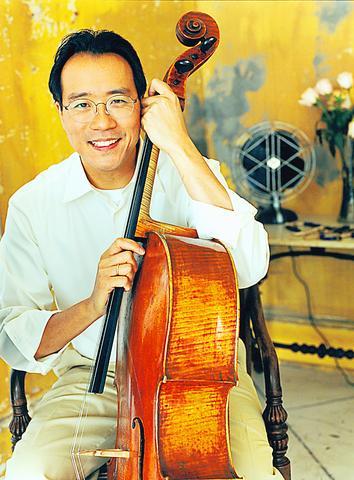
PHOTO COURTESY OF SONY MUSIC ENTERTAINMENT
Meaning "thank you Brazil" in English, Obrigado Brazil encompasses a variety of Brazilian musical styles. Among the up-beat pop, smooth urban beats and European classical works is the folk song tradition of choro, which will form the main part of the concert. Samba and bossa nova may be widely identified with Brazil today, but both have roots in choro.
The style started among street musicians who put together African rhythms, Portuguese popular musical styles and European salon music into serenades in the 1870s. Heitor Villa-Lobos, Brazil's most celebrated classical composer, whose works are featured at the concert, based his compositions on choro. Derived from "chorar," the Portuguese verb for "to cry," choro is infectiously sorrowful as Brazilian poet and bossa nova lyricist Vincius de Moraes once wrote about the genre -- "Sadness has no end; happiness does."
Different from the always smiling cellist's classical performances, which are mostly of a sunny tone, there's more of a mood swing and emotional complexity in Obrigado Brazil. "I've always loved Brazilian music," Ma said before the album's release in July. "There's an undercurrent of sensuality in it that is incredibly seductive.
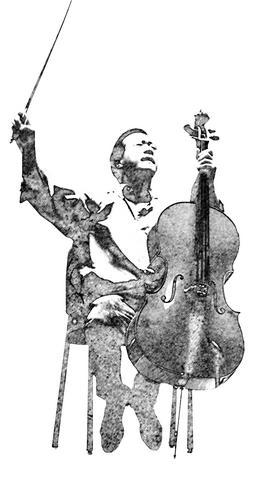
It's a place between the conscious and the unconscious -- a place where the rational and the irrational meet."
Musicians supporting Ma at the concert include percussionist Cyro Baptista, clarinetist Paquito D'Rivera, singer/guitarist Rosa Passos, and guitarists Semrgio and Odair Assad, the same team as on the album.
"All of the musicians on this album are absolute masters of their specific genres of Brazilian music and everybody is incredibly generous," Ma said before the album release, "The recording session was like one long party -- really warm and festive."
The concert will open with Brazilian keyboard artist Cesar Camargo Mariano's Cristal, a cheerfully elegant piece which Ma will perform with Stott. The duo will then switch to a
melancholic mood with Villa-Lobos' classical number Alma Brasileira, or "Brazilian Soul."
Villa-Lobos was discovered by late master pianist Arthur Rubinstein playing cello in a theater in Rio de Janeiro. Rubinstein arranged for Villia-Lobos to seek a better career in Paris. But the self-taught musician, whose first musical book was the map of Brazil, later chose to return and become the first world-famous Brazilian composer.
Antonio Carlos Jobim's works are also part of this concert. Baptista will join Ma and Stott on a poignant rendition of Chega de Saudade, as the siren-like Passos lends her subtle and sincere vocals to the lingering music. In O Amor em Paz, another well-known bossa nova number, the versatile Assads will drop in an intoxicating bit of romance suitable for an autumn evening.
As this is a Latin American music concert, Ma will also perform the works of Astor Piazzolla, such as the heart-rending Zita and the emotionally intense Tango Suite. Closing the concert will probably be Waldir Azevedo's Brasileirinho, a well-known choro piece from the 1940s. Ma, together with D'Rivera and Baptista, create such flowing and cheerful renditions of the melodies that the audience will find it hard to sit still, as in the case of previous concerts on Ma's tour.
The ability to bring out the unexpected in musicians from different cultures has been Ma's trademark since his 1996 collaboration with Mark O'Conner and Edger Meyer on the album Appalachia Waltz, where there is a surprising chemistry between classical music and folk music, country blues and jazz from America.
Enlisting help from outstanding musicians around the world, Ma founded in 1988 the Silk Road Project, an artistic, cultural and educational organization to study "the ebb and flow of ideas along" the ancient trade route. The resulting Silk Road Ensemble explores the boundaries between innovation and tradition, in Mongolian and Middle Eastern music.
Ma's first recording of South American music, Soul of the Tango interpreted the works of Argentina's master of the nuevo tango, Astor Piazzolla, and helped win one of his 14 Grammy Awards. The same production team is behind his new album.
Touring for the album started in August. It has taken Ma and the ensemble through Amsterdam, London and various stops in the US. After the Taipei show, they are due to perform in Japan, before more touring in the US throughout the fall.
Yo-Yo Ma and seven other musicians will perform An Evening of Latin American Music at 7:45pm, Oct. 28 at the National Concert Hall (國家音樂廳 ). Tickets range from NT$1,800 to NT$3,600 and are available at Era ticketing outlets.

In late October of 1873 the government of Japan decided against sending a military expedition to Korea to force that nation to open trade relations. Across the government supporters of the expedition resigned immediately. The spectacle of revolt by disaffected samurai began to loom over Japanese politics. In January of 1874 disaffected samurai attacked a senior minister in Tokyo. A month later, a group of pro-Korea expedition and anti-foreign elements from Saga prefecture in Kyushu revolted, driven in part by high food prices stemming from poor harvests. Their leader, according to Edward Drea’s classic Japan’s Imperial Army, was a samurai

The following three paragraphs are just some of what the local Chinese-language press is reporting on breathlessly and following every twist and turn with the eagerness of a soap opera fan. For many English-language readers, it probably comes across as incomprehensibly opaque, so bear with me briefly dear reader: To the surprise of many, former pop singer and Democratic Progressive Party (DPP) ex-lawmaker Yu Tien (余天) of the Taiwan Normal Country Promotion Association (TNCPA) at the last minute dropped out of the running for committee chair of the DPP’s New Taipei City chapter, paving the way for DPP legislator Su

It’s hard to know where to begin with Mark Tovell’s Taiwan: Roads Above the Clouds. Having published a travelogue myself, as well as having contributed to several guidebooks, at first glance Tovell’s book appears to inhabit a middle ground — the kind of hard-to-sell nowheresville publishers detest. Leaf through the pages and you’ll find them suffuse with the purple prose best associated with travel literature: “When the sun is low on a warm, clear morning, and with the heat already rising, we stand at the riverside bike path leading south from Sanxia’s old cobble streets.” Hardly the stuff of your
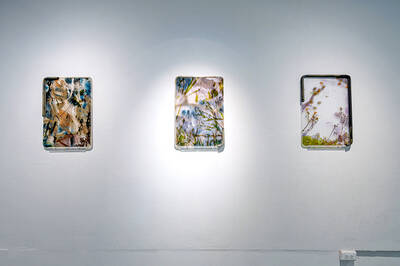
Located down a sideroad in old Wanhua District (萬華區), Waley Art (水谷藝術) has an established reputation for curating some of the more provocative indie art exhibitions in Taipei. And this month is no exception. Beyond the innocuous facade of a shophouse, the full three stories of the gallery space (including the basement) have been taken over by photographs, installation videos and abstract images courtesy of two creatives who hail from the opposite ends of the earth, Taiwan’s Hsu Yi-ting (許懿婷) and Germany’s Benjamin Janzen. “In 2019, I had an art residency in Europe,” Hsu says. “I met Benjamin in the lobby


 RSS
RSS